Larus glaucescens
Glaucous-winged Gull
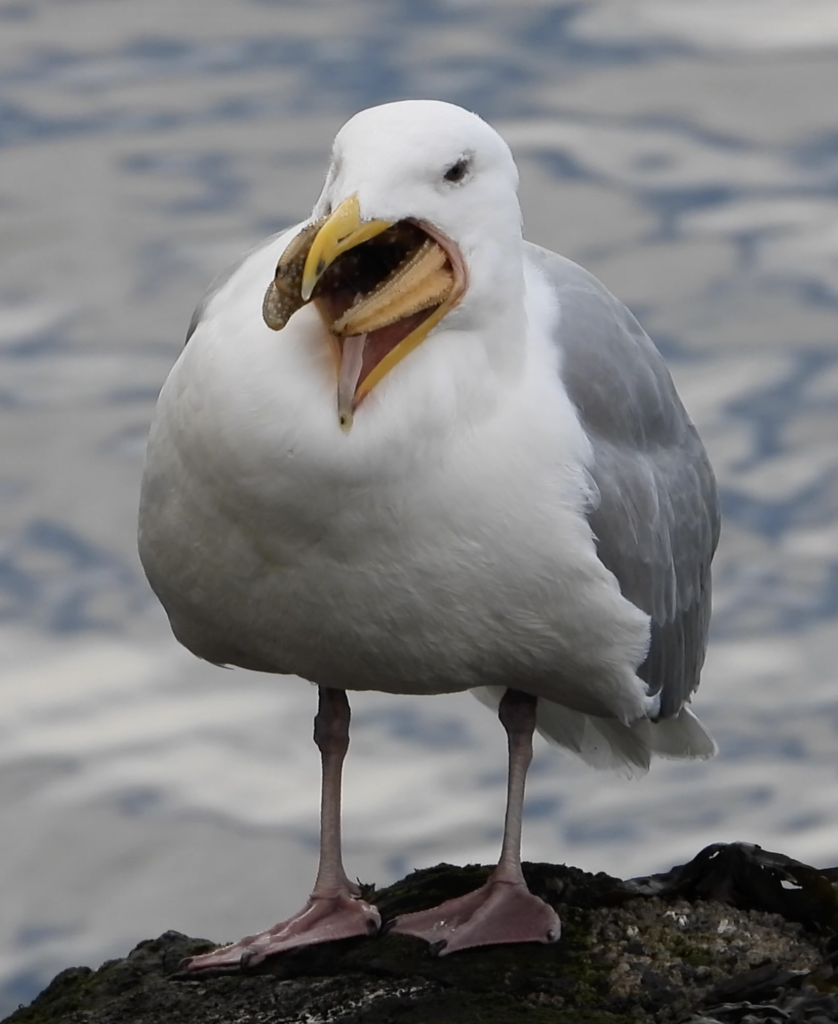
(c) Scott Veirs, some rights reserved (CC BY) · licence
Family: Laridae · Class: Aves · Order: Charadriiformes
Larus glaucescens (Glaucous-winged Gull) is a California animal in the Laridae family.
The Glaucous-winged Gull is a large seabird measuring 56 to 68 centimeters (22 to 27 inches) in length with a wingspan of 120 to 150 centimeters (47 to 59 inches). Adults weigh between 730 and 1,690 grams (1.6 to 3.7 pounds). The species exhibits distinctive pale gray wing tips that appear nearly white in flight, distinguishing it from other large gulls. Adults display white heads and underparts, pale gray backs and wings, yellow bills with a red spot near the tip, and pink legs. During winter, adults develop light brown streaking on the head and neck. Juveniles are mottled brown and gray, gradually acquiring adult plumage over four years. The Glaucous-winged Gull breeds along the North Pacific coast from Alaska south to Oregon, with the largest breeding populations in Alaska and British Columbia. In California, the species occurs primarily as a winter visitor and migrant along the entire coastline from October through April. Small numbers may remain through summer, particularly in northern California. The species is most abundant in the San Francisco Bay Area, Monterey Bay, and coastal areas of Humboldt and Del Norte counties. Vagrant individuals occasionally appear at inland locations, particularly at large lakes and reservoirs. This species inhabits marine and estuarine environments, including rocky coastlines, sandy beaches, mudflats, harbors, and offshore waters. Glaucous-winged Gulls frequently utilize urban waterfront areas, landfills, and fishing ports. During the breeding season, they nest on coastal cliffs, rocky islands, and increasingly on human-made structures such as buildings and piers. The species shows strong site fidelity to traditional roosting and feeding areas. Glaucous-winged Gulls are opportunistic omnivores with a diverse diet including fish, marine invertebrates, bird eggs and chicks, small mammals, and human food waste. They employ various foraging strategies including surface diving, scavenging, and kleptoparasitism. The species forms large feeding aggregations at productive marine areas and garbage dumps. Breeding occurs from May through August, with pairs constructing nests of grass, seaweed, and feathers. Females typically lay two to three eggs, which both parents incubate for 26 to 28 days. Chicks fledge after 35 to 54 days but remain dependent on parents for several additional weeks. The Glaucous-winged Gull is not federally listed and maintains stable populations throughout most of its range. The species has actually expanded its breeding range southward in recent decades, establishing new colonies in Washington and Oregon. Climate change may benefit this adaptable species through warming ocean temperatures and changing prey distributions. Primary conservation concerns include potential impacts from marine pollution, plastic ingestion, and oil spills. The species' opportunistic feeding behavior and urban adaptability have contributed to its overall population stability, with North American populations estimated at approximately 300,000 to 400,000 individuals.
Classification
Class: Aves · Order: Charadriiformes · Family: Laridae
Frequently asked questions
How is Larus glaucescens classified?
Larus glaucescens belongs to class Aves, order Charadriiformes, family Laridae.
What family does Larus glaucescens belong to?
Larus glaucescens is in the Laridae family.
What is Larus glaucescens?
The Glaucous-winged Gull is a large seabird measuring 56 to 68 centimeters (22 to 27 inches) in length with a wingspan of 120 to 150 centimeters (47 to 59 inches).
Is Larus glaucescens found in California?
Yes. Larus glaucescens is recorded in California in The California Species Project's catalogue.
Related species
Other California species in the same genus, family, or bioregion.
Data from The California Species Project — 14,000+ California species with verified data from CNPS, CDFW, USFWS, and more.