Larus glaucoides
Iceland Gull
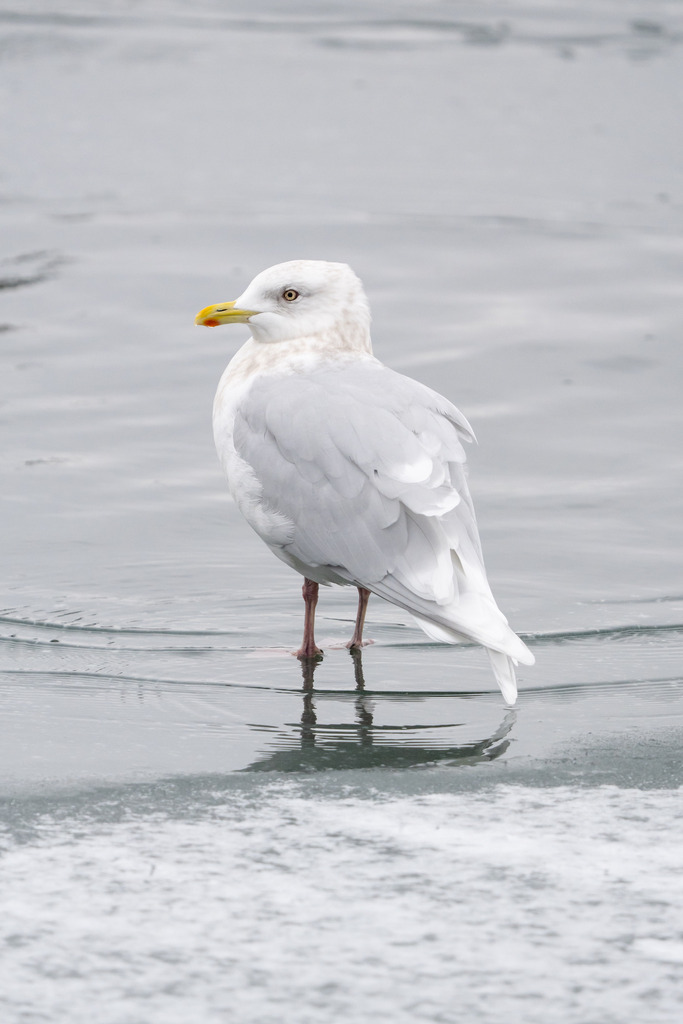
(c) Andrew Lai, some rights reserved (CC BY) · licence
Family: Laridae · Class: Aves · Order: Charadriiformes
Larus glaucoides (Iceland Gull) is a California animal in the Laridae family.
The Iceland Gull is a medium-sized gull species that occurs as a rare visitor to California's coastal waters during winter months. Adults measure 52 to 60 centimeters (20 to 24 inches) in length with a wingspan of 130 to 145 centimeters (51 to 57 inches). The species exhibits sexual dimorphism in size, with females typically smaller than males. Adult Iceland Gulls display pale gray upperparts and white underparts, with a distinctive white-tipped wing pattern. The head remains white year-round in adults, though first-winter birds show variable brown streaking. The bill is yellow with a red spot on the lower mandible, and legs are pink to yellow. Unlike many gull species, Iceland Gulls lack black wingtips, instead showing pale gray to white wing tips with subtle darker markings. Iceland Gulls breed in the Arctic regions of Greenland, Iceland, and northeastern Canada, with the North American subspecies L. g. kumlieni nesting primarily in the Canadian Arctic archipelago. During winter, these gulls migrate south along the Atlantic and Pacific coasts. In California, Iceland Gulls are uncommon winter visitors, typically observed from November through March. They occur most frequently along the northern California coast, with documented sightings from Humboldt County south to Monterey Bay. The species is considered a vagrant in southern California, with only scattered records from Los Angeles and Orange counties. During their California visits, Iceland Gulls inhabit coastal environments including rocky shores, sandy beaches, harbors, and estuaries. They are often found in mixed flocks with other gull species, particularly Herring Gulls and Thayer's Gulls. The species shows preference for areas with abundant fish and marine invertebrates, frequently foraging in shallow coastal waters and tidal zones. Iceland Gulls are opportunistic feeders with a diet consisting primarily of fish, marine invertebrates, and carrion. They employ various foraging strategies including surface dipping, shallow diving, and scavenging along shorelines. During the breeding season in their Arctic range, they consume fish, crustaceans, mollusks, and occasionally bird eggs and chicks. These gulls are typically less aggressive than larger gull species when competing for food resources. They breed in small colonies on cliff ledges and rocky outcrops, constructing nests of grass, moss, and seaweed. Females lay two to three eggs, which are incubated for approximately 25 days. The Iceland Gull is not federally or state-listed in California, reflecting its status as a naturally uncommon visitor rather than a breeding resident. The species is classified as Least Concern globally by the International Union for Conservation of Nature, with stable populations across its Arctic breeding range. Climate change poses potential long-term challenges through alterations to Arctic breeding habitats and changes in marine food webs. In California, the primary conservation considerations involve maintaining coastal habitat quality and monitoring for population changes that might indicate broader environmental shifts affecting Arctic seabirds.
Classification
Class: Aves · Order: Charadriiformes · Family: Laridae
Frequently asked questions
How is Larus glaucoides classified?
Larus glaucoides belongs to class Aves, order Charadriiformes, family Laridae.
What family does Larus glaucoides belong to?
Larus glaucoides is in the Laridae family.
What is Larus glaucoides?
The Iceland Gull is a medium-sized gull species that occurs as a rare visitor to California's coastal waters during winter months.
Is Larus glaucoides found in California?
Yes. Larus glaucoides is recorded in California in The California Species Project's catalogue.
Related species
Other California species in the same genus, family, or bioregion.
Data from The California Species Project — 14,000+ California species with verified data from CNPS, CDFW, USFWS, and more.