Larus hyperboreus
Glaucous Gull
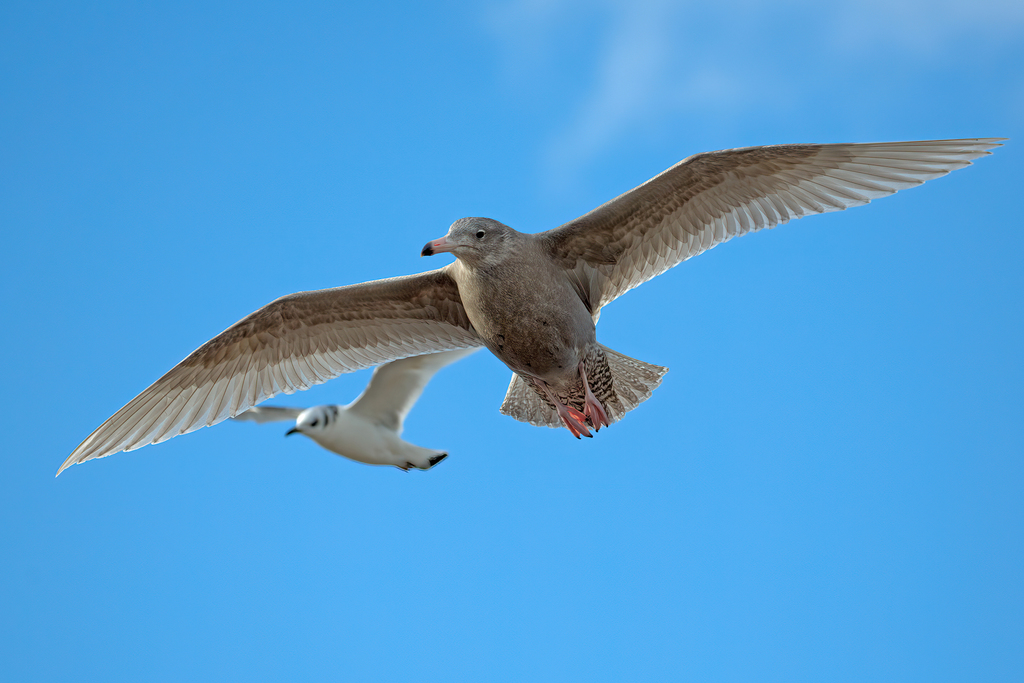
(c) Nigel Voaden, some rights reserved (CC BY) · licence
Family: Laridae · Class: Aves · Order: Charadriiformes
Larus hyperboreus (Glaucous Gull) is a California animal in the Laridae family.
The Glaucous Gull is a large Arctic seabird and one of the largest gulls in North America. Adults measure 60 to 68 cm (24 to 27 inches) in length with a wingspan of 140 to 165 cm (55 to 65 inches). Body weight ranges from 960 to 2,700 grams (2.1 to 6.0 pounds), with males typically larger than females. The species is characterized by its pale gray mantle and white wingtips, distinguishing it from other large gulls that have black wingtips. Adults in breeding plumage display a bright yellow bill with an orange-red spot on the lower mandible, pink legs, and pale yellow eyes. Winter adults show darker bill tips and duller leg coloration. Juveniles are uniformly pale buff or cream-colored with pink bills that have dark tips. The Glaucous Gull breeds in the high Arctic regions of Alaska, northern Canada, Greenland, Svalbard, and northern Eurasia. In California, the species occurs as a rare winter visitor and migrant along the coast, typically from October through April. Observations are most frequent in northern California, particularly in the San Francisco Bay Area, Humboldt Bay, and Monterey Bay. The species is irregular in occurrence, with some winters producing multiple sightings while others yield none. During the breeding season, Glaucous Gulls inhabit Arctic tundra, coastal cliffs, and islands. They nest on rocky ledges, gravel bars, and flat tundra areas near water. In California waters, the species frequents harbors, estuaries, beaches, and offshore waters. They are often observed at fishing ports, landfills, and areas with concentrations of other gulls, where they may act as kleptoparasites. Glaucous Gulls are opportunistic predators and scavengers. Their diet includes fish, marine invertebrates, bird eggs and chicks, small mammals, and carrion. They frequently steal food from other seabirds and are known to prey on eggs and young of colonial nesting birds including murres, auklets, and other gulls. The species is highly aggressive and uses its large size to dominate feeding situations. Breeding occurs from May to August in Arctic regions, with pairs typically laying 2 to 3 olive-brown eggs in a ground nest lined with vegetation, feathers, and debris. The Glaucous Gull is not federally or state-listed in California, reflecting its status as a non-breeding visitor rather than a resident species. Globally, the species is classified as Least Concern by the International Union for Conservation of Nature, with stable Arctic populations estimated at 290,000 to 370,000 individuals. Climate change poses potential long-term threats to Arctic breeding habitats through altered sea ice patterns and warming temperatures. In California, the species faces typical coastal threats including pollution, disturbance, and reduced prey availability, though its irregular occurrence limits the significance of these local impacts.
Classification
Class: Aves · Order: Charadriiformes · Family: Laridae
Frequently asked questions
How is Larus hyperboreus classified?
Larus hyperboreus belongs to class Aves, order Charadriiformes, family Laridae.
What family does Larus hyperboreus belong to?
Larus hyperboreus is in the Laridae family.
What is Larus hyperboreus?
The Glaucous Gull is a large Arctic seabird and one of the largest gulls in North America.
Is Larus hyperboreus found in California?
Yes. Larus hyperboreus is recorded in California in The California Species Project's catalogue.
Related species
Other California species in the same genus, family, or bioregion.
Data from The California Species Project — 14,000+ California species with verified data from CNPS, CDFW, USFWS, and more.