Larus occidentalis
Western Gull
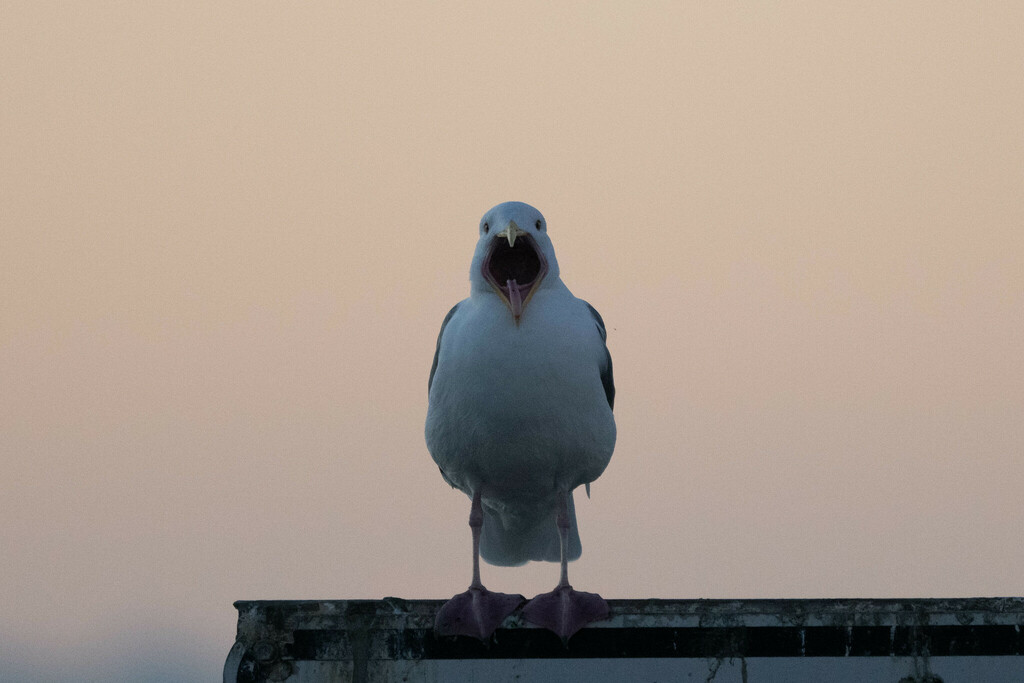
(c) cello caruso-turiello, some rights reserved (CC BY) · licence
Family: Laridae · Class: Aves · Order: Charadriiformes
Larus occidentalis (Western Gull) is a California animal in the Laridae family.
The Western Gull is a large, robust seabird measuring 55 to 68 cm (22 to 27 inches) in length with a wingspan of 130 to 144 cm (51 to 57 inches). Adults weigh between 800 to 1,400 grams (1.8 to 3.1 pounds). Breeding adults display a dark slate-gray mantle and wings contrasting with a white head, neck, underparts, and tail. The bill is bright yellow with an orange-red spot near the tip of the lower mandible. Legs and feet are bright pink to yellow. Non-breeding adults show gray streaking on the head and neck. Juveniles are mottled brown overall, gradually acquiring adult plumage over four years through a series of molts. Western Gulls breed along the Pacific Coast from Washington through Baja California, Mexico. In California, the species nests on offshore islands and rocky coastal areas from the Oregon border south to the Channel Islands. Major breeding colonies occur on the Farallon Islands, Año Nuevo Island, and throughout the Channel Islands including Santa Barbara, Anacapa, Santa Cruz, Santa Rosa, and San Miguel islands. During winter, the species ranges along the entire California coast and extends inland to large bodies of water including the Salton Sea. The species inhabits marine and coastal environments, showing strong preference for rocky shorelines, offshore islands, beaches, harbors, and adjacent urban areas. Western Gulls nest on cliff tops, rocky ledges, and flat areas of offshore islands, typically selecting sites with minimal vegetation. During non-breeding seasons, they frequent estuaries, mudflats, garbage dumps, parking lots, and urban waterfronts. The species ranges from sea level to elevations of approximately 300 meters on nesting islands. Western Gulls are opportunistic omnivores with a diverse diet including fish, marine invertebrates, eggs, chicks of other seabirds, small mammals, and human food waste. They employ various foraging strategies including surface dipping, shallow diving, scavenging, and kleptoparasitism. Breeding occurs from May through August, with pairs typically laying 2 to 3 olive-brown eggs marked with dark spots in shallow scrapes lined with vegetation, feathers, or debris. Both parents incubate eggs for 25 to 32 days and feed chicks regurgitated food. Young fledge at 6 to 7 weeks but remain dependent on parents for several additional weeks. Western Gulls are highly social, forming large roosting flocks and maintaining complex social hierarchies. The Western Gull is not federally or state listed and maintains stable populations throughout its range. According to Partners in Flight, the global breeding population is estimated at approximately 130,000 individuals, with the majority breeding in California waters. The species has shown resilience to human disturbance and has adapted well to urban environments, though individual colonies may face localized threats from development, introduced predators, pollution, and climate change effects on prey availability. Oil spills pose periodic risks to coastal populations, while plastic pollution and fishing gear entanglement represent ongoing conservation concerns.
Classification
Class: Aves · Order: Charadriiformes · Family: Laridae
Frequently asked questions
How is Larus occidentalis classified?
Larus occidentalis belongs to class Aves, order Charadriiformes, family Laridae.
What family does Larus occidentalis belong to?
Larus occidentalis is in the Laridae family.
What is Larus occidentalis?
The Western Gull is a large, robust seabird measuring 55 to 68 cm (22 to 27 inches) in length with a wingspan of 130 to 144 cm (51 to 57 inches).
Is Larus occidentalis found in California?
Yes. Larus occidentalis is recorded in California in The California Species Project's catalogue.
Related species
Other California species in the same genus, family, or bioregion.
Data from The California Species Project — 14,000+ California species with verified data from CNPS, CDFW, USFWS, and more.