Larus schistisagus
Slaty-backed Gull
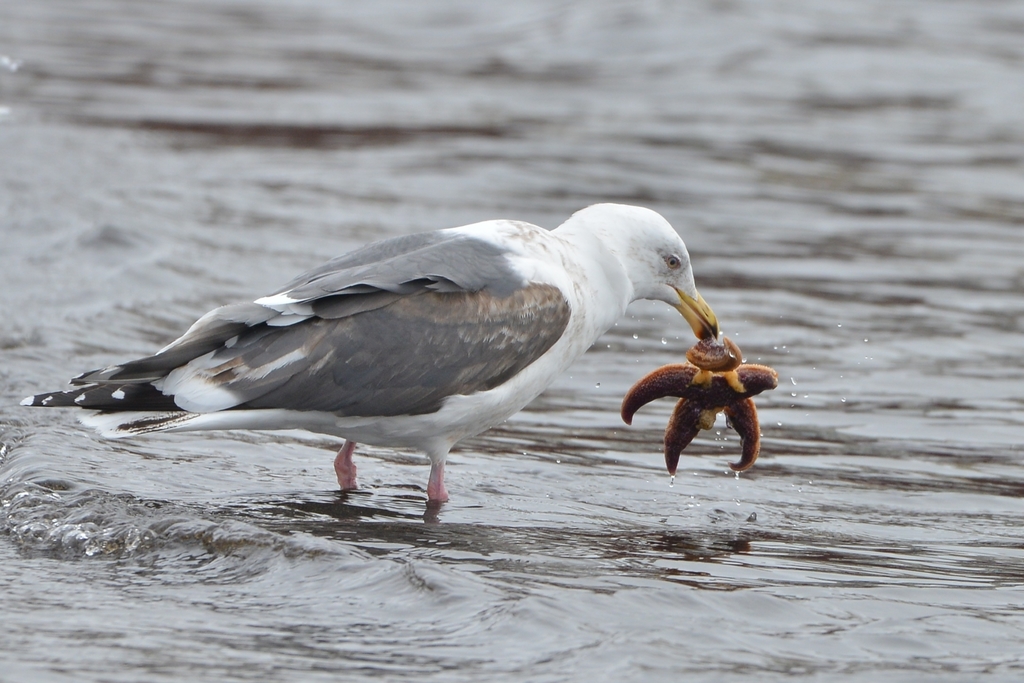
(c) Валерия Ковалева, some rights reserved (CC BY) · licence
Family: Laridae · Class: Aves · Order: Charadriiformes
Larus schistisagus (Slaty-backed Gull) is a California animal in the Laridae family.
The Slaty-backed Gull is a large seabird native to the North Pacific region. Adults measure 61 to 68 cm (24 to 27 inches) in length with a wingspan of 132 to 160 cm (52 to 63 inches). The species exhibits typical gull proportions with a robust body, long wings, and webbed feet. Adult birds in breeding plumage display a distinctive dark slate-gray mantle and wing coverts that contrast sharply with the white head, neck, underparts, and tail. The bill is yellow with a red gonydeal spot, and the legs are pink to flesh-colored. In winter plumage, adults develop brown streaking on the head and neck. Juvenile birds show brown mottling throughout their plumage, requiring up to four years to reach adult coloration. The Slaty-backed Gull breeds primarily along the coasts of northeastern Asia, including the Kamchatka Peninsula, Sakhalin Island, the Kuril Islands, and coastal regions of the Russian Far East and northern Japan. During winter, the species migrates south along Asian coasts and across the North Pacific. In North America, Slaty-backed Gulls occur as regular but uncommon visitors to Alaska, particularly the Aleutian Islands and western coastal areas. The species appears as a rare vagrant along the Pacific coast of the continental United States, with documented records from Washington, Oregon, and California. Most California observations occur during winter months along the central and northern coastline. Slaty-backed Gulls inhabit coastal and marine environments, showing preference for rocky shores, harbors, estuaries, and offshore waters. During the breeding season, they nest on cliff ledges, rocky islands, and coastal bluffs. In winter, the species frequents harbors, piers, beaches, and nearshore waters where food sources are abundant. They often associate with other large gulls at fishing ports and waste disposal sites. The species exhibits typical gull feeding behavior, employing both scavenging and active foraging strategies. Their diet consists primarily of fish, marine invertebrates, crustaceans, and mollusks, supplemented by carrion and human-generated food waste. Slaty-backed Gulls are opportunistic feeders that will plunge-dive for fish or pick food items from the water surface. Breeding occurs from May through July, with pairs constructing nests of grass, seaweed, and other vegetation on elevated coastal sites. Females typically lay 2 to 3 olive-brown eggs with dark markings. Both parents participate in incubation, which lasts approximately 28 days, and in feeding the young until fledging occurs at 6 to 7 weeks of age. The Slaty-backed Gull is not federally listed under the Endangered Species Act and lacks special conservation status in California. The global population appears stable, though specific population estimates are not well-documented. The species faces typical seabird threats including habitat disturbance at breeding colonies, pollution, overfishing of prey species, and climate change impacts on marine ecosystems. In California, the species remains primarily a vagrant, with no established breeding populations requiring specific conservation measures.
Classification
Class: Aves · Order: Charadriiformes · Family: Laridae
Frequently asked questions
How is Larus schistisagus classified?
Larus schistisagus belongs to class Aves, order Charadriiformes, family Laridae.
What family does Larus schistisagus belong to?
Larus schistisagus is in the Laridae family.
What is Larus schistisagus?
The Slaty-backed Gull is a large seabird native to the North Pacific region.
Is Larus schistisagus found in California?
Yes. Larus schistisagus is recorded in California in The California Species Project's catalogue.
Related species
Other California species in the same genus, family, or bioregion.
Data from The California Species Project — 14,000+ California species with verified data from CNPS, CDFW, USFWS, and more.