Larus smithsonianus
American Herring Gull
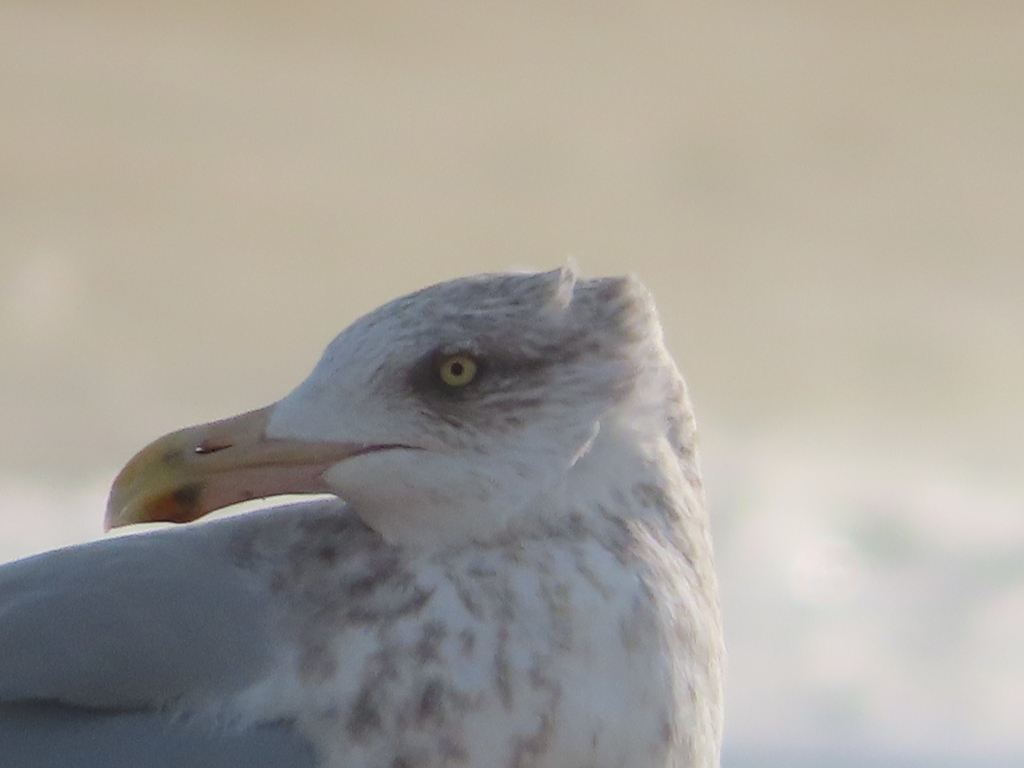
(c) Mila C., some rights reserved (CC BY) · licence
Family: Laridae · Class: Aves · Order: Charadriiformes
Larus smithsonianus (American Herring Gull) is a California animal in the Laridae family.
The American Herring Gull is a large, adaptable seabird measuring 56-66 cm (22-26 inches) in length with a wingspan of 124-155 cm (49-61 inches). Adults display pale gray upperparts, white underparts, and a yellow bill with a red spot on the lower mandible. The legs are pink or flesh-colored. During breeding season, adults develop a white head and neck, while winter adults show brown streaking on the head and nape. Juveniles are mottled brown and take four years to reach adult plumage, progressing through distinct immature stages with varying degrees of brown and gray coloration. The species breeds across a vast range from Alaska through Canada to the Great Lakes region and Atlantic coast of North America, extending from Newfoundland south to North Carolina. In California, American Herring Gulls occur primarily as winter visitors and migrants along the coast, with some year-round residents. The species is most common in northern California coastal areas, San Francisco Bay, and the Central Valley during winter months. Breeding populations are concentrated in the Great Lakes, where the species nests on natural and artificial islands. American Herring Gulls occupy diverse habitats including marine coastlines, estuaries, harbors, landfills, agricultural fields, and urban areas. According to Birds of the World, they nest in many different habitats, including Arctic tundra, small lakes in the boreal forest, natural and artificial islands in the Great Lakes, rooftops in cities, windswept islands in the Atlantic Ocean, and barrier beaches and saltmarshes. During winter, they frequent beaches, mudflats, fishing ports, and inland water bodies where food sources are abundant. These opportunistic omnivores consume a wide variety of foods including fish, crustaceans, mollusks, marine worms, insects, small mammals, eggs, and human food waste. They employ various foraging strategies: surface dipping, shallow diving, scavenging, and kleptoparasitism (stealing food from other birds). Breeding occurs from April through August, with pairs constructing nests of vegetation, seaweed, and debris on islands, cliffs, or rooftops. Females typically lay 2-3 olive-brown eggs with dark markings. Both parents incubate eggs for 28-30 days and care for young, which fledge after 35-49 days but may depend on parents for several more weeks. The American Herring Gull is not federally or state-listed as threatened or endangered and maintains stable to increasing populations across most of its range. The species demonstrates high adaptability to human-modified environments and has expanded its range southward along the Atlantic coast over the past century. However, local populations face threats from habitat loss, pollution, and human disturbance at nesting sites. Climate change may affect prey availability and breeding success in some regions. The species was formerly classified as a subspecies of the European Herring Gull but is now recognized as a distinct species based on genetic and morphological differences.
Classification
Class: Aves · Order: Charadriiformes · Family: Laridae
Frequently asked questions
How is Larus smithsonianus classified?
Larus smithsonianus belongs to class Aves, order Charadriiformes, family Laridae.
What family does Larus smithsonianus belong to?
Larus smithsonianus is in the Laridae family.
What is Larus smithsonianus?
The American Herring Gull is a large, adaptable seabird measuring 56-66 cm (22-26 inches) in length with a wingspan of 124-155 cm (49-61 inches).
Is Larus smithsonianus found in California?
Yes. Larus smithsonianus is recorded in California in The California Species Project's catalogue.
Related species
Other California species in the same genus, family, or bioregion.
Data from The California Species Project — 14,000+ California species with verified data from CNPS, CDFW, USFWS, and more.