Lasioglossum ovaliceps
Oval-headed Sweat Bee
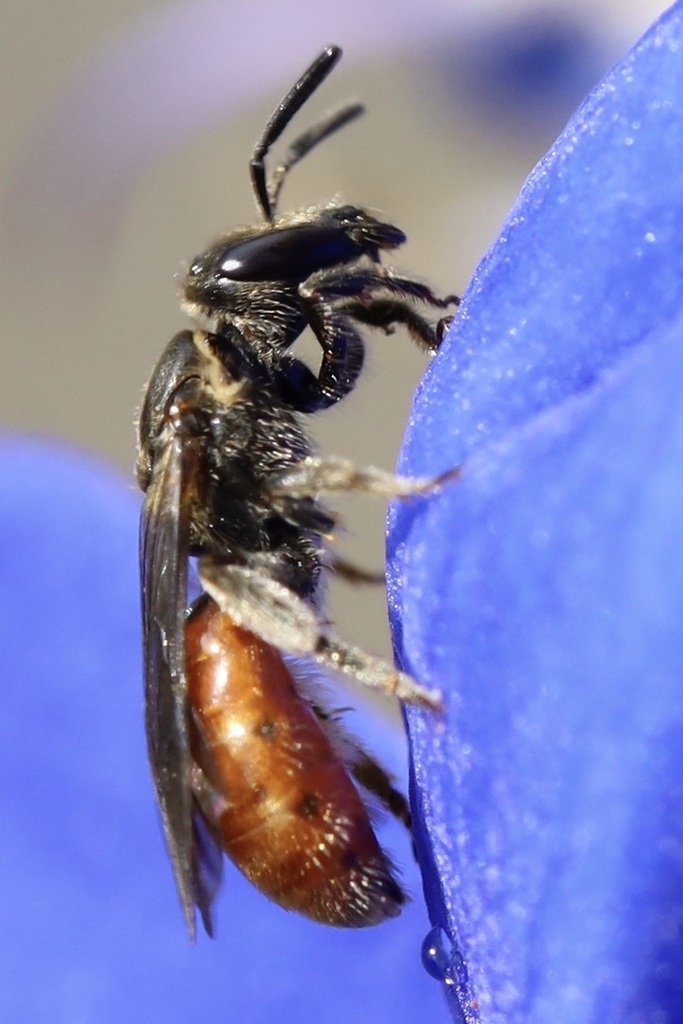
(c) eebee, some rights reserved (CC BY) · licence
Family: Halictidae · Class: Insecta · Order: Hymenoptera
Lasioglossum ovaliceps (Oval-headed Sweat Bee) is a California animal in the Halictidae family.
The oval-headed sweat bee is a small member of the family Halictidae, measuring approximately 4-7 mm in length. This species exhibits the typical slender build characteristic of sweat bees, with a dusky black to dull metallic green coloration. The body is relatively hairless compared to other bee families, giving it a smooth, wasp-like appearance. Like other Lasioglossum species, it displays bands of hair on the innermost portions of abdominal segments, distinguishing it from the closely related genus Halictus, which has hair bands on the outermost portions of segments (BugGuide). Lasioglossum ovaliceps appears to have a limited distribution, with documented records from California. A female specimen was photographed in Pasadena, Los Angeles County, indicating the species occurs in southern California (BugGuide). The specific range and distribution patterns remain poorly documented, with limited occurrence data available in biodiversity databases. The species was originally described by Cockerell in 1898 as Halictus ovaliceps and has undergone several taxonomic revisions, including placement in the subgenus Evylaeus and currently in Hemihalictus sensu lato. Habitat preferences for this species have not been well documented in the scientific literature. Like other small sweat bees in the genus Lasioglossum, it likely inhabits diverse environments including urban gardens, natural areas, and agricultural landscapes. The Pasadena record suggests the species can occur in urban and suburban environments of the Los Angeles Basin. Sweat bees in this genus typically nest in soil, creating small burrows where they provision cells with pollen and nectar for their developing larvae. Behavioral and ecological information for L. ovaliceps remains limited. As members of the Halictidae family, these bees are generalist pollinators that visit a variety of flowering plants to collect pollen and nectar. The common name "sweat bee" derives from their attraction to human perspiration as a source of moisture and salts. Like other Lasioglossum species, they likely exhibit fast, sometimes erratic flight patterns and may be observed crawling around the base of flowers or inside flower heads while foraging. The species presumably has an annual life cycle typical of the genus, with females emerging in spring to establish nests, provision cells throughout the growing season, and produce offspring that overwinter as adults or prepupae. No formal conservation status has been assigned to Lasioglossum ovaliceps at federal or state levels. The species lacks comprehensive population data or threat assessments, reflecting the general paucity of research on small halictid bees. NatureServe Explorer indicates no conservation status rank has been determined. The limited distribution records and apparent rarity in collections suggest this species may have a restricted range or be easily overlooked due to its small size and similarity to other Lasioglossum species. Species identification within this genus is notoriously difficult, often requiring examination of microscopic features such as puncture density on the thorax and surface texture patterns. Scientific documentation for this species remains limited. The information presented here synthesizes available observations from taxonomic databases and photographic records. Additional field studies are needed to better understand the distribution, habitat requirements, and ecological role of this small sweat bee in California ecosystems.
Classification
Class: Insecta · Order: Hymenoptera · Family: Halictidae
Frequently asked questions
How is Lasioglossum ovaliceps classified?
Lasioglossum ovaliceps belongs to class Insecta, order Hymenoptera, family Halictidae.
What family does Lasioglossum ovaliceps belong to?
Lasioglossum ovaliceps is in the Halictidae family.
What is Lasioglossum ovaliceps?
The oval-headed sweat bee is a small member of the family Halictidae, measuring approximately 4-7 mm in length.
Is Lasioglossum ovaliceps found in California?
Yes. Lasioglossum ovaliceps is recorded in California in The California Species Project's catalogue.
Related species
Other California species in the same genus, family, or bioregion.
Data from The California Species Project — 14,000+ California species with verified data from CNPS, CDFW, USFWS, and more.