Lasioglossum titusi
Titus's Sweat Bee
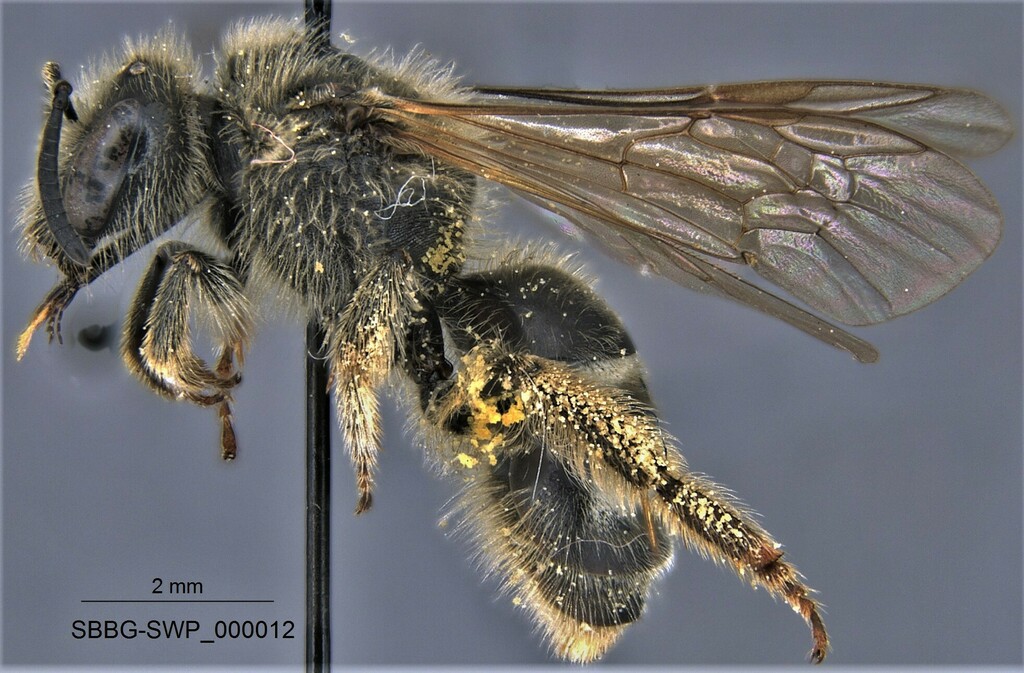
(c) Kylie Etter, some rights reserved (CC BY) · licence
Family: Halictidae · Class: Insecta · Order: Hymenoptera
Lasioglossum titusi (Titus's Sweat Bee) is a California animal in the Halictidae family.
Lasioglossum titusi, commonly known as Titus's Sweat Bee, is a native bee species in the family Halictidae. This small to medium-sized sweat bee exhibits the typical morphology of the genus Lasioglossum, with a metallic sheen on the integument and relatively compact body structure characteristic of ground-nesting bees. Like other members of this genus, females possess specialized pollen-collecting structures including scopae on the hind legs for transporting pollen back to nesting sites. The species occurs in California, where it has been documented in various grassland and shrubland habitats. Specific distributional data for L. titusi remains limited in the scientific literature, though the species appears to be associated with native plant communities throughout its range. The extent of its historical versus current distribution has not been comprehensively documented. Titus's Sweat Bee inhabits native grassland ecosystems, particularly those supporting diverse forb communities that provide nectar and pollen resources. Research has documented the species collecting pollen from mountain dandelion in restored serpentine grasslands, where native pollinators including L. titusi show significantly higher abundance compared to areas invaded by non-native grasses such as barbed goatgrass (Aigner, as cited in CNPS Fremontia 2011). The species appears to be associated with serpentine soils and native grassland restoration sites, suggesting habitat specificity for indigenous plant communities. Elevation ranges and specific microhabitat requirements have not been well documented in available literature. As a member of the Halictidae, L. titusi exhibits typical sweat bee behavior including ground-nesting habits and solitary to semi-social colony organization. Females construct burrows in suitable soil substrates where they provision brood cells with pollen and nectar collected from flowering plants. The species demonstrates floral specialization or generalization patterns that require further research to fully characterize. Seasonal flight periods, brood development timing, and overwintering strategies have not been comprehensively studied. Males likely emerge before females in typical halictid fashion, with mating occurring at emergence sites or on flowers. Currently, Lasioglossum titusi does not appear on federal or state endangered species lists. However, like many native pollinators, the species faces potential threats from habitat conversion, invasive plant species, and pesticide use in agricultural landscapes. Research indicates that native bee abundance, including L. titusi populations, is significantly higher in restored native grasslands compared to areas dominated by invasive annual grasses (Aigner, CNPS Fremontia 2011). This suggests that grassland restoration efforts may benefit the species and other native pollinators. Detailed ecological studies of this species remain limited. The information presented here synthesizes available observations from scientific literature and restoration ecology research. Enhanced documentation of this species' distribution, host plant relationships, and population trends would contribute valuable data for California's native pollinator conservation efforts.
Classification
Class: Insecta · Order: Hymenoptera · Family: Halictidae
Frequently asked questions
How is Lasioglossum titusi classified?
Lasioglossum titusi belongs to class Insecta, order Hymenoptera, family Halictidae.
What family does Lasioglossum titusi belong to?
Lasioglossum titusi is in the Halictidae family.
What is Lasioglossum titusi?
Lasioglossum titusi, commonly known as Titus's Sweat Bee, is a native bee species in the family Halictidae.
Is Lasioglossum titusi found in California?
Yes. Lasioglossum titusi is recorded in California in The California Species Project's catalogue.
Related species
Other California species in the same genus, family, or bioregion.
Data from The California Species Project — 14,000+ California species with verified data from CNPS, CDFW, USFWS, and more.