Lasionycteris noctivagans
Silver-haired Bat
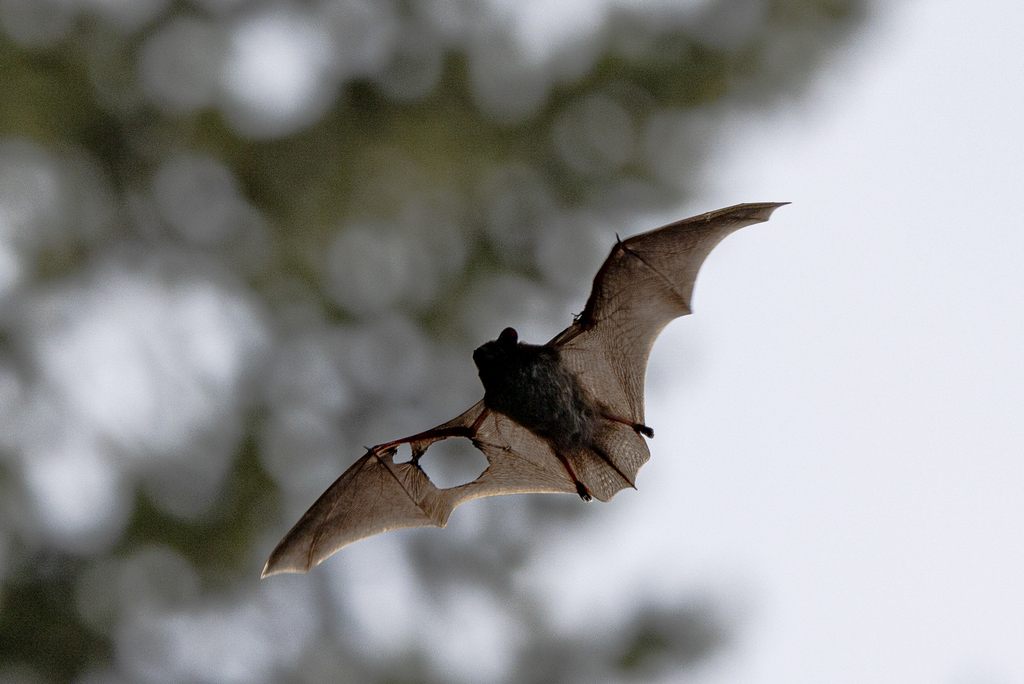
(c) Kalvin Chan, some rights reserved (CC BY) · licence
Family: Vespertilionidae · Class: Mammalia · Order: Chiroptera
Conservation status: G3G4 S3S4
Lasionycteris noctivagans (Silver-haired Bat) is a California animal in the Vespertilionidae family.
The silver-haired bat is a medium-sized North American bat characterized by its distinctive dark fur tipped with silver or white. Adults measure 9 to 12 centimeters (3.5 to 4.7 inches) in total length with a wingspan of 27 to 31 centimeters (10.6 to 12.2 inches). Body mass ranges from 8 to 12 grams (0.3 to 0.4 ounces). The species exhibits sexual dimorphism, with females typically larger than males. The dorsal fur appears nearly black with frosted silver tips, while the ventral surface is lighter brown to buff colored. The ears are short, rounded, and naked, measuring approximately 13 to 16 millimeters in length. Wing membranes are dark brown to black. Silver-haired bats occur throughout much of North America, from southern Canada to northern Mexico. In California, the species is found primarily in forested regions of the northern two-thirds of the state, including the Sierra Nevada, Cascade Range, Coast Ranges, and Transverse Ranges. Populations are present at elevations from sea level to approximately 2,900 meters (9,500 feet). The species exhibits seasonal migrations, with northern populations moving south during winter months. This species inhabits coniferous and mixed forests, particularly those dominated by Douglas fir, ponderosa pine, and redwood. Silver-haired bats roost primarily in tree cavities, beneath loose bark, and in rock crevices. Summer roosts are typically located 3 to 15 meters above ground in snags or mature trees with exfoliating bark. During migration and winter, individuals may utilize buildings, bridges, and other human-made structures. The species shows strong fidelity to forested corridors during travel between roosting and foraging areas. Silver-haired bats are insectivorous, feeding primarily on soft-bodied flying insects including moths, flies, mosquitoes, and termites. Foraging typically occurs over water bodies, forest clearings, and along tree lines during the first few hours after sunset. The species employs echolocation calls with frequencies ranging from 25 to 35 kilohertz. Mating occurs during late summer and fall migration, with females storing sperm through winter. Delayed fertilization occurs in spring, and females give birth to twins in late June or July after a gestation period of 50 to 60 days. Young are capable of flight at approximately three weeks of age. The silver-haired bat is not federally listed but carries a global conservation rank of G3G4, indicating the species may be vulnerable to extirpation. In California, the species ranks S3S4, suggesting populations may be at risk. Primary threats include habitat loss from logging and forest management practices, white-nose syndrome, and wind energy development. Climate change may affect migration patterns and prey availability. Forest fragmentation reduces connectivity between roosting and foraging habitats. The species' dependence on mature forest stands makes it particularly vulnerable to intensive timber harvesting practices that remove large snags and trees with suitable bark characteristics.
Classification
Class: Mammalia · Order: Chiroptera · Family: Vespertilionidae
Conservation status
G3G4 S3S4
Frequently asked questions
How is Lasionycteris noctivagans classified?
Lasionycteris noctivagans belongs to class Mammalia, order Chiroptera, family Vespertilionidae.
What family does Lasionycteris noctivagans belong to?
Lasionycteris noctivagans is in the Vespertilionidae family.
Is Lasionycteris noctivagans protected or of conservation concern?
Lasionycteris noctivagans carries the following status: G3G4 S3S4.
What is Lasionycteris noctivagans?
The silver-haired bat is a medium-sized North American bat characterized by its distinctive dark fur tipped with silver or white.
Is Lasionycteris noctivagans found in California?
Yes. Lasionycteris noctivagans is recorded in California in The California Species Project's catalogue.
Related species
Other California species in the same genus, family, or bioregion.
Data from The California Species Project — 14,000+ California species with verified data from CNPS, CDFW, USFWS, and more.