Lasiurus frantzii
Western Red Bat
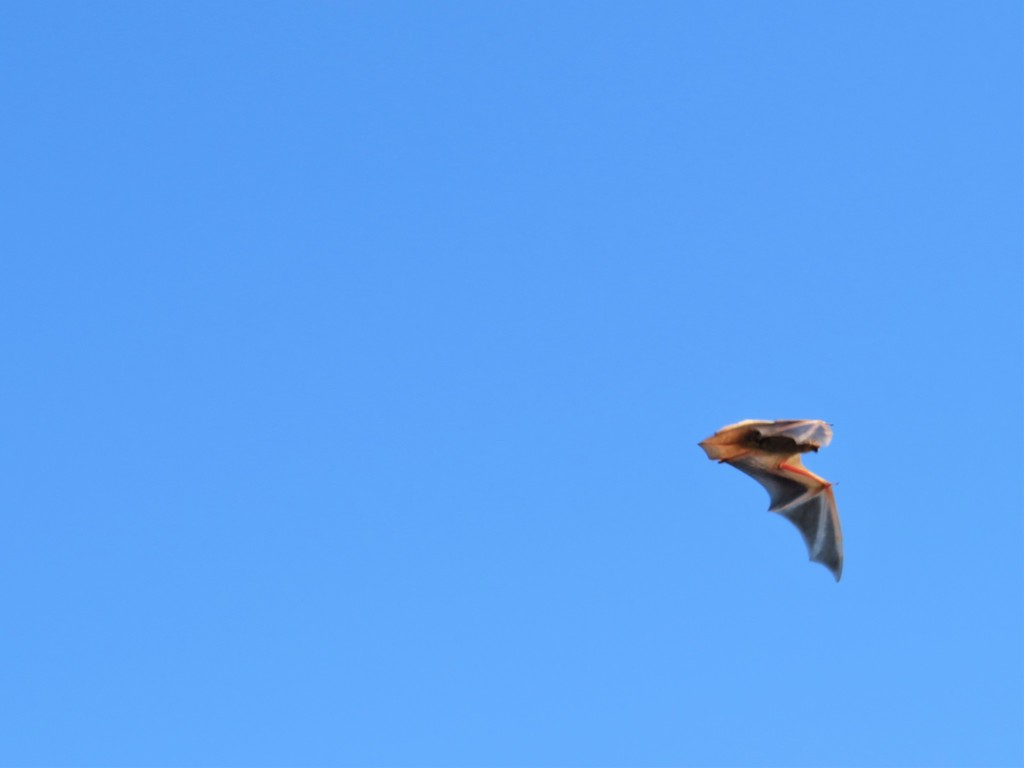
(c) Linzy L., some rights reserved (CC BY-SA) · licence
Family: Vespertilionidae · Class: Mammalia · Order: Chiroptera
Conservation status: G4 S3
Lasiurus frantzii (Western Red Bat) is a California animal in the Vespertilionidae family.
The Western red bat is a medium-sized insectivorous bat with distinctive reddish fur coloration. Adults measure 105-125 mm (4.1-4.9 inches) in total length with a wingspan reaching 280-330 mm (11-13 inches). Males typically display brighter red pelage, while females exhibit more subdued reddish-brown coloration with frosted tips on the fur. The species possesses long, narrow wings adapted for swift flight and a furred interfemoral membrane that extends to the tip of the tail. Western red bats can be distinguished from Eastern red bats through genetic analysis, as the two species are morphologically similar and difficult to differentiate in the field. Historically, the Western red bat ranged throughout western North America from British Columbia to Central America. In California, the species occurs from sea level to approximately 2,400 meters (7,900 feet) elevation, inhabiting various regions including the Central Valley, coastal areas, and lower montane zones. Recent genetic confirmation has documented the species in Sutter County, demonstrating its continued presence in the Sacramento Valley region (CDFW 2024). Western red bats utilize diverse habitat types including riparian forests, oak woodlands, agricultural areas with trees, and urban environments with suitable roosting sites. The species shows strong preference for edge habitats where forested areas meet open spaces. Roosting typically occurs in foliage of deciduous trees, particularly willows, cottonwoods, and sycamores, where individuals hang from branches 2-4 meters above ground. Unlike many bat species that form colonies, Western red bats are largely solitary, with females occasionally roosting with their young. The species exhibits seasonal migration patterns, moving to warmer regions during winter months. Mating occurs during late summer and fall, with females storing sperm until spring fertilization. Gestation lasts approximately 90 days, with parturition occurring from May through July. Females typically produce 1-4 pups per year, with twins being most common. Young become volant at 4-6 weeks of age. Western red bats are aerial insectivores, foraging primarily on moths, beetles, and other flying insects captured during sustained flight patterns. Foraging typically begins shortly after sunset and continues throughout the night in areas 3-10 meters above ground or vegetation. The Western red bat holds a Global/State Rank of G4 S3, indicating the species is apparently secure globally but vulnerable in California. The California Department of Fish and Wildlife designates it as a Species of Special Concern. Primary threats include habitat loss due to riparian forest removal, urban development, and agricultural intensification. Pesticide use reduces insect prey availability and may cause direct mortality through bioaccumulation. Wind energy development poses collision risks during migration and foraging activities. Recently, the invasive fungus Pseudogymnoascus destructans, causative agent of white-nose syndrome, was confirmed in a Western red bat in California for the first time in 2024, representing an emerging conservation concern (USFWS 2024). Climate change may affect prey availability and suitable roosting habitat distribution. Conservation efforts focus on preserving riparian corridors, maintaining mature tree stands, and monitoring population trends across the species' California range.
Classification
Class: Mammalia · Order: Chiroptera · Family: Vespertilionidae
Conservation status
G4 S3
Frequently asked questions
How is Lasiurus frantzii classified?
Lasiurus frantzii belongs to class Mammalia, order Chiroptera, family Vespertilionidae.
What family does Lasiurus frantzii belong to?
Lasiurus frantzii is in the Vespertilionidae family.
Is Lasiurus frantzii protected or of conservation concern?
Lasiurus frantzii carries the following status: G4 S3.
What is Lasiurus frantzii?
The Western red bat is a medium-sized insectivorous bat with distinctive reddish fur coloration.
Is Lasiurus frantzii found in California?
Yes. Lasiurus frantzii is recorded in California in The California Species Project's catalogue.
Related species
Other California species in the same genus, family, or bioregion.
Data from The California Species Project — 14,000+ California species with verified data from CNPS, CDFW, USFWS, and more.