Laterallus jamaicensis
Black Rail
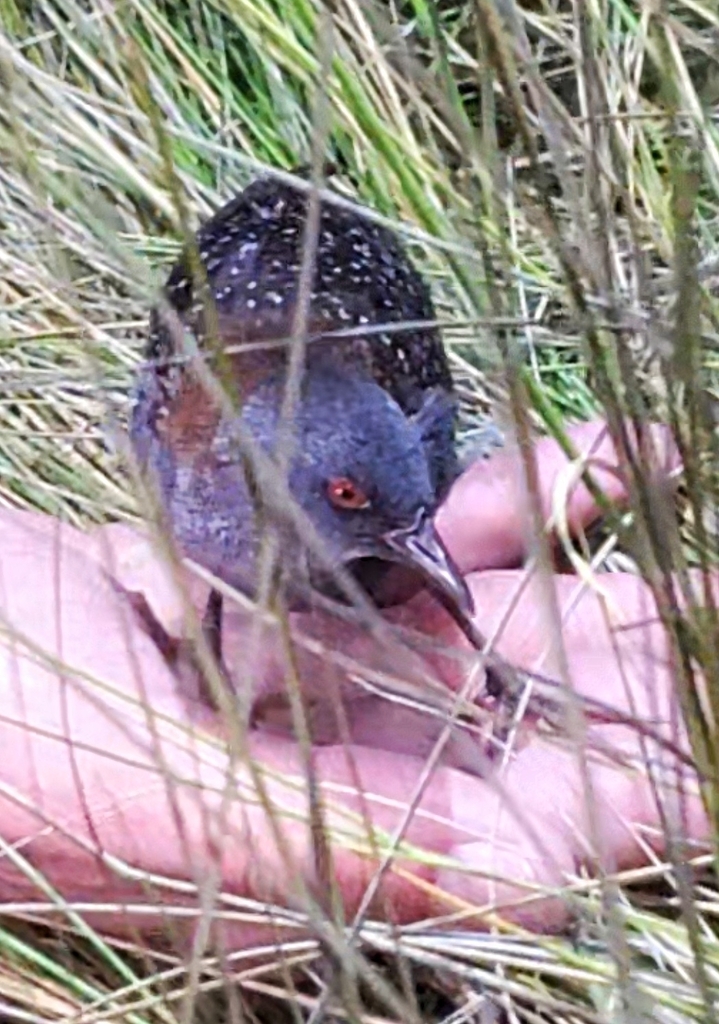
(c) JD Flores, some rights reserved (CC BY) · licence
Family: Rallidae · Class: Aves · Order: Gruiformes
Laterallus jamaicensis (Black Rail) is a California animal in the Rallidae family.
The Black Rail is North America's smallest rail, measuring 10-15 cm (4-6 inches) in length with a wingspan of 22-25 cm (8.7-9.8 inches). Adults are predominantly blackish with a distinctive black bill and dark eyes. The species exhibits subtle sexual dimorphism, with males displaying white speckles on the back and flanks, while females show more brownish tones. Juveniles are duller than adults with less distinct markings. The species' secretive nature and small size make it one of the most difficult North American birds to observe. The Black Rail has a disjunct distribution across North America, with populations occurring along the Atlantic and Gulf coasts from Massachusetts to Texas, in scattered inland locations, and along the Pacific coast. In California, the subspecies L. j. coturniculus (California Black Rail) occurs in coastal areas including Bodega Bay, Tomales Bay, Bolinas Lagoon, and the San Francisco Bay estuary, extending south to San Diego County. The species also inhabits scattered inland freshwater marshes in the Central Valley and southern California. Black Rails occupy shallow wetland habitats with water depths typically less than 15 cm (6 inches), preferring areas with shallower water than other North American rails. In coastal areas, they nest in the high portions of salt marshes above mean high tide, utilizing areas with dense vegetation cover. Inland populations inhabit shallow freshwater marshes, wet meadows, flooded grasslands, and managed wetlands. The species requires areas with both open water for foraging and dense emergent vegetation for nesting and cover. Black Rails are primarily crepuscular and nocturnal, most active during dawn and dusk hours. They are opportunistic omnivores, feeding on small invertebrates, seeds, and plant material. The species forages by picking prey from water surfaces and vegetation. Breeding occurs from April through July, with peak activity in May and June. Females construct well-concealed nests in dense vegetation, typically laying 6-8 cream-colored eggs with brown spots. The species exhibits strong site fidelity, often returning to the same breeding areas annually. The California Black Rail is listed as a Category 1 taxon by the U.S. Fish and Wildlife Service, making it a candidate for federal listing as threatened. The Eastern Black Rail subspecies (L. j. jamaicensis) was federally listed as threatened in 2020. Primary threats include habitat loss due to coastal development, sea level rise, altered hydrology, and wetland degradation. Agricultural conversion and urban development have eliminated much of the species' historical inland habitat. Climate change poses increasing threats through accelerated sea level rise and altered precipitation patterns affecting wetland hydrology. Population monitoring is challenging due to the species' secretive behavior, but available data suggest significant declines across much of the range, particularly in California where habitat loss has been extensive.
Classification
Class: Aves · Order: Gruiformes · Family: Rallidae
Frequently asked questions
How is Laterallus jamaicensis classified?
Laterallus jamaicensis belongs to class Aves, order Gruiformes, family Rallidae.
What family does Laterallus jamaicensis belong to?
Laterallus jamaicensis is in the Rallidae family.
What is Laterallus jamaicensis?
The Black Rail is North America's smallest rail, measuring 10-15 cm (4-6 inches) in length with a wingspan of 22-25 cm (8.7-9.8 inches).
Is Laterallus jamaicensis found in California?
Yes. Laterallus jamaicensis is recorded in California in The California Species Project's catalogue.
Related species
Other California species in the same genus, family, or bioregion.
Data from The California Species Project — 14,000+ California species with verified data from CNPS, CDFW, USFWS, and more.