Lavinia symmetricus navarroensis
Navarro roach
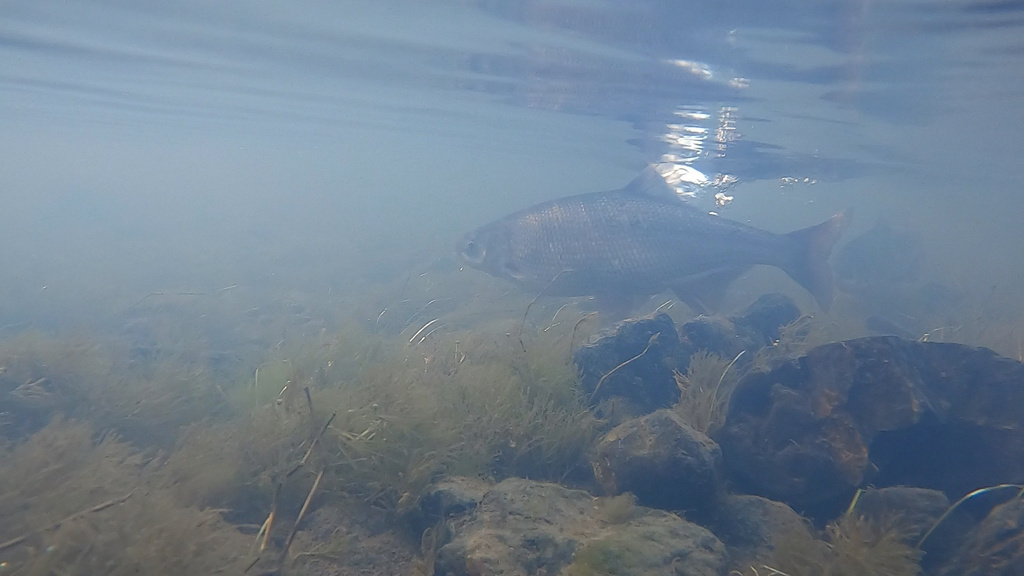
(c) Mike Heine, some rights reserved (CC BY) · licence
Family: Leuciscidae · Class: Actinopterygii · Order: Cypriniformes
Conservation status: G4T1T2 S2S3
Lavinia symmetricus navarroensis (Navarro roach) is a California animal in the Leuciscidae family.
The Navarro roach (Lavinia symmetricus navarroensis) is a subspecies of hitch endemic to the coastal watersheds of Mendocino County, California. Adults typically measure 100 to 300 mm (4 to 12 inches) in total length, with a streamlined, laterally compressed body characteristic of cyprinid fishes. The species displays a silvery coloration with darker dorsal surfaces and pale ventral areas. The mouth is subterminal with small pharyngeal teeth adapted for processing plant material and small invertebrates. Distinguishing features include a relatively deep body profile and specific scale and fin ray counts that differentiate it from other Lavinia subspecies. Historically, the Navarro roach was distributed throughout the Navarro River watershed in coastal Mendocino County. The subspecies occurs in tributaries and mainstem reaches of the Navarro River system, from headwater streams to areas near the river mouth. Current distribution appears more restricted than historical range, with populations documented in several tributaries including the North Fork Navarro River and various smaller creeks within the watershed. Navarro roach inhabit freshwater stream systems characterized by cool, clear water with moderate to low gradient flows. The species occurs in pools, runs, and riffle areas with substrates ranging from sand and gravel to cobble and bedrock. Adults are typically found in deeper pool habitats with overhead cover provided by riparian vegetation, undercut banks, or large woody debris. Juveniles utilize shallow, near-shore areas with emergent or submerged vegetation. Water temperatures generally range from 10 to 20 degrees Celsius (50 to 68 degrees Fahrenheit) in occupied habitats. The subspecies exhibits omnivorous feeding behavior, consuming aquatic insects, small crustaceans, algae, and detritus. Spawning occurs during spring months, typically from March through May, when water temperatures begin to rise. Adults move to shallow gravel beds in tributary streams to spawn, with females depositing adhesive eggs in redds excavated in suitable substrate. Sexual maturity is reached at approximately two to three years of age. The species demonstrates schooling behavior, particularly during juvenile stages, and adults may form loose aggregations in preferred pool habitats. The Navarro roach is ranked G4T1T2 globally and S2S3 in California, indicating the subspecies is critically imperiled to imperiled throughout its range. While not federally listed, the subspecies faces significant conservation challenges due to its extremely limited distribution and small population size. Primary threats include habitat degradation from logging activities, agricultural practices, and urban development within the watershed. Water diversions and altered flow regimes affect spawning success and juvenile survival. Sedimentation from erosion impacts spawning gravels and reduces pool habitat quality. Introduction of non-native fish species poses additional threats through competition and predation. Climate change may exacerbate existing stressors through altered precipitation patterns and increased water temperatures. Conservation efforts focus on watershed protection, riparian habitat restoration, and monitoring of remaining populations to assess population trends and habitat conditions.
Classification
Class: Actinopterygii · Order: Cypriniformes · Family: Leuciscidae
Conservation status
G4T1T2 S2S3
Frequently asked questions
How is Lavinia symmetricus navarroensis classified?
Lavinia symmetricus navarroensis belongs to class Actinopterygii, order Cypriniformes, family Leuciscidae.
What family does Lavinia symmetricus navarroensis belong to?
Lavinia symmetricus navarroensis is in the Leuciscidae family.
Is Lavinia symmetricus navarroensis protected or of conservation concern?
Lavinia symmetricus navarroensis carries the following status: G4T1T2 S2S3.
What is Lavinia symmetricus navarroensis?
The Navarro roach (Lavinia symmetricus navarroensis) is a subspecies of hitch endemic to the coastal watersheds of Mendocino County, California.
Is Lavinia symmetricus navarroensis found in California?
Yes. Lavinia symmetricus navarroensis is recorded in California in The California Species Project's catalogue.
Related species
Other California species in the same genus, family, or bioregion.
Data from The California Species Project — 14,000+ California species with verified data from CNPS, CDFW, USFWS, and more.