Lavinia symmetricus ssp. 4
Clear Lake - Russian River roach
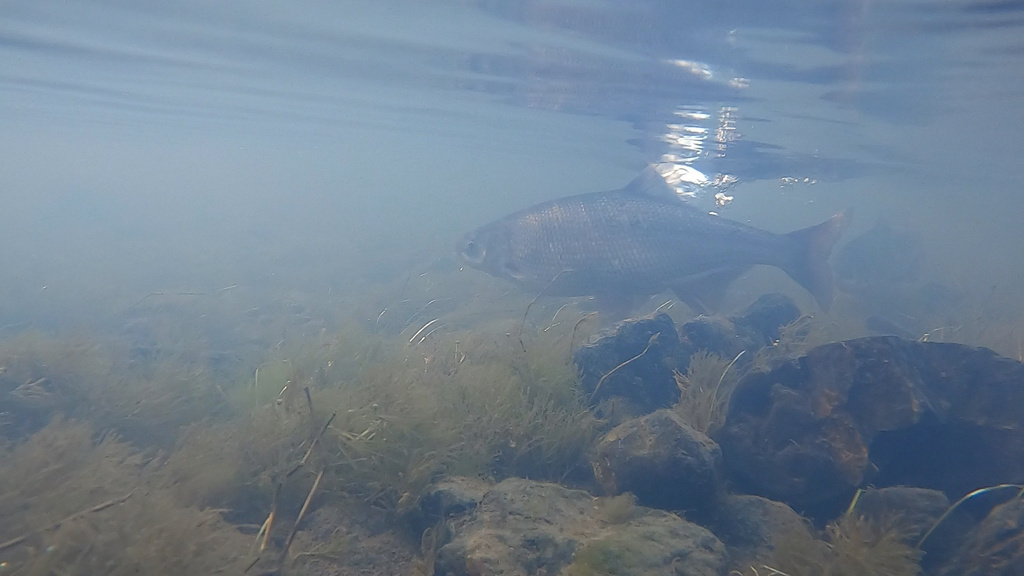
(c) Mike Heine, some rights reserved (CC BY) · licence
Family: Leuciscidae · Class: Actinopterygii · Order: Cypriniformes
Conservation status: G4T2T3 S2S3
Lavinia symmetricus ssp. 4 (Clear Lake - Russian River roach) is a California animal in the Leuciscidae family.
The Clear Lake - Russian River roach (Lavinia symmetricus ssp. 4) is a freshwater cyprinid fish endemic to northern California's Clear Lake basin and Russian River drainage. This subspecies represents one of several geographically distinct populations of the California roach complex, distinguished by specific morphological and genetic characteristics that reflect its isolated evolutionary history. Adults typically reach lengths of 50 to 100 mm (2.0 to 3.9 inches), with a streamlined, laterally compressed body characteristic of the genus Lavinia. The species exhibits a olive-brown to bronze dorsal coloration with silvery sides and a white ventral surface. Males develop more pronounced coloration during breeding season, with enhanced orange-red tints on the fins and body. The mouth is small and subterminal, adapted for bottom feeding, with pharyngeal teeth arranged in a 2,5-4,2 pattern typical of cyprinids. Historically, this subspecies occupied Clear Lake, the largest natural freshwater lake entirely within California, along with tributaries and connected waterways in the Russian River system in Lake, Mendocino, and Sonoma counties. The current distribution has become fragmented due to habitat modification, with populations now restricted to specific reaches of streams and the lake itself. Clear Lake, located at approximately 400 meters (1,300 feet) elevation, serves as the primary habitat for the largest remaining populations. The subspecies inhabits a variety of freshwater environments including lake margins, pools, and slow-moving stream sections with sand, gravel, or rocky substrates. Optimal habitat features include areas with aquatic vegetation, fallen woody debris, and overhanging riparian cover that provide refuge and foraging opportunities. Water temperatures range from 4°C (39°F) in winter to 24°C (75°F) in summer, with the species showing tolerance for the naturally turbid conditions of Clear Lake. Clear Lake - Russian River roach are omnivorous, feeding on algae, aquatic insects, small crustaceans, and organic detritus. Spawning occurs from April through July when water temperatures reach 15 to 20°C (59 to 68°F). Adults move to shallow areas with gravel or rocky substrates where females deposit adhesive eggs. No parental care is provided after spawning. The species exhibits schooling behavior, particularly juveniles, which form aggregations in nearshore areas during summer months. The subspecies faces significant conservation challenges reflected in its G4T2T3 S2S3 ranking, indicating moderate global concern with higher state-level vulnerability. Primary threats include habitat degradation from agricultural runoff, urban development, introduced species competition and predation, and water diversions that alter natural flow regimes. Clear Lake's ecosystem has been substantially modified by introduced fish species including largemouth bass, bluegill, and carp, which compete for resources and prey upon native fish. Climate change poses additional risks through altered precipitation patterns and increased water temperatures that may exceed thermal tolerance limits.
Classification
Class: Actinopterygii · Order: Cypriniformes · Family: Leuciscidae
Conservation status
G4T2T3 S2S3
Frequently asked questions
How is Lavinia symmetricus ssp. 4 classified?
Lavinia symmetricus ssp. 4 belongs to class Actinopterygii, order Cypriniformes, family Leuciscidae.
What family does Lavinia symmetricus ssp. 4 belong to?
Lavinia symmetricus ssp. 4 is in the Leuciscidae family.
Is Lavinia symmetricus ssp. 4 protected or of conservation concern?
Lavinia symmetricus ssp. 4 carries the following status: G4T2T3 S2S3.
What is Lavinia symmetricus ssp. 4?
The Clear Lake - Russian River roach (Lavinia symmetricus ssp.
Is Lavinia symmetricus ssp. 4 found in California?
Yes. Lavinia symmetricus ssp. 4 is recorded in California in The California Species Project's catalogue.
Related species
Other California species in the same genus, family, or bioregion.
Data from The California Species Project — 14,000+ California species with verified data from CNPS, CDFW, USFWS, and more.