Leiothlypis luciae
Lucy's Warbler
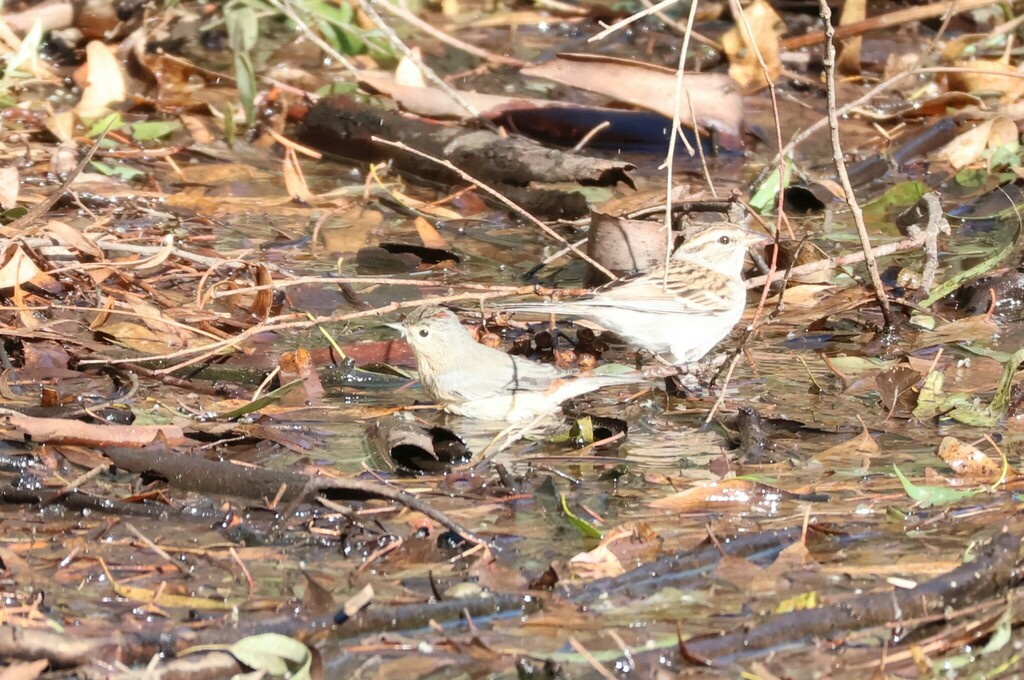
(c) Millie Basden, some rights reserved (CC BY) · licence
Family: Parulidae · Class: Aves · Order: Passeriformes
Conservation status: G5 S3
Leiothlypis luciae (Lucy's Warbler) is a California animal in the Parulidae family.
Lucy's Warbler is one of the smallest New World warblers, measuring approximately 10-11 cm (4-4.3 inches) in length. This species displays subdued plumage with gray upperparts and whitish underparts. Males in breeding season show a distinctive chestnut crown patch and rump patch, while females and non-breeding males exhibit more muted coloration. The species lacks the bold wing bars or bright yellow coloration typical of many other warblers. Lucy's Warbler breeds in the southwestern United States, including Arizona, Nevada, southern California, New Mexico, and extreme southwestern Utah, extending into northwestern Mexico. In California, the species occurs primarily in the southeastern desert regions along the Colorado River and in scattered desert riparian areas. The species was first discovered along the lower Colorado River at Fort Mojave, Arizona, near the junction of Arizona, California, and Nevada (Cooper 1861). As a Neotropical migrant, Lucy's Warbler winters in western Mexico. This species occupies dense lowland riparian mesquite woodlands and is uniquely adapted to hot lower Sonoran desert habitats. Lucy's Warbler inhabits the driest habitat of the four southwestern lowland-breeding warblers and has been called the "mesquite warbler" due to its strong association with mesquite bosques (Gilman 1909). The species may also be found in willows, arrowweed (Tessaria sericea) close to rivers, and less frequently in paloverdes (Cercidium spp.) and ironwoods (Olneya tesota). These habitats typically occur at elevations ranging from 1,700 to 1,800 feet above sea level in areas such as the Moapa Valley (USFWS 2025). Lucy's Warbler holds the distinction of being the only tree cavity-nesting warbler in the western United States. This insectivorous species feeds primarily on small insects and larvae gleaned from foliage and bark. Breeding occurs during spring and early summer, with the species constructing nests in natural tree cavities or old woodpecker holes in mesquite and other desert trees. The species' breeding behavior and nesting requirements make it dependent on mature riparian woodland with suitable nesting cavities. Lucy's Warbler is classified as a Species of Special Concern by the California Department of Fish and Wildlife, reflecting concerns about population trends and habitat availability. The species faces threats from habitat loss due to water diversions, agricultural conversion, and urban development in desert riparian areas. Dam construction and water management practices along the Colorado River system have significantly altered the natural flow regimes that support the mesquite bosques essential for this species. Climate change poses additional challenges through increased temperatures and altered precipitation patterns in already arid habitats. The often remote locations of suitable mesquite bosques make this small, inconspicuous bird difficult to survey and monitor effectively. Conservation efforts focus on protecting and restoring riparian habitats, maintaining adequate water flows, and managing invasive plant species that can degrade native vegetation communities. The species occurs in several protected areas, including Moapa Valley National Wildlife Refuge in Nevada, where it utilizes riparian and wetland habitats supported by thermal springs (USFWS 2025).
Classification
Class: Aves · Order: Passeriformes · Family: Parulidae
Conservation status
G5 S3
Frequently asked questions
How is Leiothlypis luciae classified?
Leiothlypis luciae belongs to class Aves, order Passeriformes, family Parulidae.
What family does Leiothlypis luciae belong to?
Leiothlypis luciae is in the Parulidae family.
Is Leiothlypis luciae protected or of conservation concern?
Leiothlypis luciae carries the following status: G5 S3.
What is Leiothlypis luciae?
Lucy's Warbler is one of the smallest New World warblers, measuring approximately 10-11 cm (4-4.3 inches) in length.
Is Leiothlypis luciae found in California?
Yes. Leiothlypis luciae is recorded in California in The California Species Project's catalogue.
Related species
Other California species in the same genus, family, or bioregion.
Data from The California Species Project — 14,000+ California species with verified data from CNPS, CDFW, USFWS, and more.