Leiothlypis virginiae
Virginia's Warbler
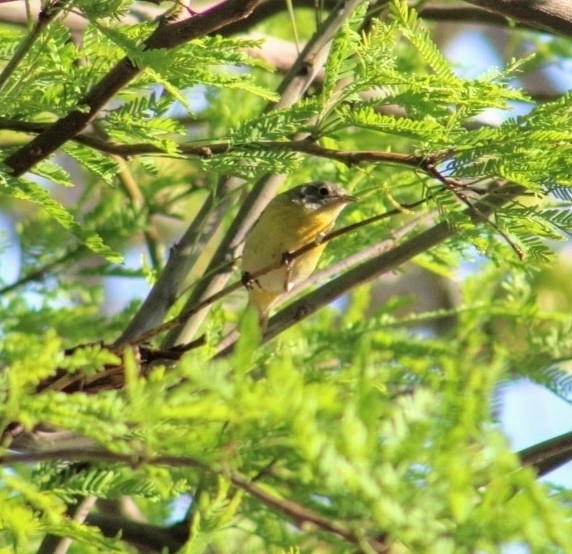
(c) Julio Cesar Ruiz García, some rights reserved (CC BY) · licence
Family: Parulidae · Class: Aves · Order: Passeriformes
Conservation status: WL · G5 S2
Leiothlypis virginiae (Virginia's Warbler) is a California animal in the Parulidae family.
Virginia's Warbler is a small, gray songbird of the southwestern United States measuring approximately 11.5 centimeters (4.5 inches) in length. The species displays subdued coloration with gray upperparts and paler underparts. Males feature a distinctive yellow breast patch and yellow undertail coverts, along with a white eye-ring and rufous crown patch that may be concealed. Females are similar but typically show less pronounced yellow coloring and may lack the crown patch entirely. Virginia's Warbler breeds across the southwestern Rocky Mountain region, with its core range extending from Colorado and Utah south through Arizona and New Mexico. The species also breeds in limited areas of Nevada, eastern California, and western Texas. In California, breeding populations are restricted to the eastern Sierra Nevada and southeastern desert mountain ranges. The species is migratory, wintering primarily in western Mexico from Sonora to Guerrero, with some individuals reaching as far south as Guatemala. This warbler inhabits steep-sloped, xeric woodland dominated by pinyon pine (Pinus edulis) and juniper (Juniperus species) communities, typically at elevations between 1,500 and 2,500 meters (4,900 to 8,200 feet). The species also utilizes oak (Quercus) woodlands and scrubland habitats. Virginia's Warbler shows a preference for areas with dense shrub understories and rocky terrain that provide nesting sites and foraging opportunities. During migration and winter, the species occupies thornscrub, pine-oak woodlands, and riparian areas at lower elevations. Virginia's Warbler feeds primarily on insects and spiders, gleaning prey from foliage and bark surfaces. The species forages actively in the mid-canopy and understory, often hovering briefly to capture insects from leaf surfaces. Breeding occurs from May through July, with females constructing cup-shaped nests on the ground or in low shrubs, typically concealed under vegetation or rock overhangs. Clutches consist of three to five white eggs marked with brown spots. The species is generally monogamous, and both parents participate in feeding nestlings. Virginia's Warbler is currently classified as a Bird of Conservation Concern by the U.S. Fish and Wildlife Service (USFWS 2021), reflecting population decline trends and habitat vulnerability. The species has experienced range-wide population decreases due to habitat fragmentation from grazing, development, and altered fire regimes that affect pinyon-juniper woodland structure. Climate change poses additional threats through shifting precipitation patterns and increasing temperatures that may affect suitable breeding habitat. The Global rank of G5 indicates the species is secure globally, while the California State rank of S2 reflects very restricted distribution within the state. Conservation efforts focus on maintaining habitat connectivity and managing grazing impacts in breeding areas.
Classification
Class: Aves · Order: Passeriformes · Family: Parulidae
Conservation status
WL · G5 S2
Frequently asked questions
How is Leiothlypis virginiae classified?
Leiothlypis virginiae belongs to class Aves, order Passeriformes, family Parulidae.
What family does Leiothlypis virginiae belong to?
Leiothlypis virginiae is in the Parulidae family.
Is Leiothlypis virginiae protected or of conservation concern?
Leiothlypis virginiae carries the following status: WL · G5 S2.
What is Leiothlypis virginiae?
Virginia's Warbler is a small, gray songbird of the southwestern United States measuring approximately 11.5 centimeters (4.5 inches) in length.
Is Leiothlypis virginiae found in California?
Yes. Leiothlypis virginiae is recorded in California in The California Species Project's catalogue.
Related species
Other California species in the same genus, family, or bioregion.
Data from The California Species Project — 14,000+ California species with verified data from CNPS, CDFW, USFWS, and more.