Lema trivittata
Three-lined Lema Beetle
no rights reserved · CC0
Family: Chrysomelidae · Class: Insecta · Order: Coleoptera
Lema trivittata (Three-lined Lema Beetle) is a California animal in the Chrysomelidae family.
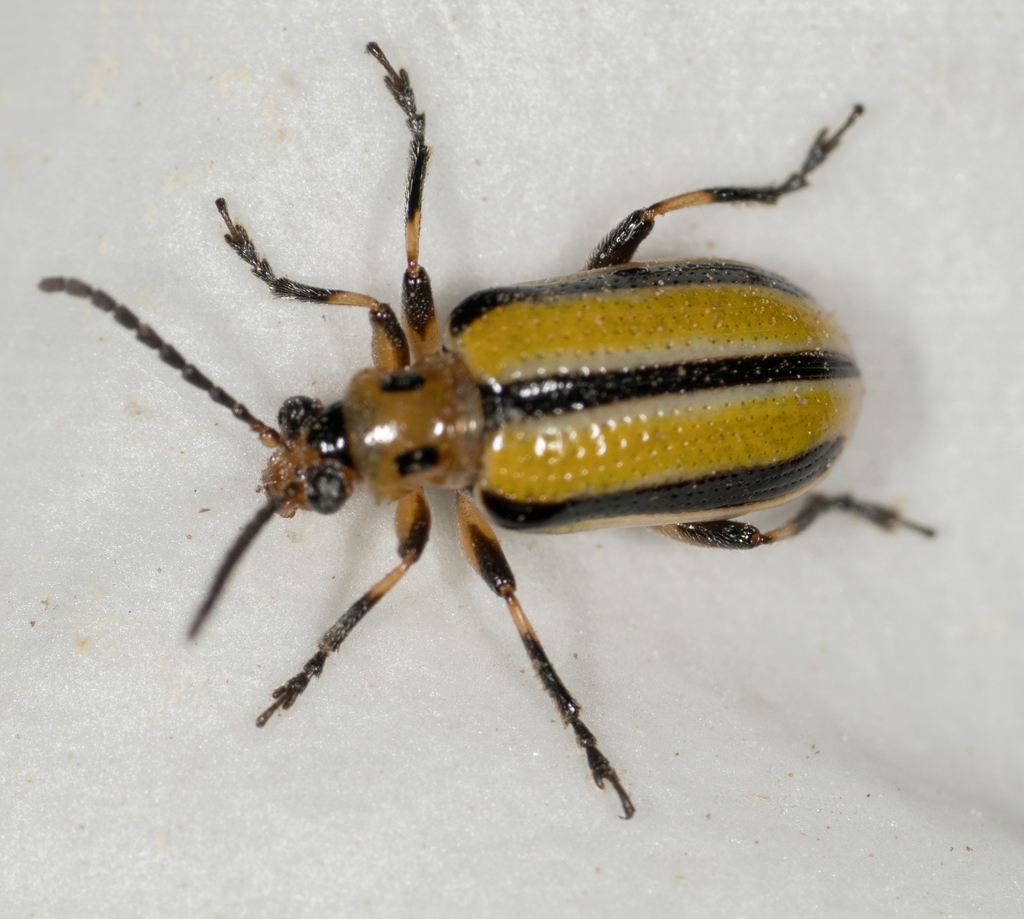
The three-lined lema beetle (Lema trivittata) is a small leaf beetle in the family Chrysomelidae, subfamily Criocerinae. Adults measure approximately 4-6 mm in length and display distinctive coloration with three longitudinal dark stripes running along yellowish or orange elytra (wing covers). The head and thorax are typically reddish-brown to orange, while the legs are yellow to orange. This species is part of the striped Lema complex and was historically confused with the closely related L. trilineata until taxonomic clarification by LeSage and Day (1979). Lema trivittata occurs across a broad range in North America, from southern Canada through much of the United States. In California, the species is distributed throughout the Central Valley, coastal ranges, and Sierra Nevada foothills. The beetle has been documented from sea level to moderate elevations, typically in agricultural areas, disturbed habitats, and natural grasslands where suitable host plants occur. This species inhabits diverse environments including agricultural fields, grasslands, roadsides, and disturbed areas. Adults and larvae are commonly found on plants in the family Solanaceae, particularly nightshades and related species. The beetles show a preference for open, sunny locations where host plants are abundant and accessible. Three-lined lema beetles are leaf feeders throughout their life cycle. Adults emerge in spring and feed on host plant foliage, creating characteristic shot-hole feeding damage. Females deposit yellow, elongated eggs in small clusters on leaf surfaces, typically on the undersides of leaves. Larvae are distinctive with their habit of covering themselves with their own excrement as protection from predators and desiccation, appearing as small, dark, slug-like creatures on leaf surfaces. This behavioral adaptation is characteristic of many Lema species. The larvae feed gregariously on leaf tissue, often skeletonizing leaves before pupating in the soil. The species typically completes one generation per year in most of its range, though multiple generations may occur in warmer climates. Lema trivittata is not currently listed under state or federal endangered species legislation and appears to maintain stable populations across its range. As a native herbivore, the species plays a role in natural ecosystem dynamics, though it can occasionally reach pest status on cultivated Solanaceae crops. The beetle's widespread distribution and apparent adaptability to various habitats suggest it faces no immediate conservation concerns. However, like many native insects, populations may be affected by habitat conversion, pesticide use in agricultural areas, and climate change impacts on host plant distributions. The species benefits from integrated pest management approaches that maintain natural enemy populations and reduce broad-spectrum insecticide applications.
Classification
Class: Insecta · Order: Coleoptera · Family: Chrysomelidae
Frequently asked questions
How is Lema trivittata classified?
Lema trivittata belongs to class Insecta, order Coleoptera, family Chrysomelidae.
What family does Lema trivittata belong to?
Lema trivittata is in the Chrysomelidae family.
What is Lema trivittata?
The three-lined lema beetle (Lema trivittata) is a small leaf beetle in the family Chrysomelidae, subfamily Criocerinae.
Is Lema trivittata found in California?
Yes. Lema trivittata is recorded in California in The California Species Project's catalogue.
Related species
Other California species in the same genus, family, or bioregion.
Data from The California Species Project — 14,000+ California species with verified data from CNPS, CDFW, USFWS, and more.