Lepidomeda vittata
Little Colorado spinedace
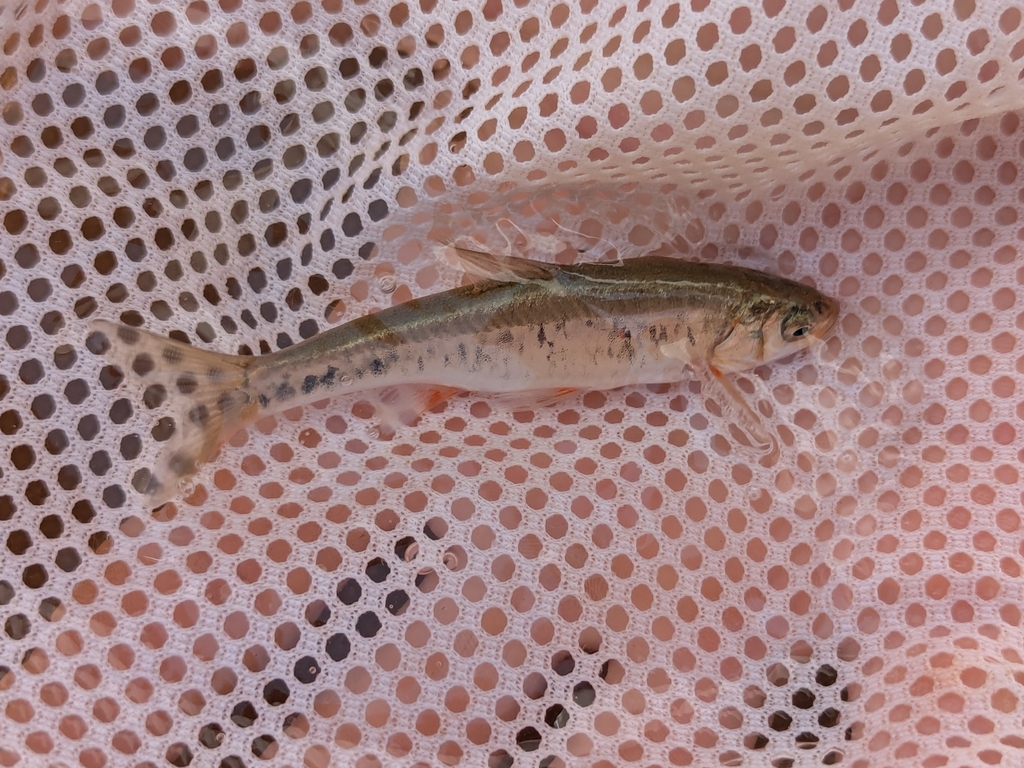
(c) colorful-corvid, some rights reserved (CC BY) · licence
Family: Leuciscidae · Class: Actinopterygii · Order: Cypriniformes
Conservation status: Threatened
Lepidomeda vittata (Little Colorado spinedace) is a California animal in the Leuciscidae family.
The Little Colorado spinedace is a small, silvery cyprinid fish measuring approximately 4 inches (10 cm) in total length. The species exhibits minimal sexual dimorphism, with both males and females displaying a characteristic silvery coloration typical of the spinedace genus. The body is elongated and streamlined, adapted for life in flowing waters. The Little Colorado spinedace is endemic to Arizona, with its range historically encompassing the northward-flowing tributaries of the Little Colorado River system, including the northern slopes of the White Mountains and tributaries along the Mogollon Rim. The U.S. Fish and Wildlife Service indicates that although few collections were documented prior to 1939, the species likely inhabited a broader range within these headwater systems. Currently, the species' distribution has become severely fragmented, with populations confined to disjunct locations within the East Clear Creek watershed, Chevelon Creek, and the upper Little Colorado River system in Apache, Navajo, and Coconino counties. The species inhabits cool, clear, flowing streams with moderate current velocity and stable substrates. These montane streams typically feature rocky bottoms with cobble and gravel, providing the flowing water conditions essential for the species' survival. The spinedace requires well-oxygenated water and appears to be sensitive to habitat modifications that alter natural flow regimes or increase sedimentation. Little Colorado spinedace are primarily insectivorous, feeding on aquatic invertebrates found in their stream habitats. Like other members of the Lepidomeda genus, they are adapted to the seasonal flow patterns of southwestern streams. Reproduction typically occurs during spring and early summer months when water conditions are optimal. The species exhibits schooling behavior and tends to occupy pool and riffle habitats within their stream systems. The U.S. Fish and Wildlife Service originally listed the Little Colorado spinedace as endangered in 1967, but reclassified it as threatened in 1987 with designated critical habitat covering approximately 2,405,000 acres. According to USFWS recovery reports, the species' population trend was listed as decreasing as of 2006. A recovery plan was finalized in 1998, with subsequent 5-year reviews conducted in 2008 and 2018 to assess recovery progress. Primary threats include habitat modification from water diversions, livestock grazing impacts, introduced species competition, and climate-related changes to stream flows. The species faces particular pressure from non-native fish species and crayfish, including the virile crayfish (Orconectes virilis), which may compete with or prey upon juvenile spinedace. Conservation efforts focus on habitat protection, flow maintenance, and non-native species control within critical habitat areas. The fragmented nature of current populations makes the species particularly vulnerable to local extirpations and reduces genetic connectivity between remaining populations.
Classification
Class: Actinopterygii · Order: Cypriniformes · Family: Leuciscidae
Conservation status
Threatened
Frequently asked questions
How is Lepidomeda vittata classified?
Lepidomeda vittata belongs to class Actinopterygii, order Cypriniformes, family Leuciscidae.
What family does Lepidomeda vittata belong to?
Lepidomeda vittata is in the Leuciscidae family.
Is Lepidomeda vittata protected or of conservation concern?
Lepidomeda vittata carries the following status: Threatened.
What is Lepidomeda vittata?
The Little Colorado spinedace is a small, silvery cyprinid fish measuring approximately 4 inches (10 cm) in total length.
Is Lepidomeda vittata found in California?
Yes. Lepidomeda vittata is recorded in California in The California Species Project's catalogue.
Related species
Other California species in the same genus, family, or bioregion.
Data from The California Species Project — 14,000+ California species with verified data from CNPS, CDFW, USFWS, and more.