Lepomis cyanellus
Green sunfish
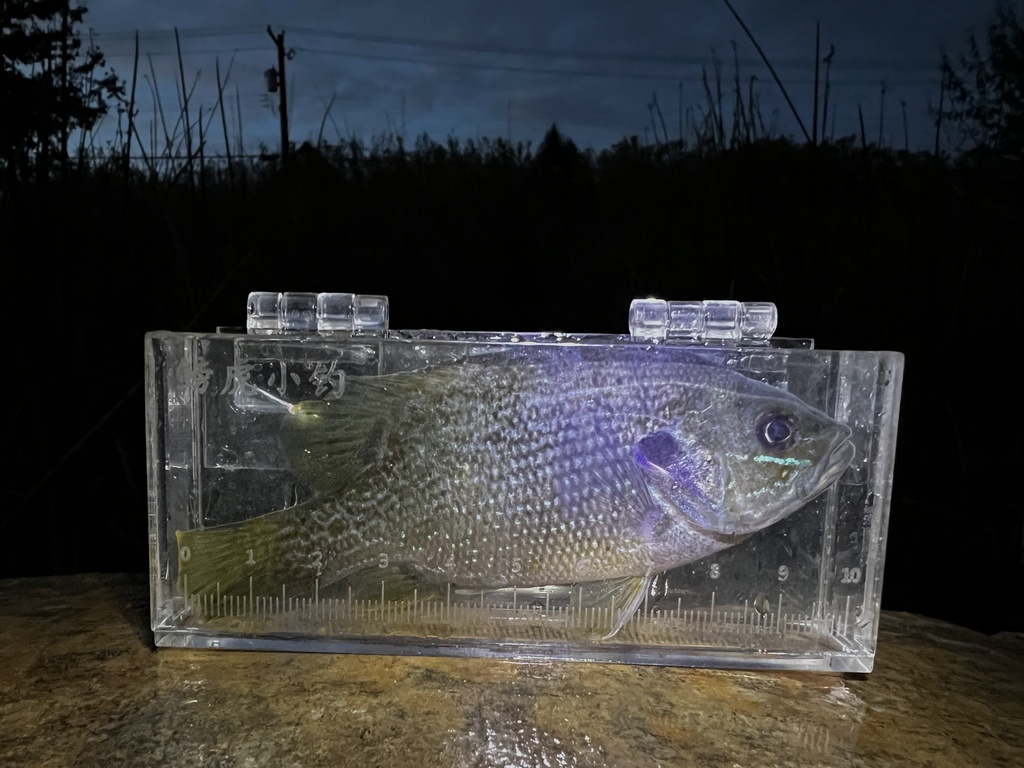
(c) Aiva Noringseth, some rights reserved (CC BY) · licence
Family: Centrarchidae · Class: Actinopterygii · Order: Perciformes
Lepomis cyanellus (Green sunfish) is a California animal in the Centrarchidae family.
The green sunfish is a small, robust freshwater fish native to central North America that has been widely introduced throughout California. Adults typically measure 76 to 152 mm (3 to 6 inches) in total length, though some individuals may reach 203 mm (8 inches). The species displays a laterally compressed, deep-bodied form characteristic of the sunfish family. The body exhibits olive-green to bluish-green coloration on the dorsal surface, transitioning to yellow-green or bronze on the sides. Dark vertical bars are often present along the flanks, though these may fade in older individuals. The opercular flap is black with a pale margin, and males develop bright orange or yellow margins on their fins during breeding season. Native to the Mississippi River basin and Great Lakes region, green sunfish have been extensively introduced across the western United States, including California. The species now occurs in numerous water bodies throughout the state, from the Central Valley to coastal drainages. Green sunfish have established populations in reservoirs, farm ponds, slow-moving streams, and irrigation canals across multiple counties. Their adaptability to diverse aquatic environments has facilitated their widespread distribution beyond their historical range. Green sunfish inhabit warm, shallow waters with moderate to heavy vegetation. The species tolerates a wide range of water conditions, including elevated temperatures, low dissolved oxygen levels, and high turbidity that would stress many native fish species. They prefer areas with sand, gravel, or mud substrates and are commonly found near aquatic vegetation, submerged logs, or other cover structures. Green sunfish can survive in water temperatures ranging from near freezing to 38°C (100°F) and tolerate salinity levels up to 17 parts per thousand. This opportunistic predator feeds on aquatic insects, small crustaceans, fish eggs, small fish, and occasionally plant material. Juveniles primarily consume zooplankton and small invertebrates, while adults take larger prey including crayfish and small fish. Spawning occurs from late spring through summer when water temperatures reach 16 to 27°C (60 to 80°F). Males construct circular nests in shallow water by clearing vegetation and debris from sandy or gravelly substrates. Females deposit 2,000 to 26,000 adhesive eggs in these nests, which males guard until fry disperse. Green sunfish may hybridize with other Lepomis species, producing fertile offspring. Green sunfish are not protected under federal or California state law and are considered a non-native species in California waters. Their introduction and establishment may impact native fish communities through competition for food and habitat resources. The species' tolerance for degraded water conditions and aggressive behavior toward other fish has raised concerns among fisheries biologists. Management efforts focus on preventing further introductions and protecting native fish habitat rather than controlling established green sunfish populations.
Classification
Class: Actinopterygii · Order: Perciformes · Family: Centrarchidae
Frequently asked questions
How is Lepomis cyanellus classified?
Lepomis cyanellus belongs to class Actinopterygii, order Perciformes, family Centrarchidae.
What family does Lepomis cyanellus belong to?
Lepomis cyanellus is in the Centrarchidae family.
What is Lepomis cyanellus?
The green sunfish is a small, robust freshwater fish native to central North America that has been widely introduced throughout California.
Is Lepomis cyanellus found in California?
Yes. Lepomis cyanellus is recorded in California in The California Species Project's catalogue.
Related species
Other California species in the same genus, family, or bioregion.
Data from The California Species Project — 14,000+ California species with verified data from CNPS, CDFW, USFWS, and more.