Lepomis gulosus
W&mouth
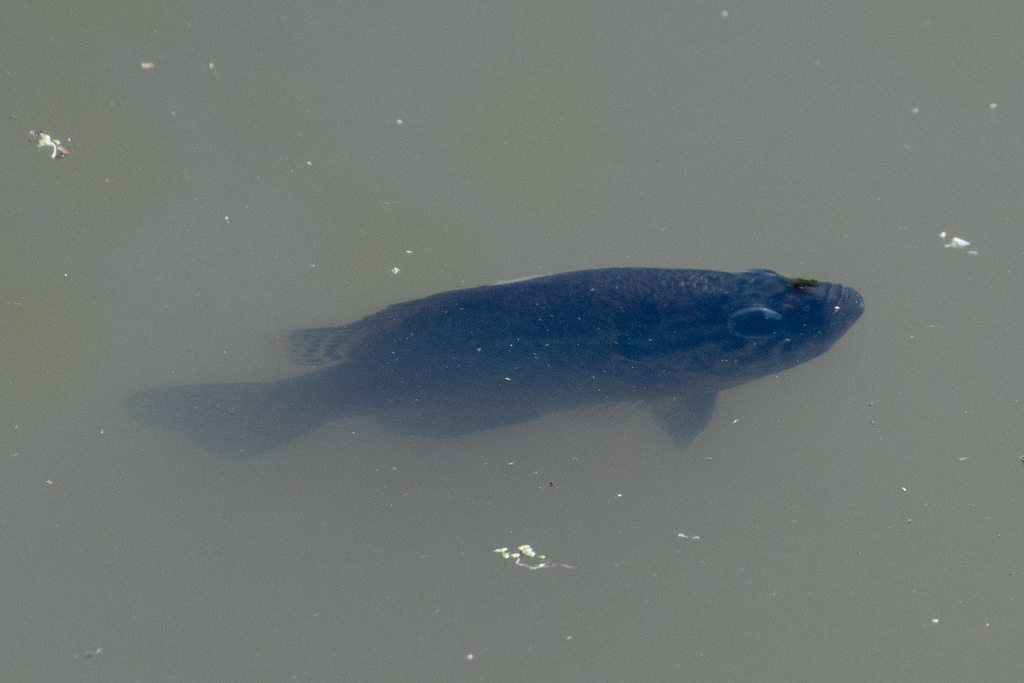
(c) Jonathan Eisen, some rights reserved (CC BY) · licence
Family: Centrarchidae · Class: Actinopterygii · Order: Perciformes
Lepomis gulosus (W&mouth) is a California animal in the Centrarchidae family.
The warmouth (Lepomis gulosus) is a medium-sized freshwater fish in the sunfish family Centrarchidae. Adults typically measure 15 to 25 cm (6 to 10 inches) in total length, with maximum sizes reaching 31 cm (12 inches). The body is deep and laterally compressed with a relatively large mouth extending to or beyond the rear edge of the eye, distinguishing it from other sunfish species. The warmouth displays an olive-brown to golden-brown coloration on the dorsal surface, fading to yellow-green or bronze on the sides. Dark brown to black vertical bars or mottled patterns are present along the body, particularly in juveniles. The gill cover features three to five reddish-brown streaks radiating from the eye, and a dark spot is typically present on the posterior margin of the gill cover. The dorsal fin contains 10 spines and 9 to 10 soft rays, while the anal fin has 3 spines and 8 to 9 soft rays. Native to the southeastern United States, the warmouth's natural range extends from the Great Lakes region south through the Mississippi River basin to the Gulf Coast states, and east to the Atlantic coastal plain from Virginia to Florida. In California, warmouth are non-native and were introduced through unauthorized releases. According to the California Department of Fish and Wildlife, established populations exist in scattered locations throughout the state, primarily in the Central Valley, Southern California, and some coastal drainages. The species has been documented in the Sacramento-San Joaquin Delta, various Central Valley reservoirs, and several Southern California water bodies. Warmouth inhabit shallow, warm waters with abundant vegetation and soft substrates. They prefer quiet backwaters, oxbow lakes, ponds, and slow-moving sections of streams and rivers. The species thrives in areas with submerged and emergent aquatic vegetation, fallen timber, and other structural cover. Warmouth tolerate turbid water conditions and can survive in habitats with relatively low dissolved oxygen levels compared to other sunfish species. They are typically found at depths less than 3 meters (10 feet) and prefer water temperatures between 20 to 30 degrees Celsius (68 to 86 degrees Fahrenheit). Warmouth are opportunistic predators with a diet consisting primarily of aquatic invertebrates, small fish, and amphibian larvae. Juveniles feed extensively on zooplankton, insect larvae, and small crustaceans, while adults consume larger prey including crayfish, worms, mollusks, and fish up to one-third their own body length. Spawning occurs from April through August when water temperatures reach 18 to 21 degrees Celsius (64 to 70 degrees Fahrenheit). Males construct circular nests in shallow water with sandy or gravelly bottoms, often near vegetation or other cover. Females deposit 5,000 to 126,000 eggs depending on body size, which the male guards until hatching occurs in 2 to 5 days. As a non-native species in California, warmouth are not protected and are considered an introduced species that may compete with native fish communities. The California Department of Fish and Wildlife monitors their distribution and abundance as part of broader aquatic ecosystem assessments. While not considered highly invasive, their presence may impact native fish species through competition for food and habitat resources.
Classification
Class: Actinopterygii · Order: Perciformes · Family: Centrarchidae
Frequently asked questions
How is Lepomis gulosus classified?
Lepomis gulosus belongs to class Actinopterygii, order Perciformes, family Centrarchidae.
What family does Lepomis gulosus belong to?
Lepomis gulosus is in the Centrarchidae family.
What is Lepomis gulosus?
The warmouth (Lepomis gulosus) is a medium-sized freshwater fish in the sunfish family Centrarchidae.
Is Lepomis gulosus found in California?
Yes. Lepomis gulosus is recorded in California in The California Species Project's catalogue.
Related species
Other California species in the same genus, family, or bioregion.
Data from The California Species Project — 14,000+ California species with verified data from CNPS, CDFW, USFWS, and more.