Lepomis macrochirus
Bluegill
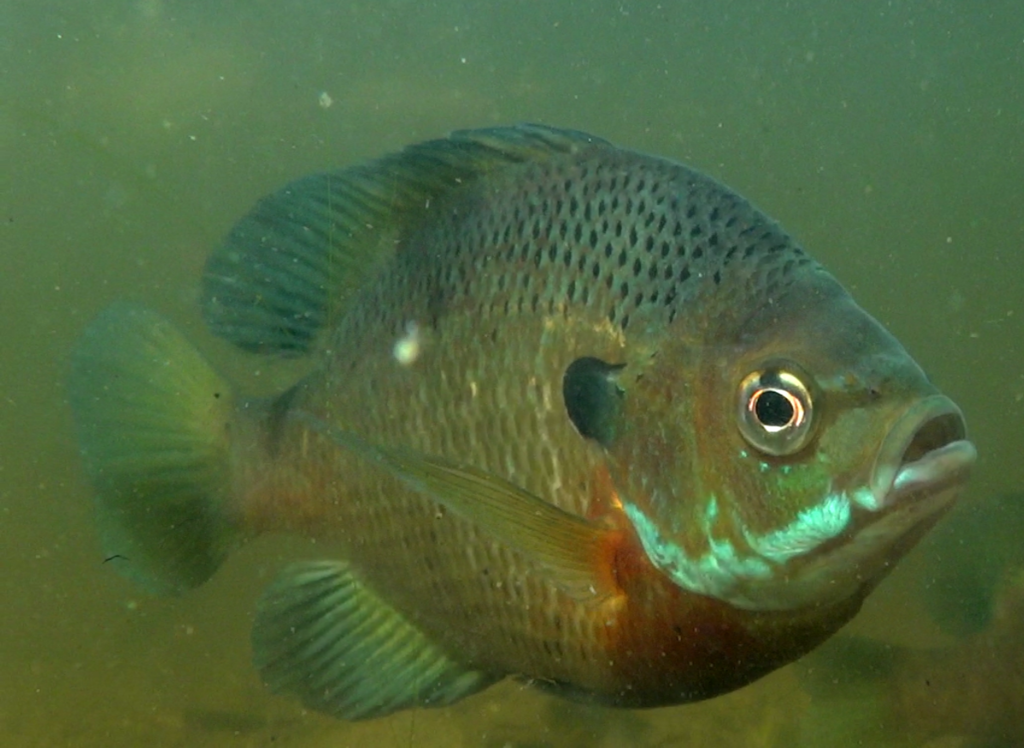
(c) Kristiina Hurme, some rights reserved (CC BY) · licence
Family: Centrarchidae · Class: Actinopterygii · Order: Perciformes
Lepomis macrochirus (Bluegill) is a California animal in the Centrarchidae family.
The bluegill is a freshwater fish native to eastern North America, widely introduced throughout California and much of the western United States. Adults typically measure 15 to 25 cm (6 to 10 inches) in total length, though individuals can reach up to 30 cm (12 inches). The body is laterally compressed and deep, with a small mouth that does not extend past the eye. Coloration varies with age, sex, and breeding condition. Adult males during spawning season develop vibrant orange-red breasts and bellies, while females and non-breeding males display more subdued olive-green to blue-gray coloration. The species is distinguished by a distinctive dark blue or black opercular flap and faint vertical bars along the sides. Bluegill are now established in suitable freshwater habitats throughout California, from the Central Valley to mountain lakes and reservoirs at elevations up to approximately 2,000 meters (6,500 feet). The species has been widely stocked in California waters since the early 1900s and is considered naturalized throughout the state. They are found in virtually every county where suitable freshwater habitat exists, including the Sacramento-San Joaquin Delta, Sierra Nevada foothill reservoirs, and coastal watersheds. The species inhabits warm, shallow areas of lakes, ponds, reservoirs, and slow-moving streams with abundant vegetation or structure. Bluegill prefer areas with soft substrates and emergent or submerged vegetation that provide cover and foraging opportunities. They typically occupy depths of 1 to 6 meters (3 to 20 feet) but may move to deeper water during winter months. Water temperatures between 18 to 24°C (65 to 75°F) are optimal for growth and reproduction. Bluegill are opportunistic omnivores, feeding on aquatic insects, small crustaceans, worms, plant matter, and small fish. Juveniles consume primarily zooplankton and small invertebrates. The species exhibits complex social and reproductive behaviors. Males construct circular nests in shallow water during spring and early summer, typically when water temperatures reach 18 to 21°C (65 to 70°F). Females may deposit 2,000 to 60,000 eggs per spawning event, depending on size and condition. Males guard nests aggressively and provide parental care until fry disperse. Bluegill can live up to 10 years and reach sexual maturity at 2 to 3 years of age. Bluegill are not listed under federal or California endangered species legislation and are considered a common, widespread species throughout their introduced range in California. Population levels are generally stable or increasing in most waters. As a non-native species, bluegill can impact native fish communities through competition for food and habitat, particularly affecting native sunfish species in areas where they co-occur. The species supports significant recreational fisheries throughout California and is actively managed by the California Department of Fish and Wildlife through stocking programs and harvest regulations. Climate change may favor bluegill expansion into higher elevation waters as temperatures increase.
Classification
Class: Actinopterygii · Order: Perciformes · Family: Centrarchidae
Frequently asked questions
How is Lepomis macrochirus classified?
Lepomis macrochirus belongs to class Actinopterygii, order Perciformes, family Centrarchidae.
What family does Lepomis macrochirus belong to?
Lepomis macrochirus is in the Centrarchidae family.
What is Lepomis macrochirus?
The bluegill is a freshwater fish native to eastern North America, widely introduced throughout California and much of the western United States.
Is Lepomis macrochirus found in California?
Yes. Lepomis macrochirus is recorded in California in The California Species Project's catalogue.
Related species
Other California species in the same genus, family, or bioregion.
Data from The California Species Project — 14,000+ California species with verified data from CNPS, CDFW, USFWS, and more.