Leptoglossus clypealis
Western Leaf-footed Bug
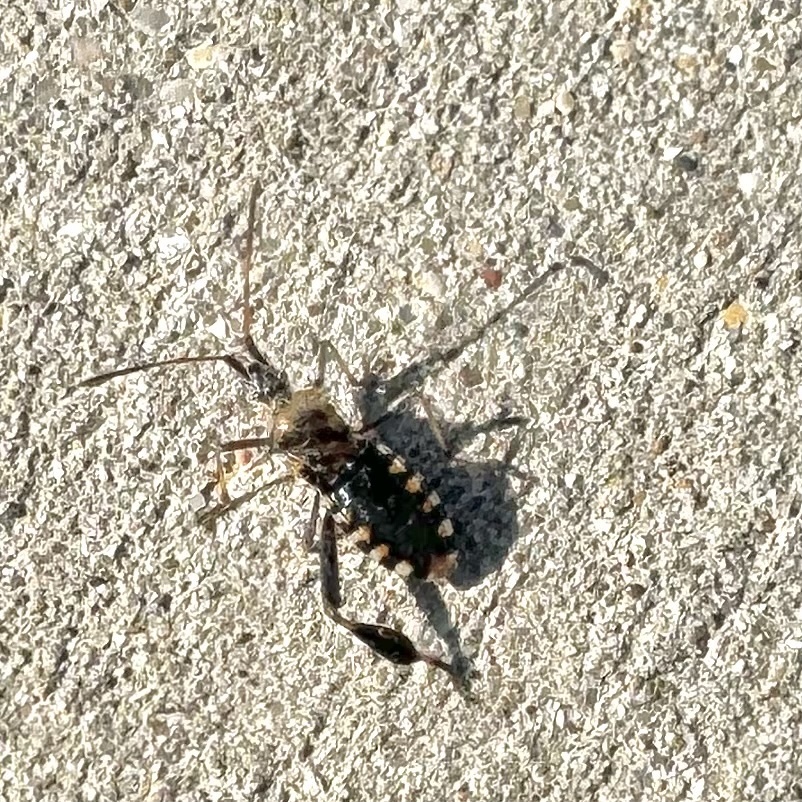
(c) Trey Philips, some rights reserved (CC BY) · licence
Family: Coreidae · Class: Insecta · Order: Hemiptera
Leptoglossus clypealis (Western Leaf-footed Bug) is a California animal in the Coreidae family.
The Western Leaf-footed Bug (Leptoglossus clypealis) is a medium-sized true bug in the family Coreidae, measuring 15-20 mm (0.6-0.8 inches) in length. Adults display a brownish-gray to dark brown coloration with distinctive enlarged, leaf-like expansions on the hind tibiae that give the species its common name. The body is elongated and somewhat flattened, with a prominent head bearing long, four-segmented antennae. The forewings are partially membranous, and when at rest, they overlap to form an X-pattern across the back. A pale yellow to cream-colored stripe often extends along the outer edges of the forewings and pronotum. This species occurs throughout much of western North America, with its range extending from British Columbia south through California, Arizona, and into Mexico. In California, L. clypealis is distributed from the coastal regions through the Central Valley and into the Sierra Nevada foothills, typically found at elevations ranging from sea level to approximately 1,500 meters (4,900 feet). The species is most commonly encountered in the southern two-thirds of the state. Western Leaf-footed Bugs inhabit a variety of open habitats including grasslands, agricultural areas, gardens, and edge environments between different vegetation types. They show a preference for areas with abundant flowering plants and are frequently found in association with composite flowers, particularly sunflowers and other members of the Asteraceae family. The species also occurs in riparian zones, oak woodlands, and chaparral communities where suitable host plants are present. As piercing-sucking insects, Western Leaf-footed Bugs feed primarily on plant juices extracted from seeds, fruits, and developing plant tissues. Adults use their needle-like mouthparts to penetrate plant materials and consume the internal fluids. They are particularly attracted to the seeds of sunflowers, but also feed on various other plants including pomegranate, citrus, almonds, and numerous wild species. The bugs are most active during warm daylight hours and exhibit strong flight capabilities, allowing them to move between host plants efficiently. Reproduction typically occurs during spring and summer months, with females laying clusters of barrel-shaped eggs on host plant stems and leaves. Leptoglossus clypealis is not currently listed under federal or state endangered species legislation and appears to maintain stable populations throughout most of its range. The species has likely benefited from agricultural practices that provide abundant host plants, particularly in areas with extensive sunflower cultivation. However, like many insects, local populations may be affected by pesticide applications and habitat modification. The Western Leaf-footed Bug occasionally becomes a minor agricultural pest when populations reach high densities on crop plants, though it rarely causes significant economic damage. Climate change may potentially affect the species' distribution and seasonal activity patterns, though specific impacts have not been well documented.
Classification
Class: Insecta · Order: Hemiptera · Family: Coreidae
Frequently asked questions
How is Leptoglossus clypealis classified?
Leptoglossus clypealis belongs to class Insecta, order Hemiptera, family Coreidae.
What family does Leptoglossus clypealis belong to?
Leptoglossus clypealis is in the Coreidae family.
What is Leptoglossus clypealis?
The Western Leaf-footed Bug (Leptoglossus clypealis) is a medium-sized true bug in the family Coreidae, measuring 15-20 mm (0.6-0.8 inches) in length.
Is Leptoglossus clypealis found in California?
Yes. Leptoglossus clypealis is recorded in California in The California Species Project's catalogue.
Related species
Other California species in the same genus, family, or bioregion.
Data from The California Species Project — 14,000+ California species with verified data from CNPS, CDFW, USFWS, and more.