Leptoglossus occidentalis
Western Conifer Seed Bug
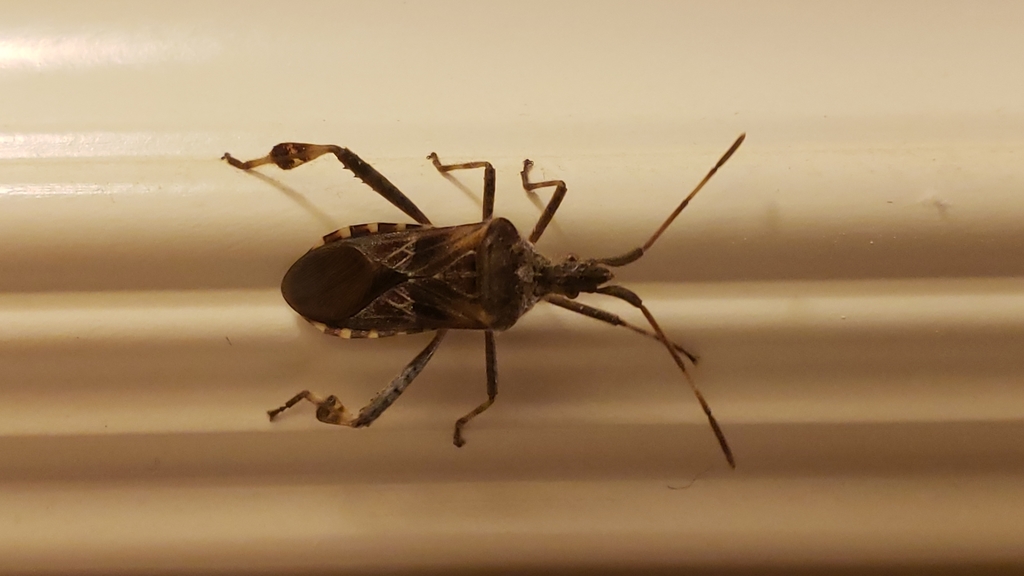
(c) Gavin Slater, some rights reserved (CC BY) · licence
Family: Coreidae · Class: Insecta · Order: Hemiptera
Leptoglossus occidentalis (Western Conifer Seed Bug) is a California animal in the Coreidae family.
The Western Conifer Seed Bug is a moderately large true bug measuring 15-20 mm (0.6-0.8 inches) in length. Adults display a dull reddish-brown coloration with a faint or sometimes absent white zigzag stripe across the forewings (hemelytra). The antennae may reach nearly the length of the body, and the species is distinguished by its characteristic leaf-footed bug appearance, with dilated hind tibiae where the outer and inner dilations are nearly equal in length (BugGuide 2025). Originally native to western North America, Leptoglossus occidentalis has dramatically expanded its range and is now widely distributed across much of North America except the southeastern United States. The species has also been introduced to Europe where it has become widely established (BugGuide 2025). In California, this bug occurs throughout coniferous regions of the state. Western Conifer Seed Bugs inhabit coniferous forests and are closely associated with cone-bearing trees. They are particularly abundant in areas with Douglas fir, pines, and other conifers. Adults often wander indoors during late fall and winter while seeking sheltered locations to overwinter, making them a common household nuisance pest during these seasons (BugGuide 2025). As their name suggests, these bugs are seed predators that feed primarily on developing conifer seeds within cones. They use their piercing-sucking mouthparts to extract seed contents, causing significant damage to cone crops. The species has been documented as a serious pest of Douglas fir seed production in California (BugGuide 2025). Adults are capable of flight and actively seek out cone-bearing trees during the reproductive season. The species exhibits typical hemipteran development with incomplete metamorphosis, passing through egg, multiple nymphal instars, and adult stages. The Western Conifer Seed Bug holds no special conservation status and is considered a common species throughout its range. Rather than requiring protection, this species is often considered an agricultural pest due to its impact on commercial seed production. In studies of whitebark pine seed production, L. occidentalis was identified as one of the most significant seed predators, damaging up to 27 percent of seeds across study sites, with seed bug damage reaching 2.7 percent of extracted seeds in California specifically (USFWS California Whitebark Pine Conservation Strategy). The species' ability to colonize new regions and its adaptability to various coniferous hosts suggest stable or expanding populations. Climate change and forest management practices may influence future distribution patterns, but current evidence indicates this species is well-established and thriving across its expanded range. The bug's tendency to aggregate in buildings during winter months brings it into frequent contact with humans, though it poses no direct threat to human health or structures.
Classification
Class: Insecta · Order: Hemiptera · Family: Coreidae
Frequently asked questions
How is Leptoglossus occidentalis classified?
Leptoglossus occidentalis belongs to class Insecta, order Hemiptera, family Coreidae.
What family does Leptoglossus occidentalis belong to?
Leptoglossus occidentalis is in the Coreidae family.
What is Leptoglossus occidentalis?
The Western Conifer Seed Bug is a moderately large true bug measuring 15-20 mm (0.6-0.8 inches) in length.
Is Leptoglossus occidentalis found in California?
Yes. Leptoglossus occidentalis is recorded in California in The California Species Project's catalogue.
Related species
Other California species in the same genus, family, or bioregion.
Data from The California Species Project — 14,000+ California species with verified data from CNPS, CDFW, USFWS, and more.