Leptoglossus zonatus
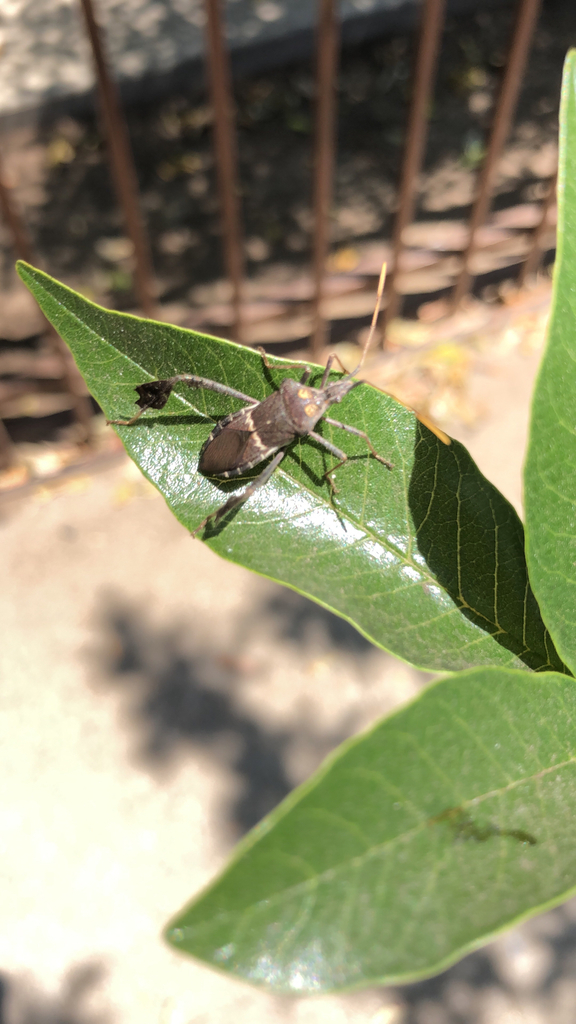
(c) Patrick McMabell, some rights reserved (CC BY) · licence
Family: Coreidae · Class: Insecta · Order: Hemiptera
Leptoglossus zonatus is a California animal in the Coreidae family.
Leptoglossus zonatus is a species of leaf-footed bug in the family Coreidae, commonly known as the western leaf-footed bug. Adults measure approximately 20 mm (0.8 inches) in length and display a gray body coloration. The species is distinguished by a characteristic zigzagging whitish band across the dorsal surface and two distinctive yellowish spots on the anterior pronotum, which serve as the primary identifying features (BugGuide). Like other members of the genus Leptoglossus, this species possesses enlarged hind tibiae that are flattened and leaf-like in appearance, giving the family its common name. Leptoglossus zonatus has an extensive range throughout the Americas, occurring from South America through Central America and Mexico into the southwestern United States. Within the United States, the species is documented from the southwestern states, with populations extending into California. The species' broad distribution reflects its adaptability to various climatic conditions across diverse geographic regions. This leaf-footed bug inhabits a variety of environments throughout its range, from tropical and subtropical regions in its southern distribution to more temperate areas in the northern portions of its range. The species shows considerable habitat flexibility, occurring in agricultural areas, gardens, natural vegetation, and disturbed habitats. Adults and nymphs are commonly found on host plants where they feed and complete their development. As a member of the Coreidae, L. zonatus is a plant-feeding species that uses piercing-sucking mouthparts to extract plant fluids. The species feeds on a variety of host plants, though specific host plant relationships and preferences require further documentation. Like other leaf-footed bugs, reproduction involves direct development with multiple nymphal stages before reaching adulthood. Adults are capable of flight and may disperse considerable distances to locate suitable host plants and mates. The species likely has multiple generations per year in warmer portions of its range, with overwintering adults emerging in spring to initiate breeding activity. Leptoglossus zonatus does not currently hold any special conservation status at the federal or state level. The species appears to maintain stable populations throughout its range and may benefit from agricultural and urban environments that provide suitable host plants. As with many widespread insects, population trends and specific conservation needs have not been thoroughly assessed. The species' broad distribution and apparent habitat flexibility suggest it is not currently facing significant conservation concerns. Scientific documentation for this species remains limited in some aspects of its biology and ecology. The information presented here is based on available sources including BugGuide and iNaturalist observations. If you have additional verified information about this species' host plant relationships, detailed life history, or ecological interactions, please contact us to help improve this species account.
Classification
Class: Insecta · Order: Hemiptera · Family: Coreidae
Frequently asked questions
How is Leptoglossus zonatus classified?
Leptoglossus zonatus belongs to class Insecta, order Hemiptera, family Coreidae.
What family does Leptoglossus zonatus belong to?
Leptoglossus zonatus is in the Coreidae family.
What is Leptoglossus zonatus?
Leptoglossus zonatus is a species of leaf-footed bug in the family Coreidae, commonly known as the western leaf-footed bug.
Is Leptoglossus zonatus found in California?
Yes. Leptoglossus zonatus is recorded in California in The California Species Project's catalogue.
Related species
Other California species in the same genus, family, or bioregion.
Data from The California Species Project — 14,000+ California species with verified data from CNPS, CDFW, USFWS, and more.