Leptogorgia chilensis
Red gorgonian
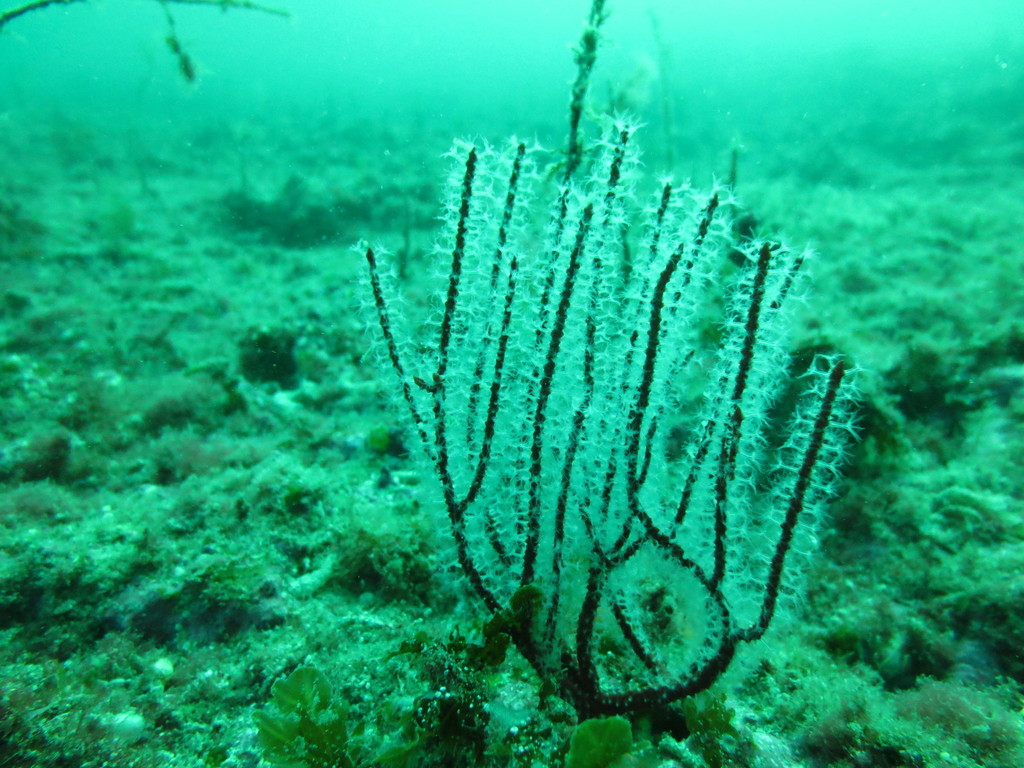
(c) Chris Teague, some rights reserved (CC BY) · licence
Family: Gorgoniidae · Class: Anthozoa · Order: Alcyonacea
Leptogorgia chilensis (Red gorgonian) is a California animal in the Gorgoniidae family.
The red gorgonian (Leptogorgia chilensis) is a colonial marine cnidarian belonging to the soft coral family Gorgoniidae. This octocoral forms branching, tree-like colonies with thin, moderately branched structures that display characteristic orange-red coloration. Individual polyps are white and measure approximately 1 millimeter in diameter, extending from the colony's flexible branches to capture planktonic prey. Leptogorgia chilensis occurs along the Pacific coast from north of Magdalena Bay, Baja California, to Santa Cruz Island, California. According to the Sanctuary Integrated Monitoring Network, central California represents the northern range limit for this species, which is more commonly found in southern California waters. The species has been documented in several California Marine Protected Areas, including waters near Painted Cave State Marine Conservation Area, Mattole Canyon State Marine Reserve, and around the Channel Islands. This gorgonian inhabits rocky reef environments at depths ranging from approximately 15 to 80 meters, though it has been observed at depths approaching 1,650 feet in submarine canyon systems like Mattole Canyon. The species typically occurs in areas with cold, nutrient-rich waters subject to seasonal upwelling. Red gorgonians attach to hard substrates on rocky seafloor habitats, often in areas where sandy bottom gives way to rocky reef systems. They are commonly found alongside other sessile invertebrates in diverse benthic communities. As suspension feeders, red gorgonians extend their polyps to capture zooplankton, small organic particles, and dissolved nutrients from the water column. The branching colony structure maximizes surface area for feeding while allowing water flow through the colony. Like other gorgonians, L. chilensis likely reproduces through both sexual reproduction, releasing gametes into the water column, and asexual reproduction through fragmentation. The colonies provide habitat structure for other marine organisms, with research documenting fish associations within one body length of individual colonies. Red gorgonians face threats common to deep-sea coral communities, including fishing gear impacts, pollution, and climate change effects such as ocean acidification and warming temperatures. The cold, deep waters they inhabit experience less temperature variation than shallow reefs, but are still vulnerable to changing ocean chemistry. Their presence in Marine Protected Areas along the California coast provides some protection from direct human impacts like trawling and anchor damage. However, as sessile organisms with likely slow growth rates typical of deep-sea corals, recovery from disturbances may be prolonged. The species' role in providing three-dimensional habitat structure makes it ecologically important for maintaining biodiversity in rocky reef communities. Current population status and trends for L. chilensis have not been comprehensively assessed, reflecting the general lack of long-term monitoring data for deep-sea coral species.
Classification
Class: Anthozoa · Order: Alcyonacea · Family: Gorgoniidae
Frequently asked questions
How is Leptogorgia chilensis classified?
Leptogorgia chilensis belongs to class Anthozoa, order Alcyonacea, family Gorgoniidae.
What family does Leptogorgia chilensis belong to?
Leptogorgia chilensis is in the Gorgoniidae family.
What is Leptogorgia chilensis?
The red gorgonian (Leptogorgia chilensis) is a colonial marine cnidarian belonging to the soft coral family Gorgoniidae.
Is Leptogorgia chilensis found in California?
Yes. Leptogorgia chilensis is recorded in California in The California Species Project's catalogue.
Related species
Other California species in the same genus, family, or bioregion.
Data from The California Species Project — 14,000+ California species with verified data from CNPS, CDFW, USFWS, and more.