Leptotes marina
Marine Blue
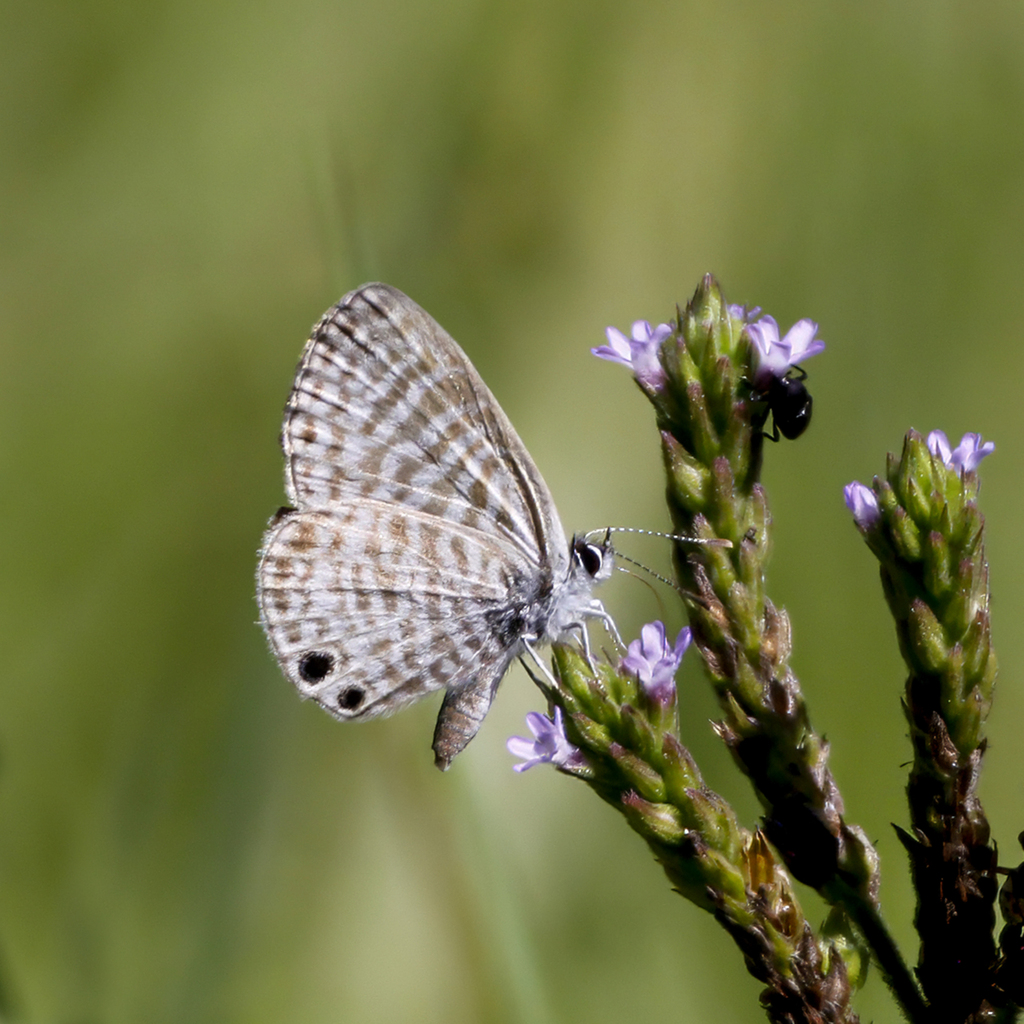
(c) Dan Vickers, some rights reserved (CC BY) · licence
Family: Lycaenidae · Class: Insecta · Order: Lepidoptera
Leptotes marina (Marine Blue) is a California animal in the Lycaenidae family.
The Marine Blue (Leptotes marina) is a small butterfly in the family Lycaenidae, characterized by its compact size and distinctive wing patterns. Adults have a wingspan ranging from 19 to 25 mm (0.75 to 1.0 inches). Males display bright blue dorsal wing surfaces with narrow dark borders, while females show brown to grayish-brown dorsal coloration with blue scaling limited to the wing bases. The ventral surfaces of both sexes are grayish-white with distinctive black spots and short, thread-like tails on the hindwings. The species can be distinguished from similar blues by the presence of orange marginal spots on the hindwing undersurfaces and the characteristic tail projections. The Marine Blue's native range extends across southern California eastward through the southwestern United States, Mexico, and Baja California south to Guatemala. Within California, the species occurs primarily in the southern counties, including San Diego, Orange, Riverside, Imperial, and southern portions of Los Angeles and San Bernardino counties. The species demonstrates extensive dispersal ability, with individuals regularly wandering far beyond the breeding range and temporarily colonizing areas as distant as Wisconsin, Indiana, Kentucky, and Louisiana. These northern populations typically cannot survive winter conditions and represent temporary range extensions. Marine Blues inhabit diverse environments from sea level to elevations of approximately 1,220 meters (4,000 feet). The species occupies disturbed areas, agricultural lands, desert washes, chaparral margins, urban gardens, and coastal sage scrub. Adults are particularly common in areas where host plants grow abundantly, including irrigated agricultural fields, residential landscapes, and naturally occurring legume communities. This multivoltine species produces multiple generations annually in favorable conditions, with continuous broods in warmer regions. Adults are active year-round in southern California, with peak abundance typically occurring from March through November. Females deposit small, white eggs singly on host plant buds, flowers, or young leaves. Larvae develop through five instars over approximately 20 to 30 days, feeding primarily on flowers, developing seeds, and tender foliage. The species utilizes an exceptionally broad range of host plants, including leadwort (Plumbago) and numerous legumes such as alfalfa (Medicago sativa), various milkvetch species (Astragalus), and mesquite (Prosopis). This polyphagous feeding strategy contributes to the species' ecological success and dispersal ability. The Marine Blue is not federally or state-listed and maintains stable populations throughout its core range. The species benefits from agricultural practices and landscaping that provide abundant leguminous host plants. Climate change may facilitate range expansion northward, as warmer temperatures could allow temporary populations to establish in previously unsuitable regions. Urban development and intensive agriculture can both positively and negatively impact local populations, depending on the availability of suitable host plants and nectar sources.
Classification
Class: Insecta · Order: Lepidoptera · Family: Lycaenidae
Frequently asked questions
How is Leptotes marina classified?
Leptotes marina belongs to class Insecta, order Lepidoptera, family Lycaenidae.
What family does Leptotes marina belong to?
Leptotes marina is in the Lycaenidae family.
What is Leptotes marina?
The Marine Blue (Leptotes marina) is a small butterfly in the family Lycaenidae, characterized by its compact size and distinctive wing patterns.
Is Leptotes marina found in California?
Yes. Leptotes marina is recorded in California in The California Species Project's catalogue.
Related species
Other California species in the same genus, family, or bioregion.
Data from The California Species Project — 14,000+ California species with verified data from CNPS, CDFW, USFWS, and more.