Lepus americanus
Snowshoe Hare
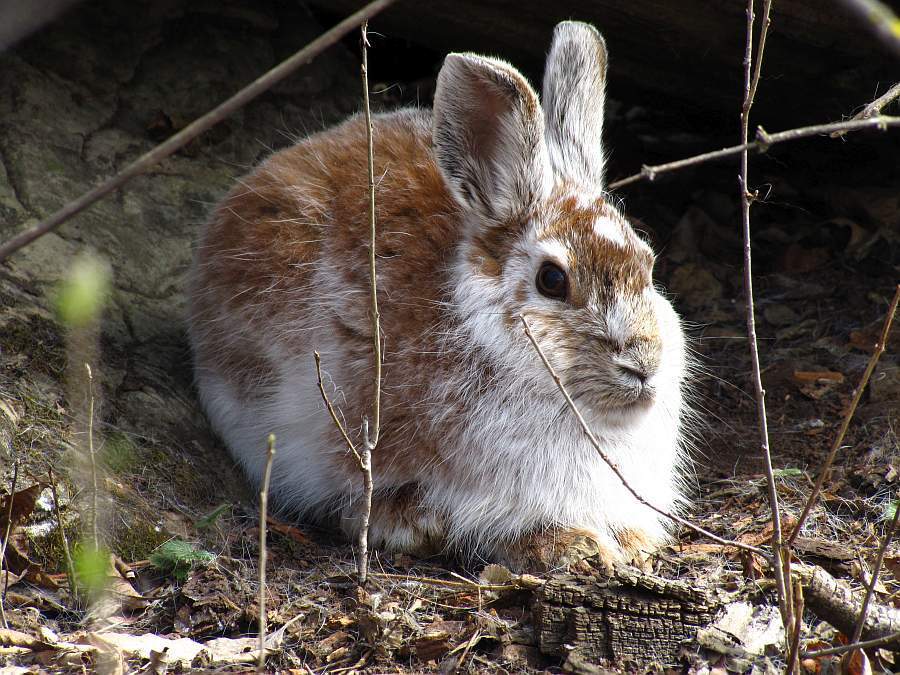
(c) christine123, some rights reserved (CC BY) · licence
Family: Leporidae · Class: Mammalia · Order: Lagomorpha
Lepus americanus (Snowshoe Hare) is a California animal in the Leporidae family.
The snowshoe hare is a medium-sized lagomorph weighing 1.3 to 1.8 kg (2.9 to 4.0 pounds) with a body length of 36 to 52 cm (14 to 20 inches). The species exhibits dramatic seasonal pelage changes: summer coats are rusty to grayish brown with white undersides, while winter coats are entirely white except for black-tipped ears. The hind feet are exceptionally large, measuring 12 to 15 cm (4.7 to 5.9 inches) in length, with dense fur and spreading toes that function as natural snowshoes. Ears are shorter relative to body size compared to other Lepus species, measuring 6 to 10 cm (2.4 to 3.9 inches). Snowshoe hares have a transcontinental range across boreal and montane forests of North America. In California, populations are restricted to high-elevation coniferous forests in the Sierra Nevada, Cascade Range, and isolated mountain ranges in the northeast. The species occurs primarily above 1,500 meters (4,900 feet) elevation, with most California populations found between 1,800 and 3,000 meters (5,900 to 9,800 feet). Historical records document populations in the San Bernardino Mountains, though current status there remains uncertain. Snowshoe hares inhabit dense coniferous and mixed forests dominated by fir, spruce, pine, and hemlock. Critical habitat features include dense understory vegetation for cover, including shrubs such as willow, alder, and serviceberry. The species requires areas with substantial snow accumulation, as their large feet and white winter pelage are evolutionary adaptations to deep snow environments. Populations utilize forest edges, clearings, and areas of regenerating forest following disturbance. Snowshoe hares are primarily crepuscular, most active during dawn and dusk hours. Summer diet consists of grasses, forbs, and leaves of deciduous shrubs and trees. Winter feeding shifts to twigs, buds, and bark of woody plants including willow, aspen, and conifer species. Breeding occurs from March through August, with females producing two to four litters annually. Gestation lasts 35 to 37 days, with litter sizes ranging from one to seven leverets, typically averaging three to four. Leverets are precocial, born fully furred with open eyes. Population densities fluctuate dramatically on 8 to 11-year cycles, particularly in northern portions of the range. In California, snowshoe hares are not federally or state listed but face conservation challenges from climate change and habitat fragmentation. Warming temperatures threaten to reduce suitable high-elevation habitat and disrupt the timing of seasonal coat color changes with snow cover. Forest management practices that eliminate dense understory vegetation reduce habitat quality. California populations represent the southern extent of the species' range and may be particularly vulnerable to climate-driven range shifts. Limited recent survey data suggests some California populations have declined, though comprehensive status assessments are lacking.
Classification
Class: Mammalia · Order: Lagomorpha · Family: Leporidae
Frequently asked questions
How is Lepus americanus classified?
Lepus americanus belongs to class Mammalia, order Lagomorpha, family Leporidae.
What family does Lepus americanus belong to?
Lepus americanus is in the Leporidae family.
What is Lepus americanus?
The snowshoe hare is a medium-sized lagomorph weighing 1.3 to 1.8 kg (2.9 to 4.0 pounds) with a body length of 36 to 52 cm (14 to 20 inches).
Is Lepus americanus found in California?
Yes. Lepus americanus is recorded in California in The California Species Project's catalogue.
Related species
Other California species in the same genus, family, or bioregion.
Data from The California Species Project — 14,000+ California species with verified data from CNPS, CDFW, USFWS, and more.