Lepus californicus
Black-tailed Jackrabbit
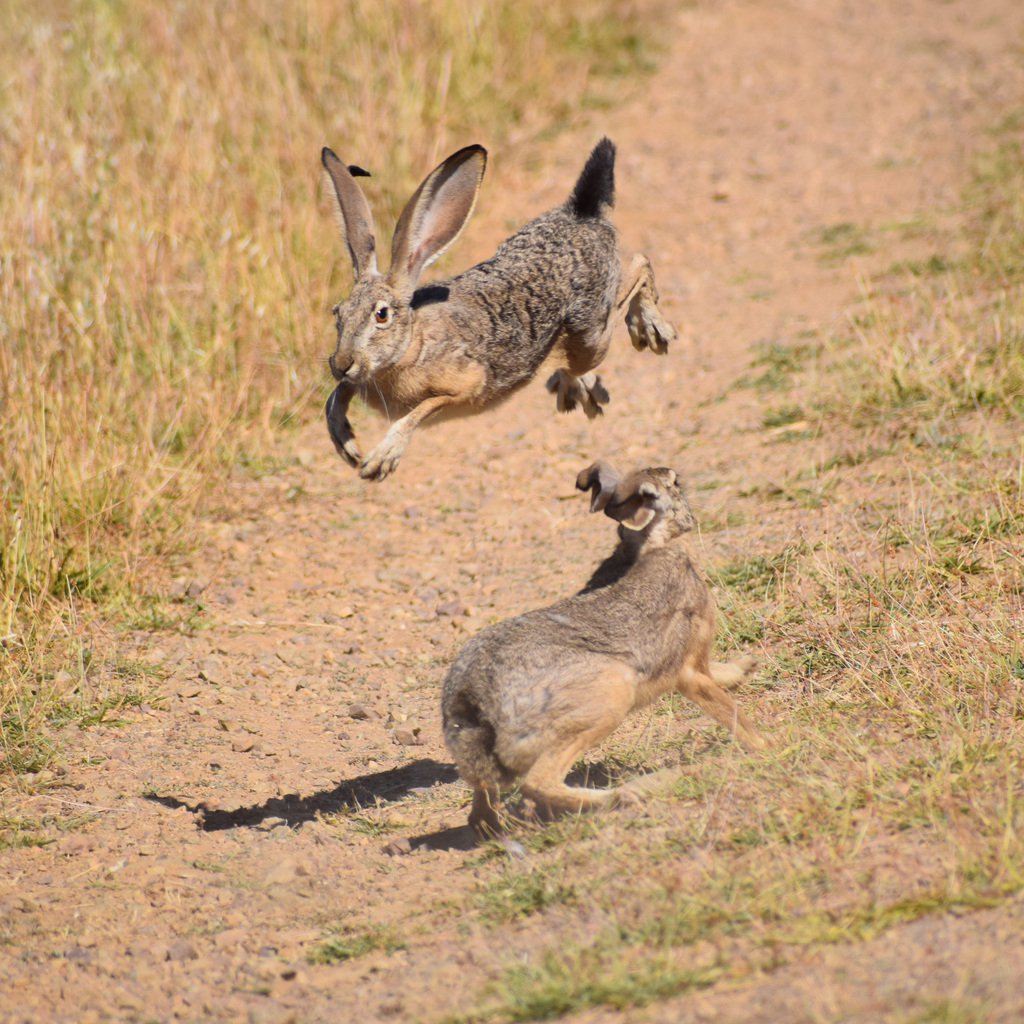
no rights reserved · CC0
Family: Leporidae · Class: Mammalia · Order: Lagomorpha
Lepus californicus (Black-tailed Jackrabbit) is a California animal in the Leporidae family.
The black-tailed jackrabbit is a large hare native to western North America, including much of California. Adults measure 465 to 630 mm (18.3 to 24.8 inches) in total length and weigh 1.3 to 3.2 kg (2.9 to 7.1 pounds). The species displays sexual dimorphism, with females typically larger than males. The pelage is grayish-brown to buff on the dorsal surface with white underparts. The distinctive black-tipped ears measure 100 to 112 mm (3.9 to 4.4 inches) in length, while the tail displays a prominent black stripe on the dorsal surface extending onto the rump. During winter months, individuals in northern populations may develop whiter pelage. Black-tailed jackrabbits occur throughout California except in dense forests and high mountain areas. The species ranges from sea level to approximately 1,829 meters (6,000 feet) elevation, with highest densities in the Central Valley, southern California valleys, and desert regions. The historical range extended throughout suitable habitat in the western United States and northwestern Mexico, with populations remaining stable across most of this distribution. The species inhabits open grasslands, agricultural areas, chaparral, desert scrub, and sagebrush communities. Black-tailed jackrabbits prefer areas with scattered shrubs or low vegetation that provide cover while maintaining open spaces for foraging and predator detection. They utilize forms, shallow depressions scraped in soil beneath shrubs or other cover, for resting during daylight hours. Black-tailed jackrabbits are primarily nocturnal and crepuscular, becoming active during evening and early morning hours. The diet consists primarily of grasses, forbs, and shrubs, with seasonal variation based on plant availability. During spring, fresh green vegetation comprises the majority of the diet, while woody browse becomes more important during winter months. The species practices coprophagy, re-ingesting soft fecal pellets to maximize nutrient extraction. Reproduction occurs year-round in favorable climates, with peak breeding from January through September. Gestation lasts approximately 41 to 47 days, and females produce 1 to 8 young per litter, typically 2 to 4. Leverets are born fully furred with eyes open and are capable of movement shortly after birth. Females may produce up to 4 litters annually under optimal conditions. Sexual maturity occurs at approximately 7 to 8 months of age. Black-tailed jackrabbits are not federally or state listed and maintain stable populations across most of their range. The species is classified as Least Concern by the International Union for Conservation of Nature. Primary threats include habitat conversion to intensive agriculture and urban development, though the species demonstrates adaptability to modified landscapes. Vehicle strikes represent a significant mortality factor in areas with high road density. Predation by coyotes, foxes, raptors, and domestic animals helps regulate local populations.
Classification
Class: Mammalia · Order: Lagomorpha · Family: Leporidae
Frequently asked questions
How is Lepus californicus classified?
Lepus californicus belongs to class Mammalia, order Lagomorpha, family Leporidae.
What family does Lepus californicus belong to?
Lepus californicus is in the Leporidae family.
What is Lepus californicus?
The black-tailed jackrabbit is a large hare native to western North America, including much of California.
Is Lepus californicus found in California?
Yes. Lepus californicus is recorded in California in The California Species Project's catalogue.
Related species
Other California species in the same genus, family, or bioregion.
Data from The California Species Project — 14,000+ California species with verified data from CNPS, CDFW, USFWS, and more.