Lepus californicus bennettii
San Diego Black-tailed Jackrabbit
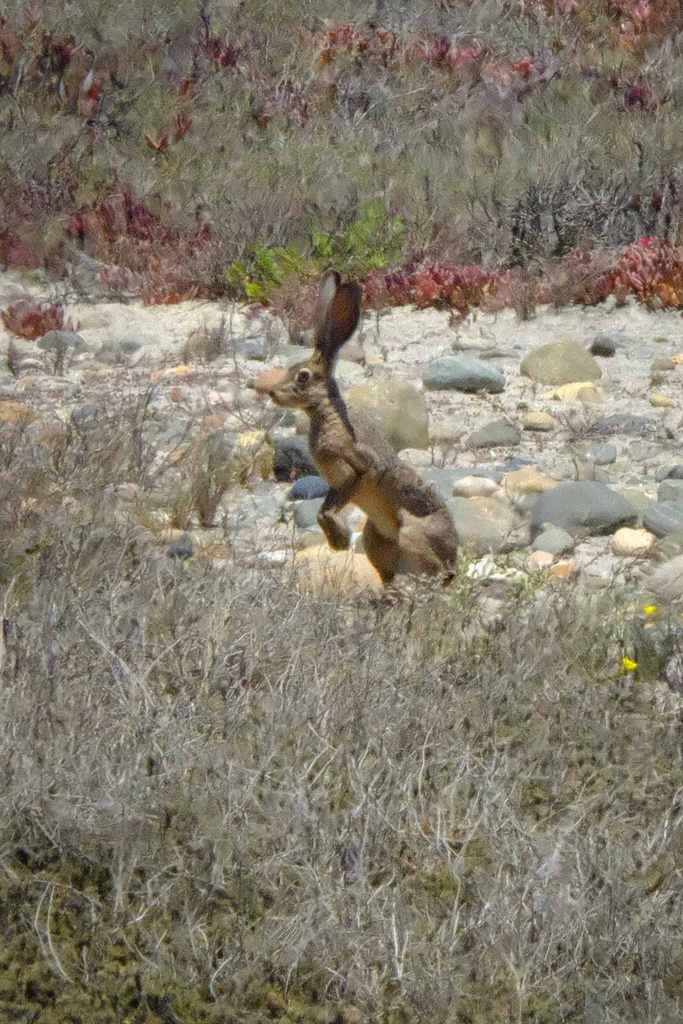
(c) Madeleine Claire, some rights reserved (CC BY) · licence
Family: Leporidae · Class: Mammalia · Order: Lagomorpha
Conservation status: G5T3T4 S3S4
Lepus californicus bennettii (San Diego Black-tailed Jackrabbit) is a California animal in the Leporidae family.
The San Diego black-tailed jackrabbit (Lepus californicus bennettii) is a subspecies of the black-tailed jackrabbit endemic to southwestern California and northwestern Baja California, Mexico. Despite its common name, this animal is a hare rather than a rabbit, distinguished by its larger size, longer ears, and longer hind legs. Adults typically measure 47 to 63 centimeters (18.5 to 24.8 inches) in total length, with ears reaching 10 to 13 centimeters (3.9 to 5.1 inches). The distinctive black-tipped tail measures 5 to 11 centimeters (2.0 to 4.3 inches) and contrasts with the grayish-brown to buff-colored dorsal pelage. The ventral surface is white to pale gray, and the large hind feet are adapted for rapid locomotion across open terrain. Historically, the San Diego black-tailed jackrabbit occupied coastal sage scrub, chaparral, and grassland habitats throughout much of San Diego County and adjacent areas. The current range has become fragmented due to urban development, with populations now restricted to remaining natural areas in eastern San Diego County, including portions of the Otay Mesa region. The subspecies extends into northwestern Baja California, Mexico, where habitat connectivity remains somewhat better preserved. This subspecies inhabits coastal sage scrub, chaparral, grasslands, and desert scrub communities, typically at elevations below 1,200 meters (3,937 feet). Unlike rabbits that seek dense cover, black-tailed jackrabbits prefer open habitats with scattered shrubs that provide some escape cover while allowing for rapid flight from predators. They require areas with sufficient foraging opportunities and open ground for their characteristic high-speed running escape behavior. San Diego black-tailed jackrabbits are primarily crepuscular and nocturnal, feeding on a variety of herbaceous plants, shrubs, and cacti. Their diet includes grasses, forbs, and the green parts of shrubs such as bursage, brittlebush, and various legumes. Breeding occurs throughout the year in favorable conditions, with females producing multiple litters annually. Gestation lasts approximately 41 to 47 days, and litters typically contain two to four precocial young that are born fully furred with open eyes. Unlike rabbits, jackrabbit young can move about shortly after birth and do not require an enclosed nest. The San Diego black-tailed jackrabbit is designated as a California Species of Special Concern and holds a global conservation rank of G5T3T4, indicating the subspecies is vulnerable to extirpation. The primary threats include habitat loss and fragmentation from urban development, particularly in coastal San Diego County where human population growth has been extensive. Agricultural conversion, infrastructure development, and fire suppression that alters natural vegetation communities also impact populations. Climate change may further stress populations by altering precipitation patterns and vegetation composition in their remaining habitat. Conservation efforts focus on habitat preservation and restoration within existing protected areas, though the subspecies' need for large territories and open landscapes presents ongoing challenges for long-term population viability.
Classification
Class: Mammalia · Order: Lagomorpha · Family: Leporidae
Conservation status
G5T3T4 S3S4
Frequently asked questions
How is Lepus californicus bennettii classified?
Lepus californicus bennettii belongs to class Mammalia, order Lagomorpha, family Leporidae.
What family does Lepus californicus bennettii belong to?
Lepus californicus bennettii is in the Leporidae family.
Is Lepus californicus bennettii protected or of conservation concern?
Lepus californicus bennettii carries the following status: G5T3T4 S3S4.
What is Lepus californicus bennettii?
The San Diego black-tailed jackrabbit (Lepus californicus bennettii) is a subspecies of the black-tailed jackrabbit endemic to southwestern California and northwestern Baja California, Mexico.
Is Lepus californicus bennettii found in California?
Yes. Lepus californicus bennettii is recorded in California in The California Species Project's catalogue.
Related species
Other California species in the same genus, family, or bioregion.
Data from The California Species Project — 14,000+ California species with verified data from CNPS, CDFW, USFWS, and more.