Lepus townsendii
White-tailed Jackrabbit
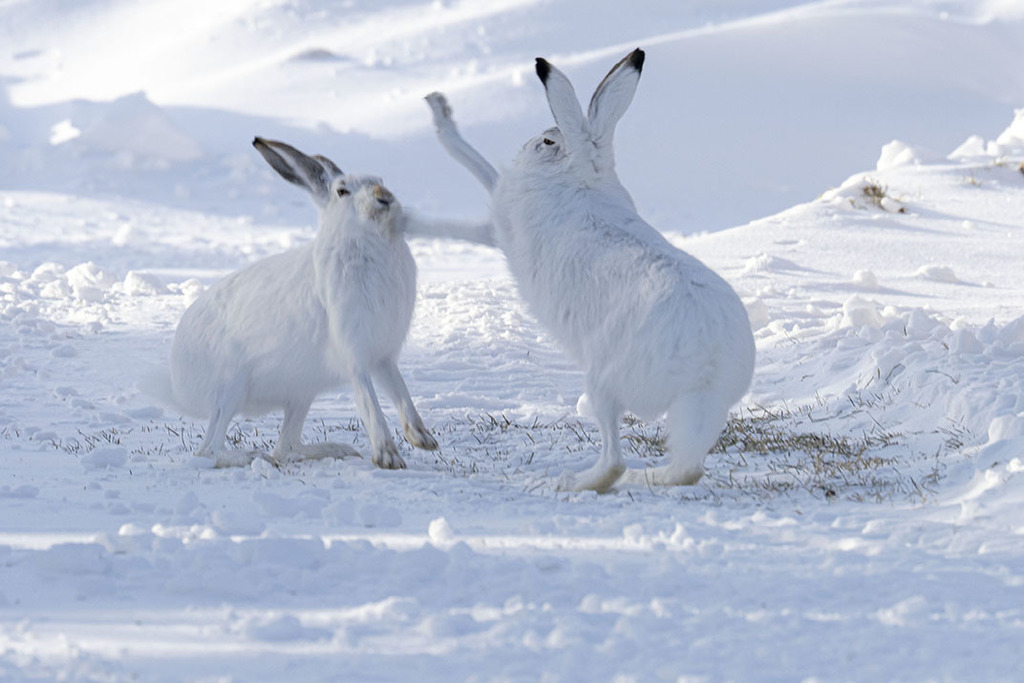
(c) Fotojunkie8’s, some rights reserved (CC BY) · licence
Family: Leporidae · Class: Mammalia · Order: Lagomorpha
Lepus townsendii (White-tailed Jackrabbit) is a California animal in the Leporidae family.
The white-tailed jackrabbit is a large lagomorph measuring 560 to 650 mm (22 to 26 inches) in total length, with adult weights ranging from 2.5 to 4.3 kg (5.5 to 9.5 pounds). This species exhibits seasonal pelage changes, with summer coats displaying grayish-brown to buffy coloration on the dorsal surface and white undersides. Winter pelage transforms to predominantly white or pale gray, providing camouflage in snow-covered environments. The ears are proportionally shorter than other jackrabbit species, measuring 100 to 115 mm (4 to 4.5 inches), with black-tipped edges. The tail remains white year-round on both dorsal and ventral surfaces, distinguishing it from the black-tailed jackrabbit. Historically, white-tailed jackrabbits occupied montane and subalpine regions of northeastern California, including portions of Modoc and Lassen counties. The species' California range represented the southwestern edge of a distribution extending north through Oregon, Washington, and into Canada, and east across the Great Basin and Rocky Mountain states. Current populations in California are extremely limited, with recent confirmed observations rare and potentially representing vagrant individuals from adjacent Nevada or Oregon populations. White-tailed jackrabbits inhabit open grasslands, sagebrush steppes, and agricultural areas at elevations ranging from 1,200 to 3,600 meters (4,000 to 12,000 feet). The species requires areas with scattered shrub cover for shelter and foraging, favoring habitats dominated by big sagebrush, bitterbrush, and native bunchgrasses. In winter, populations move to lower elevations with reduced snow accumulation, utilizing wind-swept ridges and south-facing slopes where vegetation remains accessible. This species exhibits crepuscular and nocturnal activity patterns, with peak foraging occurring during dawn and dusk hours. Diet consists primarily of grasses, forbs, and shrubs during summer months, shifting to woody browse including sagebrush, willow twigs, and bark during winter. Breeding occurs from March through July, with females producing one to three litters per year. Gestation lasts 36 to 42 days, resulting in litters of three to eight leverets. Young are born fully furred with open eyes in shallow depressions lined with vegetation and fur. White-tailed jackrabbits are not federally listed but face significant conservation challenges in California. The species has experienced range contraction throughout western North America due to habitat conversion, agricultural intensification, and climate change. In California, the combination of limited suitable habitat, small population size, and isolation from source populations increases extinction risk. Primary threats include livestock grazing impacts on native plant communities, urban development, and increasingly frequent drought conditions that reduce forage availability. The species' dependence on snow-covered environments makes it particularly vulnerable to warming temperatures and altered precipitation patterns associated with climate change.
Classification
Class: Mammalia · Order: Lagomorpha · Family: Leporidae
Frequently asked questions
How is Lepus townsendii classified?
Lepus townsendii belongs to class Mammalia, order Lagomorpha, family Leporidae.
What family does Lepus townsendii belong to?
Lepus townsendii is in the Leporidae family.
What is Lepus townsendii?
The white-tailed jackrabbit is a large lagomorph measuring 560 to 650 mm (22 to 26 inches) in total length, with adult weights ranging from 2.5 to 4.3 kg (5.5 to 9.5 pounds).
Is Lepus townsendii found in California?
Yes. Lepus townsendii is recorded in California in The California Species Project's catalogue.
Related species
Other California species in the same genus, family, or bioregion.
Data from The California Species Project — 14,000+ California species with verified data from CNPS, CDFW, USFWS, and more.