Lethocerus americanus
American Giant Water Bug
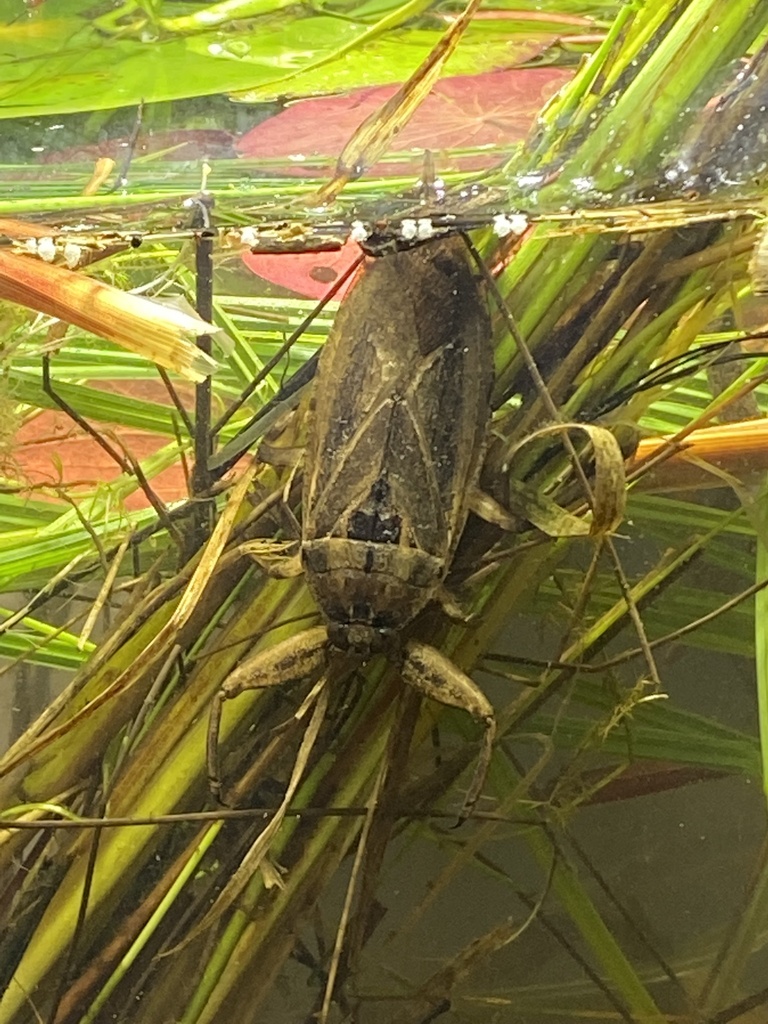
no rights reserved · CC0
Family: Belostomatidae · Class: Insecta · Order: Hemiptera
Lethocerus americanus (American Giant Water Bug) is a California animal in the Belostomatidae family.
The American Giant Water Bug is among North America's largest aquatic insects, measuring 50 to 60 mm (2.0 to 2.4 inches) in length. Adults display a flattened, oval body with powerful raptorial front legs adapted for capturing prey. The forewings are leathery at the base with membranous tips, while the hindwings are entirely membranous and folded beneath when at rest. Coloration ranges from dark brown to black with lighter brown markings. Males possess distinctive abdominal modifications for carrying eggs during brooding behavior. This species occurs across much of North America, from southern Canada through the United States to northern Mexico. In California, populations are documented primarily in the Central Valley and coastal regions, with scattered records in the Sierra Nevada foothills. Historical records indicate broader distribution throughout suitable aquatic habitats statewide, though current populations appear more localized. The species ranges from sea level to moderate elevations, typically below 1,500 meters. American Giant Water Bugs inhabit permanent or semi-permanent freshwater bodies including ponds, lakes, slow-moving streams, and marshes. They require well-vegetated aquatic environments with emergent and submerged plants that provide both hunting grounds and attachment sites for eggs. Adults are strong swimmers but also capable of flight between water bodies. The species shows preference for waters with moderate depth and abundant aquatic vegetation, avoiding fast-flowing streams and highly polluted waters. These predatory insects are ambush hunters that capture fish, tadpoles, small frogs, and various aquatic invertebrates using their powerful front legs. They inject digestive enzymes through their piercing mouthparts and consume liquefied tissues. Reproduction involves unique paternal care, with females cementing eggs to the male's back in distinctive parallel rows (BugGuide 2025). Males carry 100 to 150 eggs for approximately three weeks, regularly surfacing to aerate the egg mass (Menke 1979). Development includes five nymphal instars over several months, with overwintering typically occurring as adults in muddy substrates or under debris. The American Giant Water Bug has no federal or state conservation listing in California. However, populations have likely declined due to habitat loss from wetland drainage, water diversions, and urbanization throughout the species' range. Pollution from agricultural runoff and urban development degrades water quality in many formerly suitable habitats. Climate change may affect the species through altered precipitation patterns and increased temperatures in shallow water bodies. The species serves as an indicator of aquatic ecosystem health, as populations require relatively clean water with diverse prey communities. Conservation efforts focus on wetland preservation and restoration, though specific population monitoring data for California remains limited. The species' ability to fly between water bodies provides some resilience to localized habitat loss, but landscape-level connectivity remains important for maintaining viable populations.
Classification
Class: Insecta · Order: Hemiptera · Family: Belostomatidae
Frequently asked questions
How is Lethocerus americanus classified?
Lethocerus americanus belongs to class Insecta, order Hemiptera, family Belostomatidae.
What family does Lethocerus americanus belong to?
Lethocerus americanus is in the Belostomatidae family.
What is Lethocerus americanus?
The American Giant Water Bug is among North America's largest aquatic insects, measuring 50 to 60 mm (2.0 to 2.4 inches) in length.
Is Lethocerus americanus found in California?
Yes. Lethocerus americanus is recorded in California in The California Species Project's catalogue.
Related species
Other California species in the same genus, family, or bioregion.
Data from The California Species Project — 14,000+ California species with verified data from CNPS, CDFW, USFWS, and more.