Leucauge venusta
Orchard Orbweaver
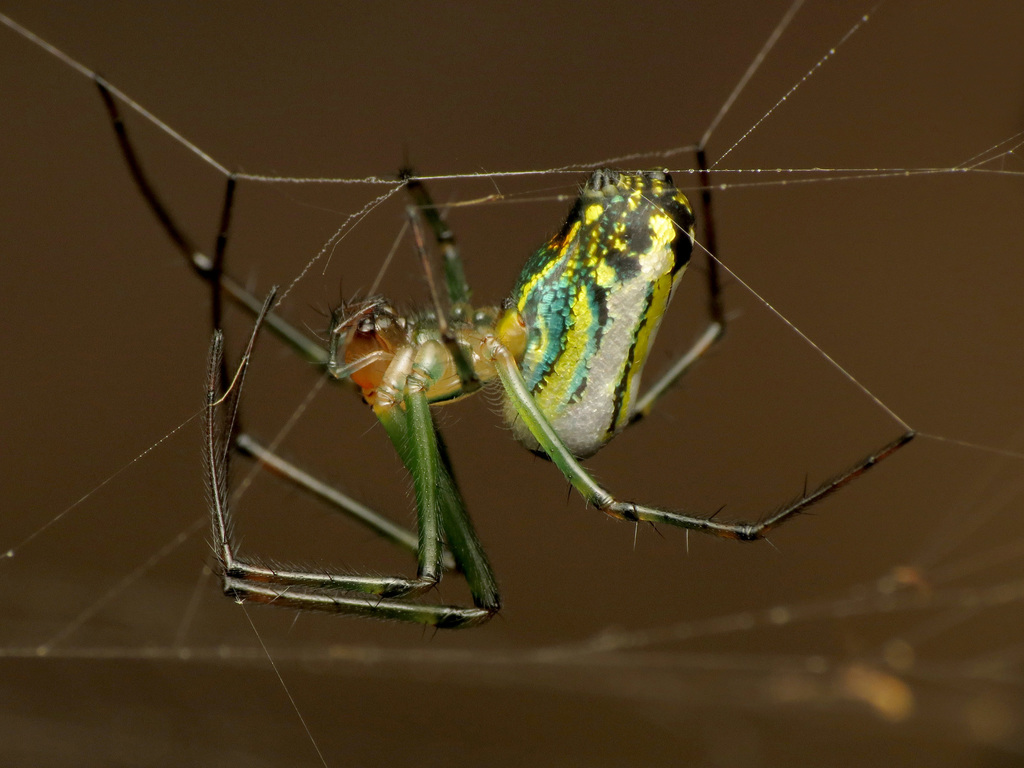
(c) Katja Schulz, some rights reserved (CC BY) · licence
Family: Tetragnathidae · Class: Arachnida · Order: Araneae
Leucauge venusta (Orchard Orbweaver) is a California animal in the Tetragnathidae family.
The orchard orbweaver is a medium-sized spider in the long-jawed orb weaver family Tetragnathidae. Adults typically measure 5.5 to 7.5 mm (0.22 to 0.30 inches) in body length, with females generally larger than males. The species displays distinctive coloration with a greenish-yellow to pale green cephalothorax and abdomen marked by silver, white, and sometimes reddish striping patterns. The legs are long and slender, often with alternating light and dark banding. Males possess elongated chelicerae (mouthparts) characteristic of the family, while females have a more robust abdomen with prominent spinnerets. Leucauge venusta occurs throughout much of eastern and central North America, ranging from southern Canada south to northern South America. In the United States, the species is found from the Atlantic coast west to the Great Plains, including most southeastern and south-central states. The western extent of its range includes parts of Texas, Oklahoma, and Kansas. Recent molecular studies have confirmed that North American populations represent a single widespread species (Ballesteros & Hormiga 2018). This species inhabits a variety of semi-open habitats including woodland edges, gardens, orchards, shrublands, and areas with mixed vegetation. Orchard orbweavers construct their webs in low shrubs, tall grasses, and herbaceous plants, typically positioning them 0.3 to 2 meters (1 to 6 feet) above ground. They show preference for areas with moderate moisture and some canopy cover, avoiding both dense forests and completely open areas. The webs are often built among cultivated plants, hence the common name referencing orchards and agricultural areas. Orchard orbweavers build semi-permanent orb webs that are nearly horizontal or inclined at various angles, distinguishing them from the vertical webs of many other orb weavers. The webs typically measure 15 to 25 cm (6 to 10 inches) in diameter and feature a distinctive design with the spider often hanging inverted in the center. They feed primarily on small flying insects including gnats, mosquitoes, aphids, and small moths. The species exhibits seasonal activity, with adults most commonly observed from late spring through early fall. Mating occurs in summer, with females producing egg sacs that are attached to vegetation near the web site. Leucauge venusta is not listed under any federal or state conservation programs and appears to maintain stable populations throughout its range. The species benefits from its adaptability to human-modified landscapes and its broad geographic distribution. As a predator of agricultural pests, orchard orbweavers provide beneficial ecosystem services in agricultural and garden settings. Climate change may affect northern populations, but the species' wide habitat tolerance suggests resilience to environmental changes. Current populations appear secure with no immediate conservation concerns identified.
Classification
Class: Arachnida · Order: Araneae · Family: Tetragnathidae
Frequently asked questions
How is Leucauge venusta classified?
Leucauge venusta belongs to class Arachnida, order Araneae, family Tetragnathidae.
What family does Leucauge venusta belong to?
Leucauge venusta is in the Tetragnathidae family.
What is Leucauge venusta?
The orchard orbweaver is a medium-sized spider in the long-jawed orb weaver family Tetragnathidae.
Is Leucauge venusta found in California?
Yes. Leucauge venusta is recorded in California in The California Species Project's catalogue.
Related species
Other California species in the same genus, family, or bioregion.
Data from The California Species Project — 14,000+ California species with verified data from CNPS, CDFW, USFWS, and more.