Leucoma salicis
White Satin Moth
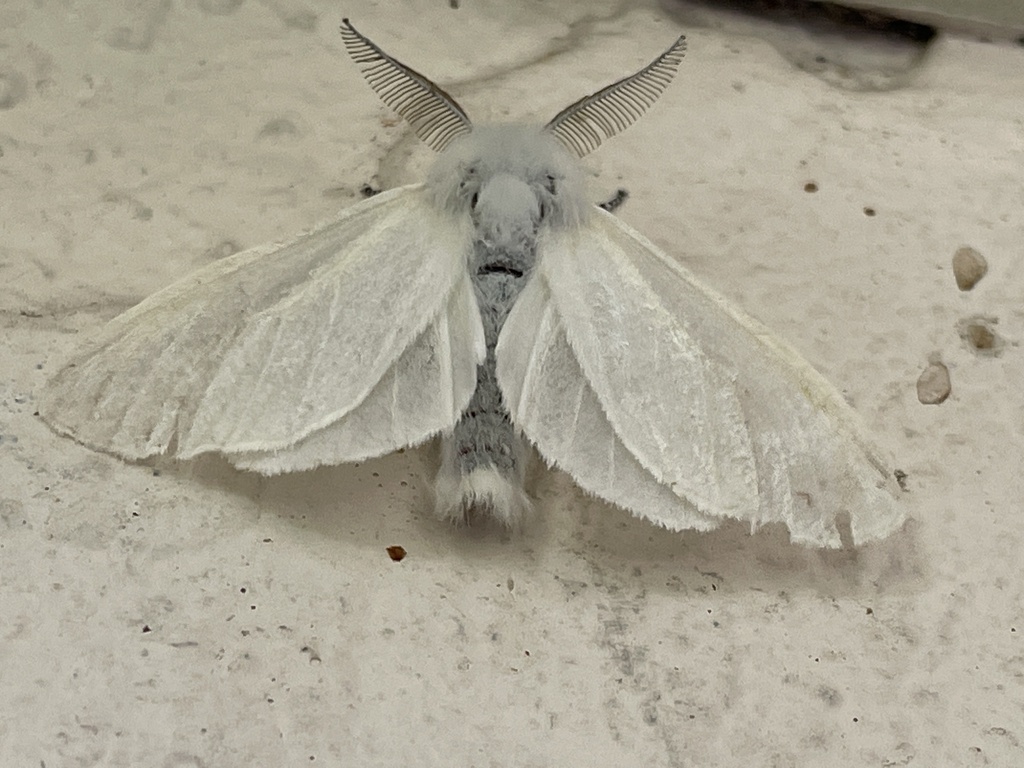
no rights reserved · CC0
Family: Erebidae · Class: Insecta · Order: Lepidoptera
Leucoma salicis (White Satin Moth) is a California animal in the Erebidae family.
The white satin moth is a medium-sized moth in the family Erebidae, subfamily Lymantriinae. Adults display predominantly white coloration with satiny wing surfaces that give the species its common name. The forewings are white with subtle dark markings, while the hindwings are typically pure white. Males possess feathery antennae and are generally smaller than females, which have thread-like antennae and more robust bodies for egg production. This species is native to Europe and was introduced to North America around 1920 (BugGuide). The moth has established populations across much of the northern United States and southern Canada. In California, Leucoma salicis occurs primarily in the northern regions where suitable host plants are present. The species has been documented in various western states as part of the broader North American introduction and subsequent range expansion. White satin moths inhabit areas where their primary host plants occur, particularly willows (Salix species) and poplars (Populus species). They are commonly found in riparian zones, urban areas with ornamental trees, and forest edges where these deciduous trees grow. The species adapts well to disturbed habitats and has successfully colonized both natural and anthropogenic environments throughout its introduced range. Larvae feed exclusively on leaves of willow and poplar species, making them occasionally problematic in ornamental plantings and natural forest systems. Caterpillars are gregarious in early instars, forming web-like shelters on branches before dispersing as they mature. The species typically produces one generation per year in most of its range. Adults emerge in summer and are attracted to artificial lights. Females lay egg masses on host plant bark, and larvae overwinter in pupal chambers constructed in bark crevices or soil. Eggs are deposited in distinctive foam-like masses that harden to protect the developing embryos through winter. Upon hatching in spring, young caterpillars feed communally before dispersing. The larval stage can cause significant defoliation of host trees during outbreak years, particularly affecting urban shade trees and riparian vegetation. As an introduced species, Leucoma salicis is not protected under federal or state conservation legislation. The moth is considered naturalized throughout much of its North American range and populations appear stable. In some regions, the species is monitored as part of forest health assessments due to its potential impacts on native willow and poplar communities. The white satin moth has been designated as a Species of Greatest Conservation Need in New York and Louisiana, though this designation likely reflects monitoring needs rather than conservation concern (BugGuide). Management efforts focus primarily on protecting valuable ornamental trees rather than species conservation. The moth's establishment demonstrates the successful colonization patterns typical of introduced Lepidoptera with broad host plant ranges and high reproductive potential.
Classification
Class: Insecta · Order: Lepidoptera · Family: Erebidae
Frequently asked questions
How is Leucoma salicis classified?
Leucoma salicis belongs to class Insecta, order Lepidoptera, family Erebidae.
What family does Leucoma salicis belong to?
Leucoma salicis is in the Erebidae family.
What is Leucoma salicis?
The white satin moth is a medium-sized moth in the family Erebidae, subfamily Lymantriinae.
Is Leucoma salicis found in California?
Yes. Leucoma salicis is recorded in California in The California Species Project's catalogue.
Related species
Other California species in the same genus, family, or bioregion.
Data from The California Species Project — 14,000+ California species with verified data from CNPS, CDFW, USFWS, and more.