Leucophaeus atricilla
Laughing Gull
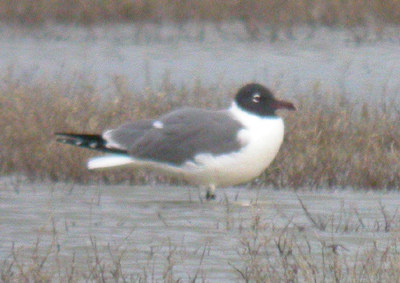
(c) Benoit NABHOLZ, some rights reserved (CC BY-SA) · licence
Family: Laridae · Class: Aves · Order: Charadriiformes
Conservation status: WL · G5 S1
Leucophaeus atricilla (Laughing Gull) is a California animal in the Laridae family.
The Laughing Gull is a medium-sized gull measuring 36 to 41 cm (14 to 16 inches) in length with a wingspan of 98 to 110 cm (39 to 43 inches). Adults weigh between 230 to 400 grams. During breeding season, adults display a distinctive black hood that extends from the bill to the nape, contrasting sharply with white underparts and gray wings and back. The bill is dark red to black, and legs are dark red. In winter plumage, the black hood is replaced by a partial gray hood with dark markings around the eye. Juveniles show brownish upperparts with darker wing tips and a dark terminal band on the tail. The species' common name derives from its distinctive laughing call, a series of ha-ha-ha notes that become higher in pitch. Historically, Laughing Gulls bred along the California coast, but the species has experienced significant range contraction on the Pacific Coast. Current breeding populations are largely restricted to the Atlantic and Gulf coasts, from Maritime Canada to Venezuela, with the largest concentrations in the southeastern United States. In California, the species is now primarily observed as a vagrant or irregular visitor, with most records from coastal areas and inland lakes. The Salton Sea has recorded occasional observations, and scattered sightings occur along the Pacific Coast from San Diego County to Humboldt County. Laughing Gulls inhabit coastal marshes, beaches, mudflats, and estuaries. They prefer areas with mix of open water and emergent vegetation for nesting. Breeding colonies are typically established on islands or isolated peninsulas in salt marshes, often on platforms of accumulated vegetation. The species also utilizes agricultural areas, landfills, and urban environments for foraging, particularly during migration and winter months. Laughing Gulls are omnivorous opportunists with a varied diet including fish, crustaceans, marine worms, insects, eggs, and chicks of other birds. They employ multiple foraging strategies including surface dipping, diving, and scavenging. Breeding occurs from April through August, with peak nesting activity in May and June. Pairs construct nests of grass and other vegetation in dense colonies. Females typically lay 2 to 4 olive-brown eggs marked with dark spots. Both parents share incubation duties for 20 to 23 days. Chicks fledge after 35 to 40 days but remain dependent on parents for several additional weeks. In California, the Laughing Gull is designated as a Watch List species with a state ranking of S1, indicating it is critically imperiled. The global population is stable with a ranking of G5, but the species has virtually disappeared as a breeding bird from the Pacific Coast. Factors contributing to the California decline include habitat loss from coastal development, human disturbance at nesting sites, and competition with expanding populations of Western Gulls and other seabirds. Climate change and altered precipitation patterns may also affect the species' ability to reestablish breeding populations in California. Conservation efforts focus on habitat protection and restoration of coastal marsh ecosystems.
Classification
Class: Aves · Order: Charadriiformes · Family: Laridae
Conservation status
WL · G5 S1
Frequently asked questions
How is Leucophaeus atricilla classified?
Leucophaeus atricilla belongs to class Aves, order Charadriiformes, family Laridae.
What family does Leucophaeus atricilla belong to?
Leucophaeus atricilla is in the Laridae family.
Is Leucophaeus atricilla protected or of conservation concern?
Leucophaeus atricilla carries the following status: WL · G5 S1.
What is Leucophaeus atricilla?
The Laughing Gull is a medium-sized gull measuring 36 to 41 cm (14 to 16 inches) in length with a wingspan of 98 to 110 cm (39 to 43 inches).
Is Leucophaeus atricilla found in California?
Yes. Leucophaeus atricilla is recorded in California in The California Species Project's catalogue.
Related species
Other California species in the same genus, family, or bioregion.
Data from The California Species Project — 14,000+ California species with verified data from CNPS, CDFW, USFWS, and more.