Leucophaeus pipixcan
Franklin's Gull
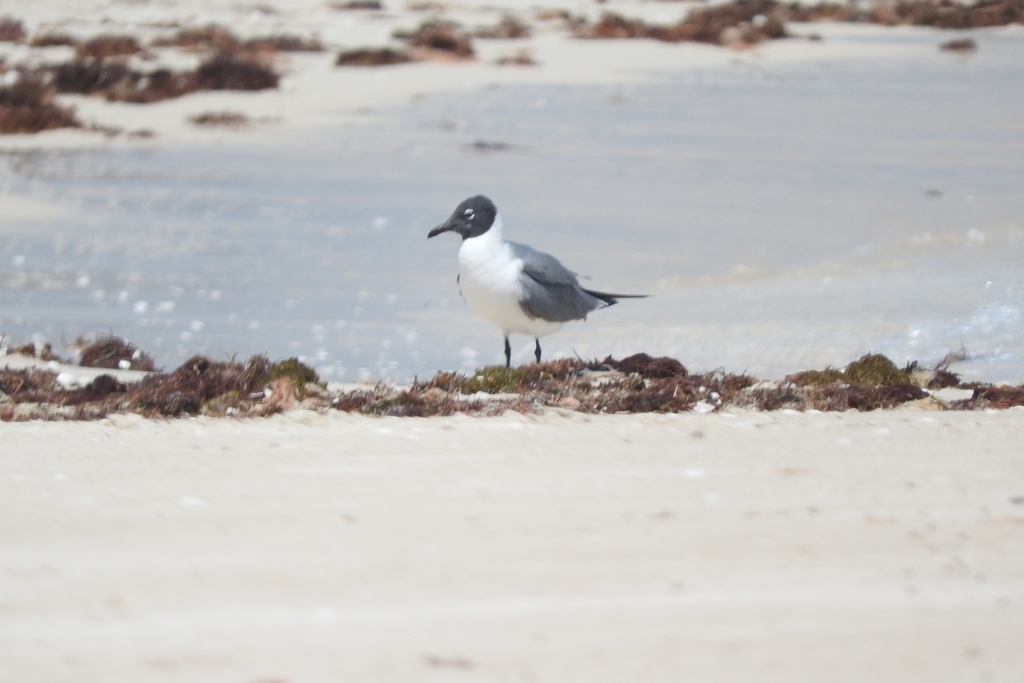
(c) Sebastián de Jesús Herrera Buenfil, some rights reserved (CC BY) · licence
Family: Laridae · Class: Aves · Order: Charadriiformes
Leucophaeus pipixcan (Franklin's Gull) is a California animal in the Laridae family.
Franklin's Gull is a medium-sized gull species measuring 32 to 36 cm (12.6 to 14.2 inches) in length with a wingspan of 85 to 95 cm (33 to 37 inches). Adults in breeding plumage display a distinctive black hood that extends from the crown to the nape, contrasting sharply with white underparts and pale gray wings. The bill is dark red to blackish, and the legs are dark red. A prominent white crescent appears above and below the eye during breeding season. In winter plumage, the black hood is replaced by a partial dark cap and ear patch. The species is distinguished from similar gulls by its smaller size, more delicate build, and distinctive wing pattern showing white wing tips separated from gray wing coverts by a black band. Franklin's Gull breeds primarily in the northern Great Plains and Prairie Pothole regions of North America, with populations extending from southern Canada through the central United States. During migration and winter, the species ranges widely across western North America, with significant numbers passing through California's Central Valley and coastal areas. In California, Franklin's Gulls are observed primarily as migrants during spring (April through May) and fall (August through October), with some individuals overwintering along the coast and in interior valleys. The species inhabits freshwater environments during breeding season, particularly shallow prairie lakes, marshes, and wetlands with emergent vegetation. Franklin's Gulls construct floating nests anchored to cattails, bulrushes, or other marsh plants. During migration and winter, they utilize a broader range of habitats including agricultural fields, flooded rice fields, reservoirs, coastal lagoons, and offshore marine waters. In California, they are frequently observed in the Sacramento Valley's flooded rice fields and along the Salton Sea. Franklin's Gulls are highly social, often forming large flocks during migration and winter. They exhibit opportunistic feeding behavior, consuming insects, earthworms, small fish, crustaceans, and agricultural waste. During breeding season, pairs construct nests in dense colonies, with females typically laying 2 to 3 eggs in late May or early June. Incubation lasts approximately 25 days, and chicks fledge after 32 to 35 days. The species is notable for its extensive migration, with some populations traveling over 10,000 km between breeding and wintering grounds. Franklin's Gull is not federally or state listed in California, though populations face challenges from habitat loss and degradation. According to the North American Bird Conservation Initiative, the species has experienced moderate population declines since the 1970s, primarily due to drainage of prairie wetlands and changes in agricultural practices. Climate change poses additional threats through altered precipitation patterns affecting breeding habitat availability. The species benefits from wetland conservation programs and sustainable agricultural practices that maintain flooded fields during migration periods.
Classification
Class: Aves · Order: Charadriiformes · Family: Laridae
Frequently asked questions
How is Leucophaeus pipixcan classified?
Leucophaeus pipixcan belongs to class Aves, order Charadriiformes, family Laridae.
What family does Leucophaeus pipixcan belong to?
Leucophaeus pipixcan is in the Laridae family.
What is Leucophaeus pipixcan?
Franklin's Gull is a medium-sized gull species measuring 32 to 36 cm (12.6 to 14.2 inches) in length with a wingspan of 85 to 95 cm (33 to 37 inches).
Is Leucophaeus pipixcan found in California?
Yes. Leucophaeus pipixcan is recorded in California in The California Species Project's catalogue.
Related species
Other California species in the same genus, family, or bioregion.
Data from The California Species Project — 14,000+ California species with verified data from CNPS, CDFW, USFWS, and more.