Leucosticte atrata
Black Rosy-Finch
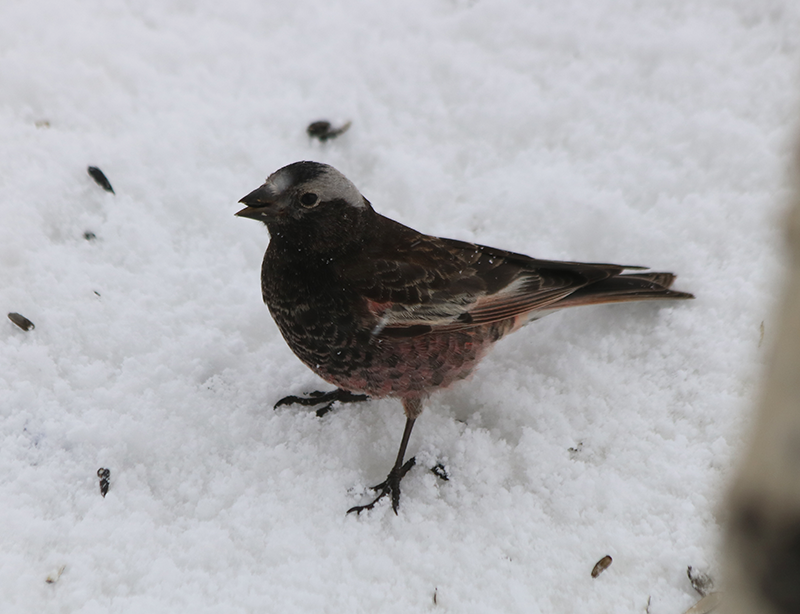
no rights reserved · CC0
Family: Fringillidae · Class: Aves · Order: Passeriformes
Leucosticte atrata (Black Rosy-Finch) is a California animal in the Fringillidae family.
The Black Rosy-Finch is a medium-sized songbird measuring 14 to 16 cm (5.5 to 6.3 inches) in length with a wingspan of 33 to 37 cm (13 to 14.6 inches). Adults weigh between 22 to 26 grams (0.8 to 0.9 ounces). Males in breeding plumage display a distinctive black head, throat, and breast with a gray-brown back and wings. The rump, lower belly, and wing coverts show varying degrees of rosy-pink coloration, most pronounced during breeding season. Females and non-breeding males appear duller with reduced pink tones and more brownish overall coloration. Both sexes possess a small, conical yellow bill with a black tip, adapted for seed consumption. The Black Rosy-Finch has the most restricted range of the three North American rosy-finch species. The breeding range extends from central Idaho and western Montana south through eastern Nevada, Utah, and western Colorado. In California, the species occurs primarily in the eastern Sierra Nevada and White Mountains of Inyo and Mono counties, with scattered records in the southern Cascades. The species breeds at high elevations and descends to lower elevations during winter, with some populations migrating to Arizona and New Mexico. Breeding habitat consists of alpine and subalpine environments above 3,000 meters (9,800 feet) elevation, including rocky slopes, talus fields, and areas near permanent snowfields. The species favors exposed ridges and cliff faces with sparse vegetation, often nesting in rock crevices or under overhanging rocks. During winter, Black Rosy-Finches move to lower elevation areas including sagebrush steppe, pinyon-juniper woodlands, and agricultural areas, typically between 1,500 to 2,700 meters (4,900 to 8,900 feet) elevation. Black Rosy-Finches are primarily granivorous, feeding on seeds of alpine plants including sedges, grasses, and forbs. During breeding season, they supplement their diet with insects, particularly dipterans and hymenopterans found near snowfields and in alpine meadows. The species exhibits nomadic behavior, moving in flocks to track food availability across the alpine landscape. Breeding occurs from May through August, with females constructing cup-shaped nests in rock crevices lined with grass, feathers, and hair. Clutch size ranges from 3 to 5 eggs, with an incubation period of 12 to 14 days. Young fledge after 18 to 20 days. The Black Rosy-Finch is not federally listed and has no special conservation status in California as of December 2025. However, the species faces potential threats from climate change, which may reduce available alpine habitat through rising temperatures and altered precipitation patterns. Winter populations appear stable, though the species' remote breeding habitat makes comprehensive population monitoring challenging. The specialized high-elevation habitat requirements make this species particularly vulnerable to environmental changes affecting alpine ecosystems.
Classification
Class: Aves · Order: Passeriformes · Family: Fringillidae
Frequently asked questions
How is Leucosticte atrata classified?
Leucosticte atrata belongs to class Aves, order Passeriformes, family Fringillidae.
What family does Leucosticte atrata belong to?
Leucosticte atrata is in the Fringillidae family.
What is Leucosticte atrata?
The Black Rosy-Finch is a medium-sized songbird measuring 14 to 16 cm (5.5 to 6.3 inches) in length with a wingspan of 33 to 37 cm (13 to 14.6 inches).
Is Leucosticte atrata found in California?
Yes. Leucosticte atrata is recorded in California in The California Species Project's catalogue.
Related species
Other California species in the same genus, family, or bioregion.
Data from The California Species Project — 14,000+ California species with verified data from CNPS, CDFW, USFWS, and more.