Leucosticte australis
Brown-capped Rosy-Finch
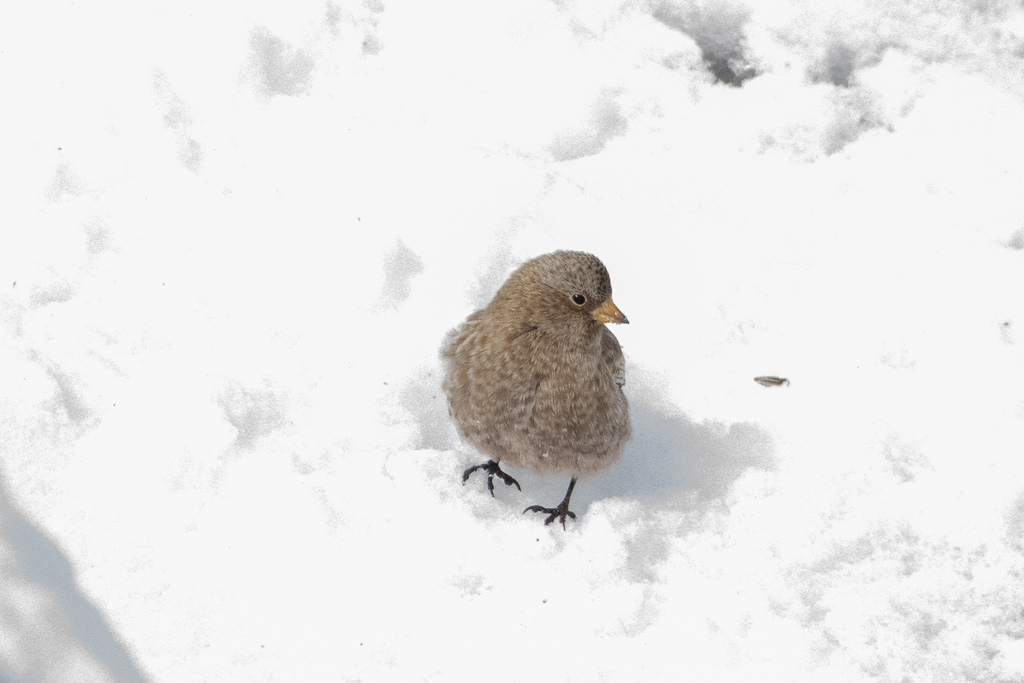
(c) Richard Littauer, some rights reserved (CC BY) · licence
Family: Fringillidae · Class: Aves · Order: Passeriformes
Leucosticte australis (Brown-capped Rosy-Finch) is a California animal in the Fringillidae family.
The Brown-capped Rosy-Finch is a small, stocky songbird measuring approximately 14-16 cm (5.5-6.3 inches) in length with a distinctive plumage pattern. Adults display a brownish cap and back, with extensive rosy-pink coloration on the wings, rump, and belly that is more pronounced than in other rosy-finch species. Males are generally more vibrant than females, particularly during breeding season. The species has a conical bill adapted for seed feeding and relatively long wings suited for high-altitude flight. This species has the most restricted range of North American rosy-finches, being almost endemic to Colorado (Birds of the World 2020). The breeding range centers on Colorado's highest peaks, with populations documented in the Front Range, Sawatch Range, Sangre de Cristo Mountains, and Mosquito Range. Small populations may extend into northern New Mexico. Winter distribution expands slightly, with birds moving to lower elevations within Colorado and occasionally dispersing to adjacent areas of Wyoming, New Mexico, and rarely Utah. Brown-capped Rosy-Finches breed at the highest altitudes of any North American bird species north of Mexico, typically nesting on cliff faces overlooking glaciers and snowfields above 3,350 meters (11,000 feet) elevation. Breeding habitat consists of alpine tundra, talus slopes, and rocky areas near permanent snowfields on peaks exceeding 4,000 meters (13,000 feet). During winter, severe weather forces birds to descend to lower elevations between 1,800-3,000 meters (6,000-10,000 feet), where they occupy montane forests, agricultural areas, and human settlements. During summer, these finches primarily forage for insects frozen on snowfield surfaces and seeds exposed along retreating snow margins (Birds of the World 2020). Their diet includes dipterans, hymenopterans, and other arthropods, supplemented by seeds from alpine plants. Winter flocks can contain hundreds of individuals that feed on seeds along roadways and at bird feeders. Breeding occurs from June through August, with nests constructed in rock crevices and cliff faces. The species exhibits strong site fidelity to breeding areas. At night during winter, birds roost communally in protected sites including old Cliff Swallow nests, barns, and caves. The Brown-capped Rosy-Finch is designated as a Bird of Conservation Concern by the U.S. Fish and Wildlife Service (2021), reflecting population concerns despite not being federally listed. The species faces threats from climate change, which affects snowfield persistence and alpine habitat availability. Recreational activities in high-altitude areas may disturb breeding sites. Population estimates suggest fewer than 50,000 individuals range-wide, with potential declines linked to warming temperatures reducing suitable alpine habitat. The restricted range and specialized habitat requirements make this species particularly vulnerable to environmental changes affecting Colorado's highest peaks.
Classification
Class: Aves · Order: Passeriformes · Family: Fringillidae
Frequently asked questions
How is Leucosticte australis classified?
Leucosticte australis belongs to class Aves, order Passeriformes, family Fringillidae.
What family does Leucosticte australis belong to?
Leucosticte australis is in the Fringillidae family.
What is Leucosticte australis?
The Brown-capped Rosy-Finch is a small, stocky songbird measuring approximately 14-16 cm (5.5-6.3 inches) in length with a distinctive plumage pattern.
Is Leucosticte australis found in California?
Yes. Leucosticte australis is recorded in California in The California Species Project's catalogue.
Related species
Other California species in the same genus, family, or bioregion.
Data from The California Species Project — 14,000+ California species with verified data from CNPS, CDFW, USFWS, and more.