Leucosticte tephrocotis
Gray-crowned Rosy-Finch
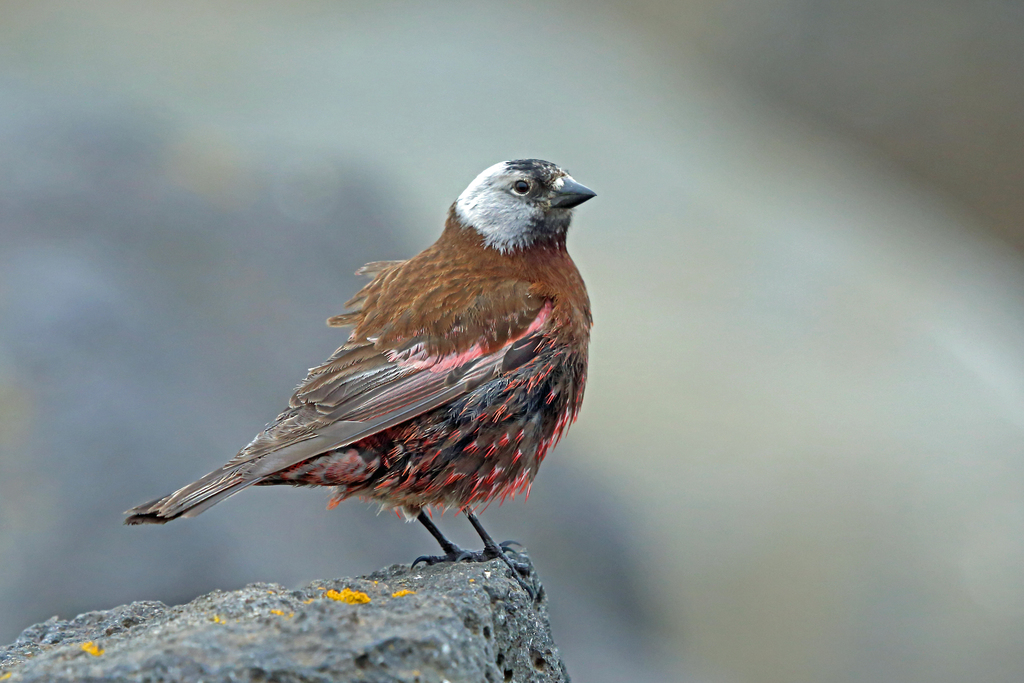
(c) Nigel Voaden, some rights reserved (CC BY) · licence
Family: Fringillidae · Class: Aves · Order: Passeriformes
Leucosticte tephrocotis (Gray-crowned Rosy-Finch) is a California animal in the Fringillidae family.
The Gray-crowned Rosy-Finch is a medium-sized songbird measuring 14 to 17 cm (5.5 to 6.7 inches) in length with a wingspan of 28 to 33 cm (11 to 13 inches). Adults weigh between 22 to 26 grams. The species displays sexual dimorphism in plumage. Males exhibit a distinctive gray crown contrasting with a brown back and wings, while the rump, belly, and wing patches show varying degrees of rosy pink coloration that intensifies during breeding season. Females are similar but with more subdued pink tones. Both sexes have a dark, conical seed-cracking bill and dark legs. The gray crown extends from the forehead to the nape, bordered by a darker band above the eye. The Gray-crowned Rosy-Finch breeds in high-elevation regions of the western United States and western Canada. In California, the species occurs primarily in the Sierra Nevada range above 3,000 meters (9,800 feet), with breeding populations documented in the Cascades and isolated records from the White Mountains. The species also breeds in mountain ranges of Montana, Wyoming, Colorado, Idaho, Washington, Oregon, Alaska, and western Canada. During winter, populations descend to lower elevations and expand their range eastward into the Great Plains. This species inhabits alpine and subalpine environments, including rocky slopes, talus fields, cliff faces, and areas near permanent snowfields and glaciers. Breeding habitat consists of exposed rocky terrain above treeline, often associated with areas of late-lying snow. Nesting sites are typically located in rock crevices, cliff ledges, or among boulder fields. During winter, Gray-crowned Rosy-Finches move to lower elevations, utilizing open grasslands, agricultural fields, and areas around human settlements. Gray-crowned Rosy-Finches are granivorous, feeding primarily on seeds of alpine plants, grasses, and sedges. During breeding season, they supplement their diet with insects including flies, beetles, and moths, which provide essential protein for reproduction. The species often forages on snowfields, collecting wind-blown seeds and insects trapped on the snow surface. Breeding occurs from May through August, with females constructing cup-shaped nests lined with feathers, hair, and fine grasses. Clutch size ranges from 3 to 5 eggs, with an incubation period of 12 to 14 days. Young fledge after approximately 15 to 20 days. The Gray-crowned Rosy-Finch is not federally listed and is considered stable across most of its range. However, climate change poses potential long-term threats to high-elevation specialists. Rising temperatures may reduce suitable alpine habitat and cause upslope shifts in vegetation zones. The species' dependence on snowfields for foraging makes it particularly vulnerable to changes in snowpack duration and extent. Current population trends indicate the species remains relatively stable, though long-term monitoring is needed to assess impacts of climate change on high-elevation populations.
Classification
Class: Aves · Order: Passeriformes · Family: Fringillidae
Frequently asked questions
How is Leucosticte tephrocotis classified?
Leucosticte tephrocotis belongs to class Aves, order Passeriformes, family Fringillidae.
What family does Leucosticte tephrocotis belong to?
Leucosticte tephrocotis is in the Fringillidae family.
What is Leucosticte tephrocotis?
The Gray-crowned Rosy-Finch is a medium-sized songbird measuring 14 to 17 cm (5.5 to 6.7 inches) in length with a wingspan of 28 to 33 cm (11 to 13 inches).
Is Leucosticte tephrocotis found in California?
Yes. Leucosticte tephrocotis is recorded in California in The California Species Project's catalogue.
Related species
Other California species in the same genus, family, or bioregion.
Data from The California Species Project — 14,000+ California species with verified data from CNPS, CDFW, USFWS, and more.