Libellula croceipennis
Neon Skimmer
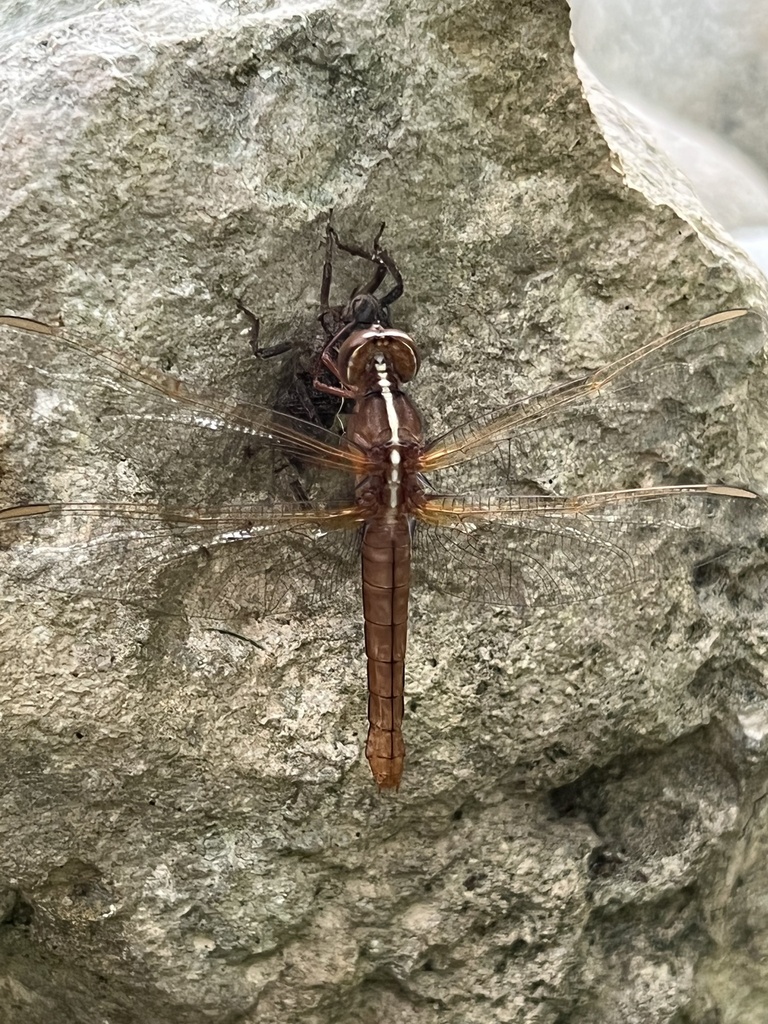
(c) Andy Jordan, some rights reserved (CC BY) · licence
Family: Libellulidae · Class: Insecta · Order: Odonata
Libellula croceipennis (Neon Skimmer) is a California animal in the Libellulidae family.
The Neon Skimmer is a medium-sized dragonfly in the family Libellulidae, distinguished by its bright coloration and amber-tinted wings. Adult males display brilliant red bodies with distinctive amber wing patches covering approximately one-quarter of each wing, extending halfway to the nodus but not reaching the rear edge of the hindwing (BugGuide 2025). Females are considerably paler with essentially clear wings, showing only faint amber coloration along the leading wing edges. Both sexes possess the robust build typical of skimmer dragonflies, with broad wings and powerful flight capabilities. The Neon Skimmer occurs across the southwestern United States, with confirmed populations in California, Louisiana, and Oklahoma (BugGuide 2025). Within California, the species has been documented in Orange County, where observations include lakeside habitats in forested areas. The species appears to have a disjunct distribution pattern across the southwestern states, though comprehensive range mapping remains incomplete. Neon Skimmers inhabit slow-moving streams and ponds, showing a preference for shaded moving water when multiple habitat options are available (BugGuide 2025). Males will defend both flowing water territories and pond habitats, adapting their territorial behavior to available resources. The species tolerates both permanent and semi-permanent water bodies, provided vegetation and appropriate perching sites are present. Suitable habitat typically includes areas with emergent vegetation that provides perching opportunities and supports prey populations. Males exhibit strong territorial behavior, particularly early in the breeding season when they vigorously defend prime habitat patches near water (BugGuide 2025). As the season progresses, territorial defense decreases and males spend more time perching. Females appear at water primarily for mating and egg-laying activities. Like other libellulids, Neon Skimmers are aerial predators, capturing flying insects including mosquitoes, midges, and other small flying prey. Reproduction follows the typical dragonfly pattern, with males establishing territories, females visiting for mating, and eggs deposited directly in water or on aquatic vegetation. The conservation status of the Neon Skimmer has not been formally evaluated by federal or state agencies. The species does not appear on current threatened or endangered species lists, though comprehensive population assessments are lacking. As with many freshwater-dependent species, potential threats may include habitat degradation from water diversions, pollution, and invasive species introductions. Climate change impacts on southwestern aquatic habitats could affect local populations, particularly in areas experiencing increased drought frequency. The species' apparently disjunct distribution suggests that maintaining habitat connectivity between population centers may be important for long-term persistence. Current population trends and specific conservation needs remain poorly documented, indicating a need for targeted surveys and ecological research to better understand this species' status and requirements.
Classification
Class: Insecta · Order: Odonata · Family: Libellulidae
Frequently asked questions
How is Libellula croceipennis classified?
Libellula croceipennis belongs to class Insecta, order Odonata, family Libellulidae.
What family does Libellula croceipennis belong to?
Libellula croceipennis is in the Libellulidae family.
What is Libellula croceipennis?
The Neon Skimmer is a medium-sized dragonfly in the family Libellulidae, distinguished by its bright coloration and amber-tinted wings.
Is Libellula croceipennis found in California?
Yes. Libellula croceipennis is recorded in California in The California Species Project's catalogue.
Related species
Other California species in the same genus, family, or bioregion.
Data from The California Species Project — 14,000+ California species with verified data from CNPS, CDFW, USFWS, and more.