Libellula forensis
Eight-spotted Skimmer
(c) Gavin Slater, some rights reserved (CC BY) · licence
Family: Libellulidae · Class: Insecta · Order: Odonata
Libellula forensis (Eight-spotted Skimmer) is a California animal in the Libellulidae family.
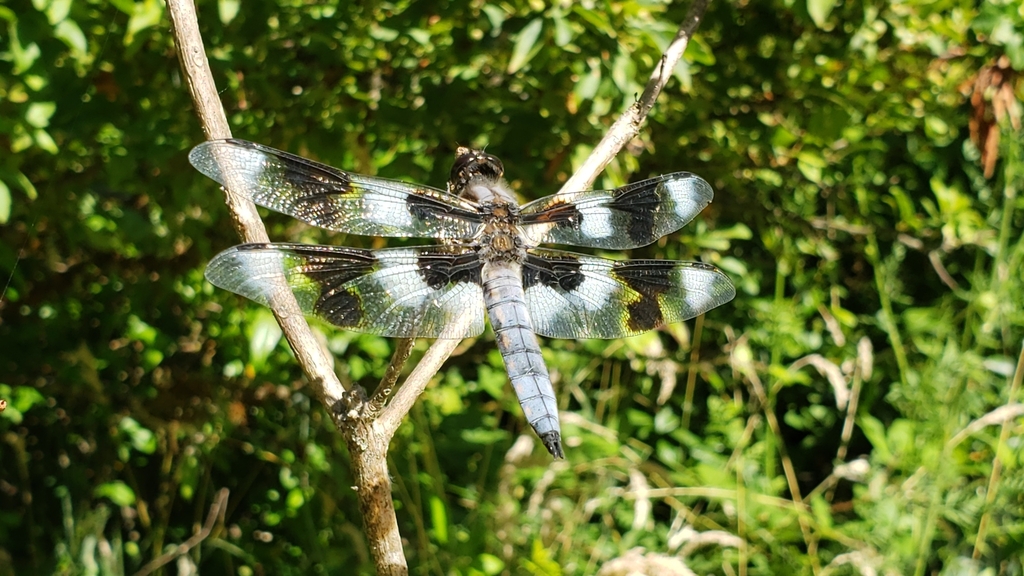
The Eight-spotted Skimmer (Libellula forensis) is a medium-sized dragonfly in the family Libellulidae, distinguished by the distinctive dark spots on its wings that give the species its common name. Adults typically measure 45-50 mm (1.8-2.0 inches) in body length with a wingspan reaching 70-80 mm (2.8-3.1 inches). Males exhibit a blue-gray pruinose coloration on the abdomen and thorax, while females and immature males display yellowish-brown coloration with darker markings. Both sexes possess the characteristic eight dark spots on their wings - two spots on each of the four wings - though spot intensity can vary among individuals. Libellula forensis occurs primarily in the western United States, with populations documented in California, Oregon, Washington, Idaho, Nevada, and Utah. In California, the species is found primarily in the northern and eastern portions of the state, including the Central Valley, Sierra Nevada foothills, and northeastern counties. According to NatureServe, the species maintains a global conservation status of G5 (secure), indicating stable populations across its range (NatureServe 2015). The Eight-spotted Skimmer inhabits a variety of aquatic environments, showing preference for still or slow-moving freshwater bodies including ponds, lakes, marshes, and sluggish streams. The species typically occurs at elevations from near sea level to approximately 2,000 meters (6,500 feet). Adults are commonly observed around vegetated shorelines where emergent and submergent aquatic plants provide perching sites and hunting grounds. Larvae develop in shallow areas with soft substrates and abundant vegetation. Adults are active fliers that engage in territorial behavior, with males establishing and defending territories over suitable breeding sites. The species exhibits a typical dragonfly life cycle, with eggs laid directly into water or on floating vegetation. Females deposit eggs by dipping the tip of their abdomen into the water surface while in flight or while perched on aquatic vegetation. Larvae are aquatic predators that feed on various small invertebrates, mosquito larvae, and other aquatic insects. The larval stage typically lasts one to two years before emergence. Adults are generalist predators, capturing flying insects including mosquitoes, flies, and smaller flying insects through aerial hunting. The Eight-spotted Skimmer currently holds no federal or state listing status and appears to maintain stable populations throughout most of its range. The species benefits from its adaptability to various aquatic habitats and relatively broad distribution. However, like many freshwater-dependent species, populations may face localized threats from habitat degradation, water diversions, and pollution affecting aquatic ecosystems. Climate change and prolonged drought conditions in western states could potentially impact breeding habitat availability in some regions. The species' current widespread distribution and stable status suggest it remains well-established across suitable habitat within its native range as of December 2025.
Classification
Class: Insecta · Order: Odonata · Family: Libellulidae
Frequently asked questions
How is Libellula forensis classified?
Libellula forensis belongs to class Insecta, order Odonata, family Libellulidae.
What family does Libellula forensis belong to?
Libellula forensis is in the Libellulidae family.
What is Libellula forensis?
The Eight-spotted Skimmer (Libellula forensis) is a medium-sized dragonfly in the family Libellulidae, distinguished by the distinctive dark spots on its wings that give the species its common name.
Is Libellula forensis found in California?
Yes. Libellula forensis is recorded in California in The California Species Project's catalogue.
Related species
Other California species in the same genus, family, or bioregion.
Data from The California Species Project — 14,000+ California species with verified data from CNPS, CDFW, USFWS, and more.