Libellula pulchella
Twelve-spotted Skimmer
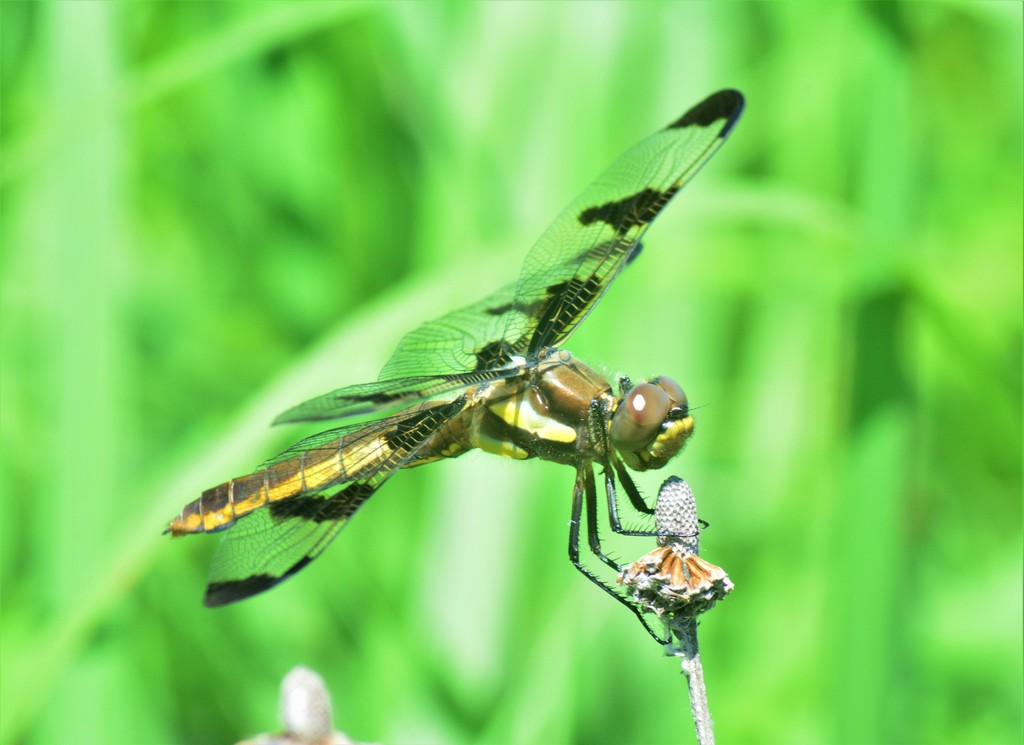
(c) earl woolsey, some rights reserved (CC BY) · licence
Family: Libellulidae · Class: Insecta · Order: Odonata
Libellula pulchella (Twelve-spotted Skimmer) is a California animal in the Libellulidae family.
The Twelve-spotted Skimmer (Libellula pulchella) is a medium-sized dragonfly in the skimmer family (Libellulidae). Adults typically measure 50-60 mm (2.0-2.4 inches) in body length with a wingspan of approximately 76-86 mm (3.0-3.4 inches). Males are distinguished by their distinctive wing pattern of three dark brown spots on each wing, creating the characteristic "twelve spots" for which the species is named. The thorax is brown with yellowish stripes, while the abdomen becomes pruinose (powdery blue-white) in mature males. Females and immature males lack the pruinescence and retain brown coloration with yellowish markings. Both sexes have clear wing membranes between the dark spots. The species has one of the most extensive distributions of any North American dragonfly. According to NatureServe, Libellula pulchella occurs across most of the United States and southern Canada, ranging from British Columbia to Nova Scotia and south to Florida, Texas, and California (NatureServe 2015). In California, the species is found throughout much of the state, particularly in areas with suitable aquatic habitat. The species also extends into Mexico, making it truly continental in scope. Twelve-spotted Skimmers inhabit a wide variety of freshwater habitats including ponds, lakes, slow-moving streams, marshes, and constructed wetlands. They show preference for open water bodies with emergent vegetation and muddy or sandy substrates. The species tolerates both permanent and temporary water bodies and can be found from sea level to moderate elevations. Adults are often observed perching on emergent vegetation, logs, or rocks near water edges. This species exhibits typical libellulid behavior, with males establishing territories over suitable breeding sites. Territorial males perch conspicuously on elevated positions and chase away intruders through aerial pursuit. Mating occurs through the characteristic dragonfly tandem position, followed by egg-laying where females deposit eggs by dipping their abdomens into shallow water or inserting eggs into soft substrates. The species is univoltine in northern regions but may have extended flight seasons in warmer climates. Adults are active hunters, capturing flying insects including mosquitoes, flies, and smaller flying arthropods. The Migratory Dragonfly Partnership documented Twelve-spotted Skimmers among migrating dragonfly species observed at hawk watch sites, though in smaller numbers than Common Green Darners and Black Saddlebags (Xerces Society 2013). Libellula pulchella has no federal or state conservation listing and maintains a Global conservation status of G5 (Secure) according to NatureServe, indicating stable populations across its range. The species benefits from its broad habitat tolerance and extensive distribution. While specific population trends have not been comprehensively assessed, the species appears to be maintaining stable populations throughout most of its range as of December 2025. Its ability to utilize both natural and artificial water bodies provides resilience against habitat modification, though degradation of freshwater ecosystems remains a potential concern for local populations.
Classification
Class: Insecta · Order: Odonata · Family: Libellulidae
Frequently asked questions
How is Libellula pulchella classified?
Libellula pulchella belongs to class Insecta, order Odonata, family Libellulidae.
What family does Libellula pulchella belong to?
Libellula pulchella is in the Libellulidae family.
What is Libellula pulchella?
The Twelve-spotted Skimmer (Libellula pulchella) is a medium-sized dragonfly in the skimmer family (Libellulidae).
Is Libellula pulchella found in California?
Yes. Libellula pulchella is recorded in California in The California Species Project's catalogue.
Related species
Other California species in the same genus, family, or bioregion.
Data from The California Species Project — 14,000+ California species with verified data from CNPS, CDFW, USFWS, and more.