Libellula quadrimaculata
Four-spotted Skimmer
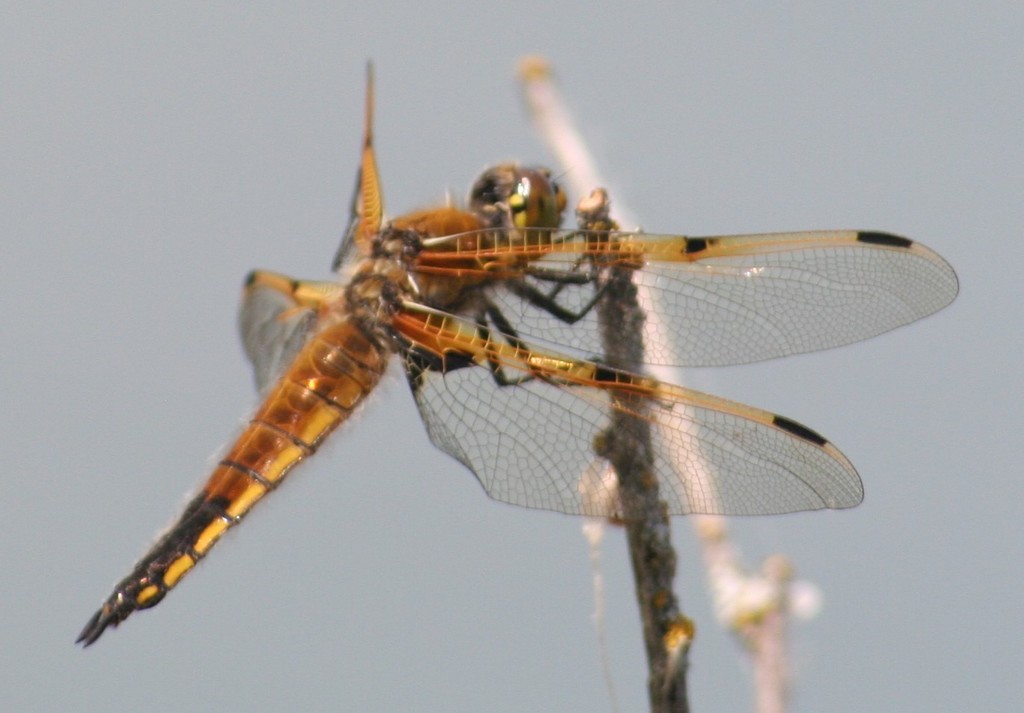
(c) Sean Frey, some rights reserved (CC BY) · licence
Family: Libellulidae · Class: Insecta · Order: Odonata
Libellula quadrimaculata (Four-spotted Skimmer) is a California animal in the Libellulidae family.
The Four-spotted Skimmer is a medium-sized dragonfly measuring 40-48 mm (1.6-1.9 inches) in body length with a wingspan of 70-85 mm (2.8-3.3 inches). Adults display a distinctive brownish-yellow body with darker markings and four prominent dark spots on the wings - one on each wing tip and one at the base of each hindwing. Males develop a blue-gray pruinescence on the abdomen with maturity, while females retain the brownish coloration. The wings are clear with yellowish patches at the base and along the leading edges. Both sexes possess robust, cylindrical abdomens and large compound eyes typical of the skimmer family. Libellula quadrimaculata has one of the most extensive distributions of any dragonfly species globally, occurring across northern North America, Europe, and Asia. In North America, the species ranges from Alaska and northern Canada south to California, Colorado, and the northern United States. The species is found throughout California primarily in mountainous regions and cooler coastal areas, with documented populations in the Sierra Nevada, Cascade Range, and northern coastal counties. Historical records indicate presence in suitable habitat from sea level to approximately 2,400 meters (7,900 feet) elevation. The Four-spotted Skimmer inhabits a variety of aquatic environments including ponds, lakes, slow-moving streams, marshes, and bog pools. Adults prefer areas with emergent and floating vegetation that provide perching sites and hunting grounds. The species shows particular affinity for water bodies with muddy or organic substrates and moderate to dense aquatic plant communities. Breeding sites typically feature shallow areas with submerged vegetation where females deposit eggs. Adults forage in open areas adjacent to water bodies, often extending 100-500 meters from the breeding habitat. Adult Four-spotted Skimmers are active hunters, capturing flying insects including mosquitoes, midges, flies, and small moths through aerial pursuit. Males establish territories over suitable breeding areas, perching on emergent vegetation or exposed substrates while defending against intruders. Mating occurs in flight, with pairs forming brief tandems before females oviposit alone by dipping their abdomens into water near vegetation. Females scatter hundreds of eggs in shallow water among aquatic plants. The aquatic nymphs are bottom-dwelling predators that feed on aquatic invertebrates, small fish, and tadpoles, requiring 1-3 years to complete development depending on climate and elevation. Adults typically emerge from May through August in California, with peak activity during warm, sunny days. The Four-spotted Skimmer is not federally or state listed and maintains stable populations across most of its range. The species benefits from its broad ecological tolerance and widespread distribution. Primary threats include habitat loss from wetland drainage and development, water pollution, and climate change impacts on montane aquatic systems. According to NatureServe, the species is ranked as apparently secure globally (G5) with stable populations in most regions. Conservation efforts focus on wetland protection and restoration of degraded aquatic habitats. The species serves as an indicator of healthy freshwater ecosystems and plays important roles in both aquatic and terrestrial food webs as predator and prey.
Classification
Class: Insecta · Order: Odonata · Family: Libellulidae
Frequently asked questions
How is Libellula quadrimaculata classified?
Libellula quadrimaculata belongs to class Insecta, order Odonata, family Libellulidae.
What family does Libellula quadrimaculata belong to?
Libellula quadrimaculata is in the Libellulidae family.
What is Libellula quadrimaculata?
The Four-spotted Skimmer is a medium-sized dragonfly measuring 40-48 mm (1.6-1.9 inches) in body length with a wingspan of 70-85 mm (2.8-3.3 inches).
Is Libellula quadrimaculata found in California?
Yes. Libellula quadrimaculata is recorded in California in The California Species Project's catalogue.
Related species
Other California species in the same genus, family, or bioregion.
Data from The California Species Project — 14,000+ California species with verified data from CNPS, CDFW, USFWS, and more.