Lichanura orcutti
Northern Three-lined Boa
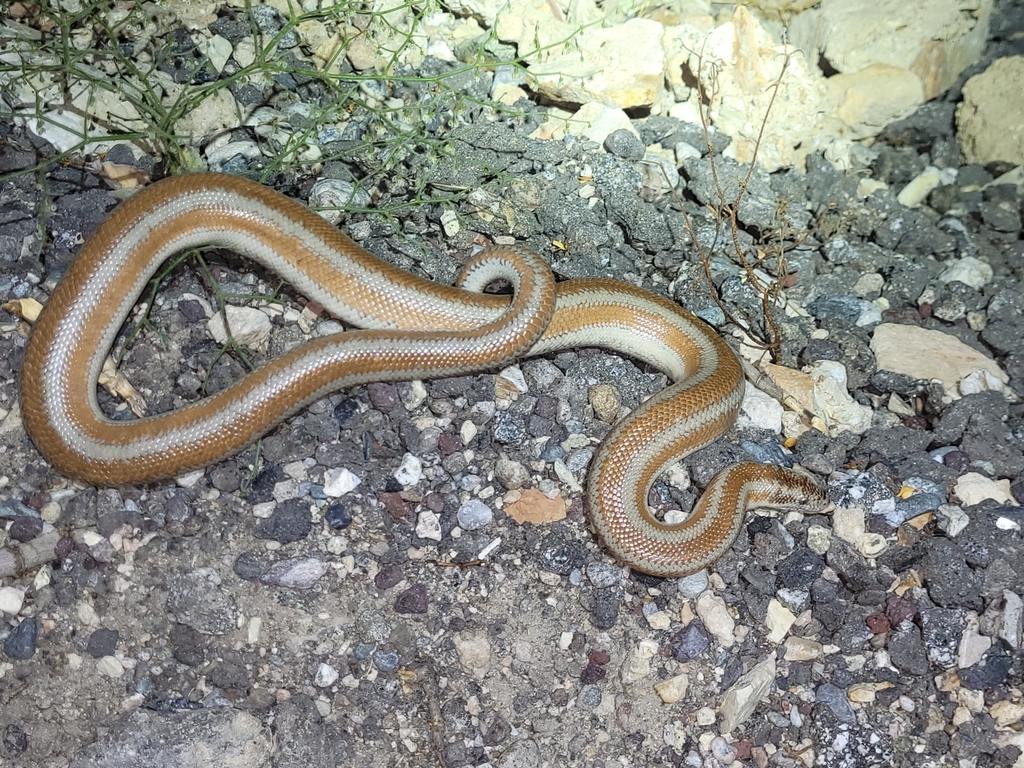
(c) RJ Baltierra, some rights reserved (CC BY) · licence
Family: Charinidae · Class: Reptilia · Order: Squamata
Lichanura orcutti (Northern Three-lined Boa) is a California animal in the Charinidae family.
The Northern Three-lined Boa (Lichanura orcutti), also known as the Rosy Boa, is a small, non-venomous constrictor native to southern California and Baja California. Adults typically measure 60 to 91 cm (24 to 36 inches) in total length, with females generally larger than males. The body is cylindrical and moderately stout with a relatively small head that is barely distinct from the neck. Coloration varies considerably but typically consists of a cream, gray, or pale brown background with three longitudinal stripes running from head to tail. These stripes range from orange and red to brown or black, and may be solid, broken, or absent entirely. The belly is cream to pale yellow with scattered dark spots. The Northern Three-lined Boa occurs in southern California from the eastern slopes of the Peninsular Ranges south into Baja California, Mexico. In California, the species is documented from Riverside, Imperial, and San Diego counties. Populations are found in the Colorado Desert region, including areas around the Salton Sea, and extend westward into the lower elevations of the Peninsular Ranges. This species inhabits arid and semi-arid environments, primarily rocky desert areas with granite outcroppings, boulder fields, and rocky washes. It occurs from sea level to approximately 1,370 meters (4,500 feet) elevation. Preferred habitat includes areas with abundant rock crevices and caves that provide shelter and temperature regulation. The species is also found in desert scrub communities dominated by creosote bush, brittlebush, and various cacti species. Northern Three-lined Boas are primarily nocturnal and crepuscular, becoming active during cooler evening and nighttime hours. They are secretive snakes that spend much of their time hidden in rock crevices, under boulders, or in underground retreats. The diet consists primarily of small mammals, including kangaroo rats, pocket mice, and other rodents, which they kill by constriction. Birds and their eggs may also be consumed. Breeding occurs in spring, typically from March to May. Females are viviparous, giving birth to 3 to 12 live young after a gestation period of approximately six months. Neonates measure 25 to 30 cm (10 to 12 inches) at birth. The Northern Three-lined Boa is not currently listed under the federal Endangered Species Act or California Endangered Species Act as of December 2025. However, populations face ongoing pressures from habitat loss due to urban development, renewable energy projects, and off-road vehicle use in desert areas. Collection for the pet trade historically impacted some populations, though this threat has diminished with protective regulations. Climate change may pose additional challenges through altered precipitation patterns and increased temperatures in desert habitats. The species benefits from protection within various state parks and wilderness areas throughout its range.
Classification
Class: Reptilia · Order: Squamata · Family: Charinidae
Frequently asked questions
How is Lichanura orcutti classified?
Lichanura orcutti belongs to class Reptilia, order Squamata, family Charinidae.
What family does Lichanura orcutti belong to?
Lichanura orcutti is in the Charinidae family.
What is Lichanura orcutti?
The Northern Three-lined Boa (Lichanura orcutti), also known as the Rosy Boa, is a small, non-venomous constrictor native to southern California and Baja California.
Is Lichanura orcutti found in California?
Yes. Lichanura orcutti is recorded in California in The California Species Project's catalogue.
More California species
This species has no close relatives in our California data — here are other species to explore.
Data from The California Species Project — 14,000+ California species with verified data from CNPS, CDFW, USFWS, and more.