Limenitis lorquini
Lorquin's Admiral
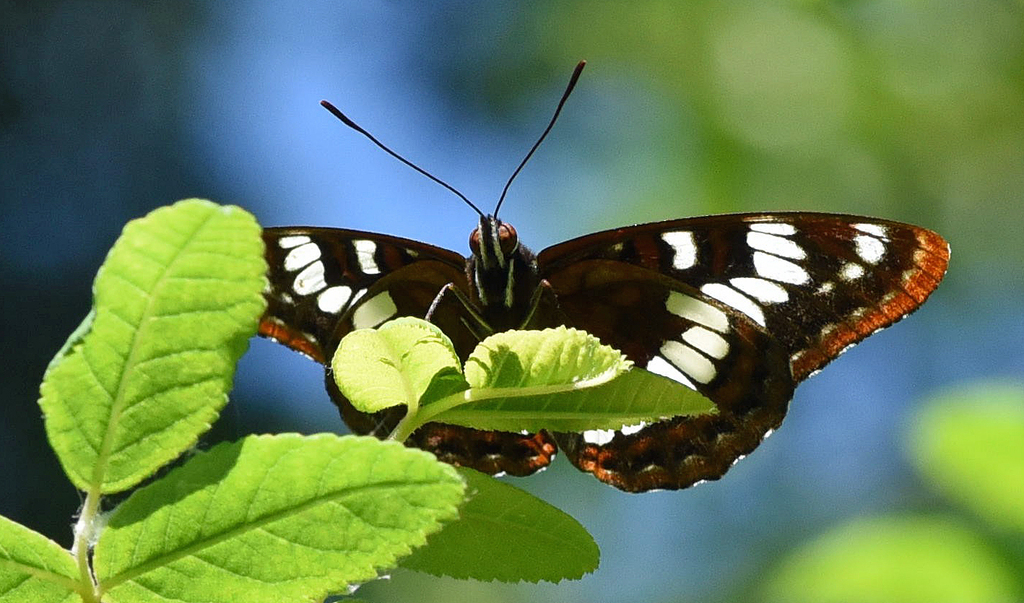
(c) Marcel_Pepin, some rights reserved (CC BY) · licence
Family: Nymphalidae · Class: Insecta · Order: Lepidoptera
Limenitis lorquini (Lorquin's Admiral) is a California animal in the Nymphalidae family.
Lorquin's Admiral (Limenitis lorquini) is a medium-sized butterfly with distinctive wing patterns that distinguish it from related species. Adults have a wingspan of 58 to 70 mm (2.3 to 2.8 inches). The dorsal wing surfaces are dark brown to black with prominent white bands extending across both forewings and hindwings. The forewings display orange patches near the wing tips, while the hindwings feature blue marginal spots along the outer edges. The ventral surfaces are lighter, with the white banding pattern repeated and additional orange and blue markings. Males and females are similar in appearance, though females tend to be slightly larger. Lorquin's Admiral ranges from British Columbia south to southern California and Baja California, extending eastward to western Montana and Idaho. In California, the species occurs throughout most of the state except the southeastern deserts, from sea level to elevations of approximately 2,400 meters (8,000 feet). Populations are most abundant in the Sierra Nevada, Cascade Range, and coastal mountains, with scattered occurrences in the Central Valley where suitable habitat exists. This species inhabits riparian areas, woodland edges, parks, gardens, and suburban areas where host plants are present. Lorquin's Admiral requires areas with flowing or standing water nearby, as adults frequently visit streams, rivers, and ponds for drinking and territorial behavior. The species favors partially shaded environments with dappled sunlight, including canyon bottoms, creek corridors, and forest clearings. Urban and suburban populations thrive in parks and residential areas with ornamental plantings. Lorquin's Admiral utilizes multiple host plant genera including wild cherry (Prunus), willows (Salix), poplar and cottonwood (Populus), and various orchard trees. Females deposit single eggs on the tips of host plant leaves, typically on new growth. The species produces two to three broods annually in most of its range, with flight periods extending from April through September. Adults are strong fliers and exhibit territorial behavior, with males establishing perches along streams and woodland paths. The species overwinters as third-instar larvae in hibernacula constructed by rolling and securing leaf edges with silk. Adults feed primarily on tree sap, rotting fruit, animal dung, and mud, rarely visiting flowers for nectar. Males engage in hilltopping behavior and establish territories near water sources where they patrol for females. Mating occurs during mid-morning hours, with females subsequently searching for suitable oviposition sites on host plants. Lorquin's Admiral is not federally or state listed and appears to maintain stable populations throughout most of its range. The species benefits from its adaptability to modified habitats and use of both native and non-native host plants. Urban development and water diversions may impact local populations by reducing riparian habitat, but the species' tolerance for suburban environments and ornamental plantings provides alternative habitat. Climate change could affect the species through altered precipitation patterns and shifts in host plant phenology, though current population trends suggest resilience to environmental changes.
Classification
Class: Insecta · Order: Lepidoptera · Family: Nymphalidae
Frequently asked questions
How is Limenitis lorquini classified?
Limenitis lorquini belongs to class Insecta, order Lepidoptera, family Nymphalidae.
What family does Limenitis lorquini belong to?
Limenitis lorquini is in the Nymphalidae family.
What is Limenitis lorquini?
Lorquin's Admiral (Limenitis lorquini) is a medium-sized butterfly with distinctive wing patterns that distinguish it from related species.
Is Limenitis lorquini found in California?
Yes. Limenitis lorquini is recorded in California in The California Species Project's catalogue.
Related species
Other California species in the same genus, family, or bioregion.
Data from The California Species Project — 14,000+ California species with verified data from CNPS, CDFW, USFWS, and more.