Limenitis weidemeyerii
Weidemeyer's Admiral
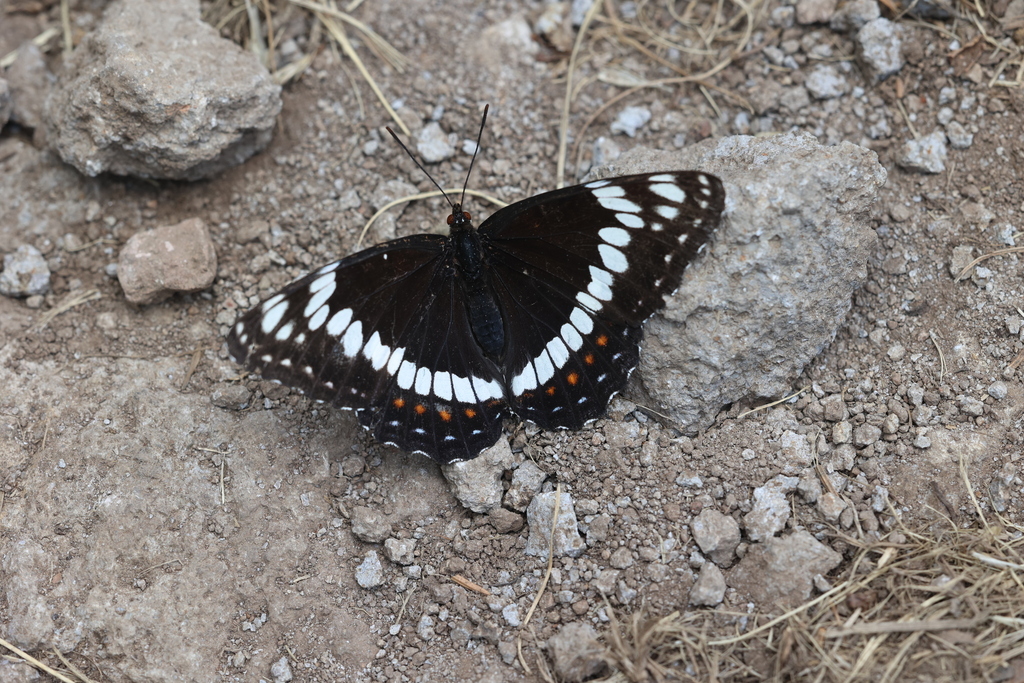
no rights reserved · CC0
Family: Nymphalidae · Class: Insecta · Order: Lepidoptera
Limenitis weidemeyerii (Weidemeyer's Admiral) is a California animal in the Nymphalidae family.
Weidemeyer's Admiral (Limenitis weidemeyerii) is a medium-sized butterfly with distinctive black wings marked by prominent white bands. Adults have a wingspan of 65 to 85 mm (2.6 to 3.3 inches). The forewings display a white median band that extends across both wings, creating a striking pattern against the dark background. The hindwings feature additional white spotting along the outer margins. Males and females are similar in appearance, though females are typically slightly larger. The ventral wing surfaces are brownish-orange with white banding and blue-spotted margins, providing effective camouflage when the butterfly is at rest with wings closed. Weidemeyer's Admiral ranges from southern Alberta south to Nebraska and east-central California, southeastern Arizona and southern New Mexico. In California, the species occurs primarily in mountainous regions of the Sierra Nevada and southern Cascade Range, typically at elevations between 1,200 and 2,400 meters (4,000 to 8,000 feet). The distribution follows riparian corridors and mountain drainages where suitable host plants are present. The species inhabits riparian woodlands, mountain meadows, and forest clearings near streams and rivers. Adults are closely associated with deciduous trees along waterways, particularly in areas where aspen groves border coniferous forests. They prefer partially shaded environments with dappled sunlight and are commonly found along hiking trails, forest roads, and canyon bottoms where host plants grow in proximity to water sources. Weidemeyer's Admiral utilizes multiple host plant species including aspen and cottonwood (Populus species), willows (Salix species), ocean spray (Holodiscus), and shadbush (Amelanchier). Females deposit single eggs on the tips of host plant leaves, typically on young shoots or saplings. Larvae feed on leaves and create shelters by rolling leaf edges together with silk. The species overwinters as partially grown larvae in rolled leaf hibernacula. Adults typically emerge from late May through August, with peak flight periods occurring in June and July. Males engage in territorial behavior, perching on prominent rocks or tree branches to watch for females and chase away intruders. Adults are strong fliers capable of soaring and gliding behavior, often seen flying several meters above the ground along riparian corridors. They feed on tree sap, rotting fruit, animal dung, and mud, rarely visiting flowers for nectar. Males establish territories along streams where they patrol for mates and engage in aerial courtship displays. Weidemeyer's Admiral is not federally or state listed and appears to maintain stable populations throughout most of its range. However, the species faces localized threats from habitat fragmentation, livestock grazing that damages riparian vegetation, water diversions that affect streamside host plants, and climate change impacts on montane ecosystems. Conservation of riparian corridors and maintenance of natural water flows are important for preserving suitable habitat for this species.
Classification
Class: Insecta · Order: Lepidoptera · Family: Nymphalidae
Frequently asked questions
How is Limenitis weidemeyerii classified?
Limenitis weidemeyerii belongs to class Insecta, order Lepidoptera, family Nymphalidae.
What family does Limenitis weidemeyerii belong to?
Limenitis weidemeyerii is in the Nymphalidae family.
What is Limenitis weidemeyerii?
Weidemeyer's Admiral (Limenitis weidemeyerii) is a medium-sized butterfly with distinctive black wings marked by prominent white bands.
Is Limenitis weidemeyerii found in California?
Yes. Limenitis weidemeyerii is recorded in California in The California Species Project's catalogue.
Related species
Other California species in the same genus, family, or bioregion.
Data from The California Species Project — 14,000+ California species with verified data from CNPS, CDFW, USFWS, and more.