Limnodromus scolopaceus
Long-billed Dowitcher
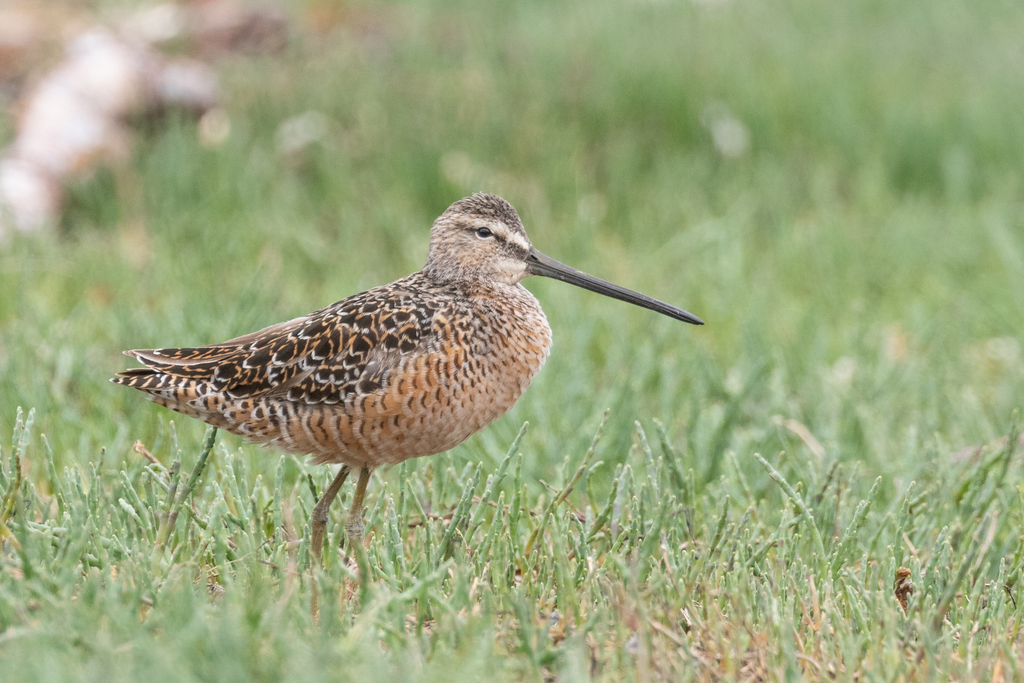
(c) Blair Dudeck, some rights reserved (CC BY) · licence
Family: Scolopacidae · Class: Aves · Order: Charadriiformes
Limnodromus scolopaceus (Long-billed Dowitcher) is a California animal in the Scolopacidae family.
The Long-billed Dowitcher is a medium-sized shorebird measuring 27 to 30 cm (10.6 to 11.8 inches) in length with a wingspan of 46 to 56 cm (18 to 22 inches). Adults weigh between 80 to 165 grams (2.8 to 5.8 ounces). The species is characterized by its exceptionally long, straight bill, which measures 55 to 75 mm (2.2 to 3.0 inches) in length. During breeding season, adults display rich rufous underparts extending from the throat to the belly, with dark barring on the flanks. The upperparts show a mottled pattern of black, brown, and buff. In non-breeding plumage, the underparts become pale gray and the upperparts are more uniformly gray-brown. The legs are greenish-yellow to olive-colored. Long-billed Dowitchers breed across Alaska and northwestern Canada, with nesting grounds extending from the Yukon Territory to Hudson Bay. In California, the species occurs as a migrant and winter resident along the entire coast and in the Central Valley. Major wintering areas include San Francisco Bay, Humboldt Bay, Salton Sea, and coastal wetlands from Del Norte County south to San Diego County. The species also utilizes inland habitats including flooded agricultural fields, sewage ponds, and managed wetlands throughout the Central Valley. The species inhabits shallow aquatic environments including mudflats, salt marshes, freshwater marshes, flooded fields, and the edges of lakes and ponds. During migration and winter, Long-billed Dowitchers prefer areas with soft substrates that allow deep probing for invertebrates. Water depths typically range from a few centimeters to 30 cm (12 inches). The species shows tolerance for both freshwater and saline conditions, utilizing habitats with varying salinity levels. Long-billed Dowitchers employ a distinctive feeding strategy, probing deeply into mud and sediment with rapid, sewing machine-like motions. Their diet consists primarily of marine worms, mollusks, crustaceans, and aquatic insect larvae. During breeding season, they also consume seeds and plant material. Nesting occurs on the ground in shallow depressions lined with grass and leaves, typically in wet tundra or bog habitats. Females lay 4 eggs between late May and early July. Incubation lasts 20 to 21 days, with both sexes participating. Chicks are precocial and fledge after approximately 25 to 30 days. The Long-billed Dowitcher is not federally listed and maintains stable populations across most of its range. According to the North American Bird Conservation Initiative, the species has experienced moderate population declines in some regions, primarily due to habitat loss in wintering areas. In California, the species benefits from wetland restoration projects and managed flooding of agricultural lands. Climate change poses potential long-term threats through alterations to breeding habitat timing and availability of coastal wintering areas due to sea level rise.
Classification
Class: Aves · Order: Charadriiformes · Family: Scolopacidae
Frequently asked questions
How is Limnodromus scolopaceus classified?
Limnodromus scolopaceus belongs to class Aves, order Charadriiformes, family Scolopacidae.
What family does Limnodromus scolopaceus belong to?
Limnodromus scolopaceus is in the Scolopacidae family.
What is Limnodromus scolopaceus?
The Long-billed Dowitcher is a medium-sized shorebird measuring 27 to 30 cm (10.6 to 11.8 inches) in length with a wingspan of 46 to 56 cm (18 to 22 inches).
Is Limnodromus scolopaceus found in California?
Yes. Limnodromus scolopaceus is recorded in California in The California Species Project's catalogue.
Related species
Other California species in the same genus, family, or bioregion.
Data from The California Species Project — 14,000+ California species with verified data from CNPS, CDFW, USFWS, and more.