Limosa haemastica
Hudsonian Godwit
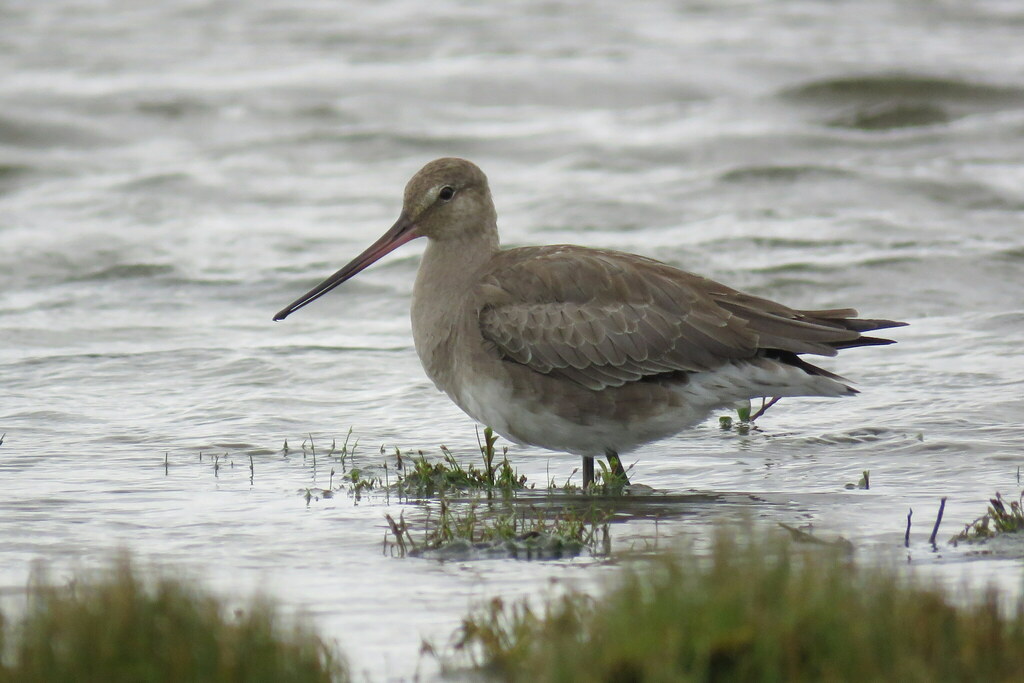
(c) William Harland, some rights reserved (CC BY) · licence
Family: Scolopacidae · Class: Aves · Order: Charadriiformes
Limosa haemastica (Hudsonian Godwit) is a California animal in the Scolopacidae family.
The Hudsonian Godwit is a large shorebird measuring 37 to 42 cm (14.5 to 16.5 inches) in length with a wingspan of 70 to 80 cm (27.5 to 31.5 inches). Adults weigh between 230 to 340 grams. The species exhibits marked sexual dimorphism, with females typically larger than males. During breeding season, adults display rich chestnut-red underparts with distinctive black and white barring on the flanks and undertail coverts. The upperparts are mottled brown and black. Non-breeding adults show gray-brown upperparts and pale underparts. The bill is long, straight to slightly upturned, and dark with a pinkish base. Legs are dark gray to black. In flight, the species shows distinctive white wing stripes and a black tail with white base. The Hudsonian Godwit breeds in subarctic regions of Alaska and northwestern Canada, primarily in the Hudson Bay lowlands, Alaska's Copper River Delta, and scattered locations across the Canadian prairies and boreal forest. In California, the species occurs as a rare migrant primarily along the coast and in the Central Valley. According to eBird records, most California sightings occur during spring migration from April to early June, with fewer fall records from July to September. The species is most frequently observed at coastal locations including San Francisco Bay, Humboldt Bay, and Salton Sea. During migration and winter, Hudsonian Godwits inhabit mudflats, salt marshes, shallow coastal lagoons, flooded agricultural fields, and sewage ponds. The species shows preference for areas with soft substrates that allow deep probing. On breeding grounds, they occupy wet sedge meadows, bogs, and marshy areas within boreal forest and tundra ecosystems. Elevation requirements vary widely, from sea level coastal areas to montane wetlands up to 1,500 meters. Hudsonian Godwits are tactile feeders, using their sensitive bill tips to locate prey buried in mud and sand. Their diet consists primarily of marine worms, mollusks, crustaceans, and insects. During breeding season, they also consume berries and plant material. Breeding occurs from late May through July, with pairs typically nesting in loose colonies. Females lay 3 to 4 olive-brown eggs marked with dark spots in a shallow scrape lined with grass and moss. Incubation lasts 22 to 25 days, with both sexes participating. Chicks fledge after 30 to 35 days. The Hudsonian Godwit is not federally listed but faces conservation concerns due to habitat loss and climate change impacts on breeding grounds. The global population is estimated at 70,000 individuals, representing one of the least numerous godwit species. The species has experienced moderate population declines over the past several decades. Primary threats include wetland drainage, coastal development, disturbance at roost sites, and potential impacts from sea-level rise on staging areas. The species' dependence on specific stopover sites during its approximately 9,000-kilometer non-stop flight from breeding to wintering grounds makes it particularly vulnerable to habitat degradation.
Classification
Class: Aves · Order: Charadriiformes · Family: Scolopacidae
Frequently asked questions
How is Limosa haemastica classified?
Limosa haemastica belongs to class Aves, order Charadriiformes, family Scolopacidae.
What family does Limosa haemastica belong to?
Limosa haemastica is in the Scolopacidae family.
What is Limosa haemastica?
The Hudsonian Godwit is a large shorebird measuring 37 to 42 cm (14.5 to 16.5 inches) in length with a wingspan of 70 to 80 cm (27.5 to 31.5 inches).
Is Limosa haemastica found in California?
Yes. Limosa haemastica is recorded in California in The California Species Project's catalogue.
Related species
Other California species in the same genus, family, or bioregion.
Data from The California Species Project — 14,000+ California species with verified data from CNPS, CDFW, USFWS, and more.