Lineus pictifrons
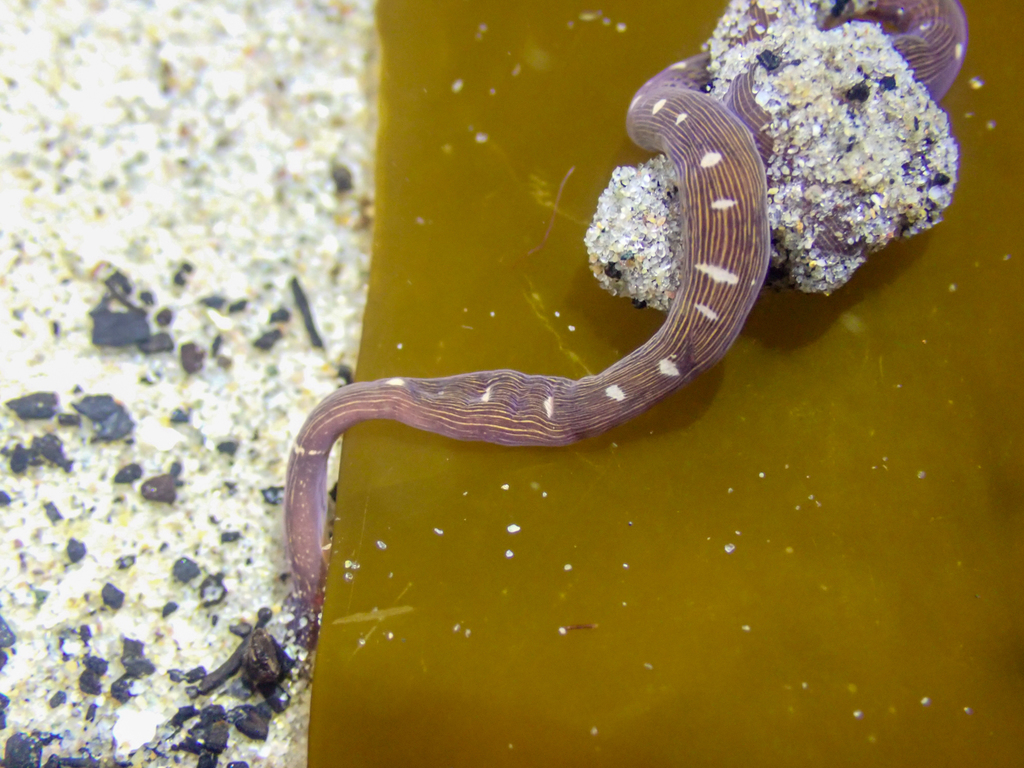
(c) Trevor Van Loon, some rights reserved (CC BY) · licence
Family: Lineidae · Class: Anopla · Order: Heteronemertea
Lineus pictifrons is a California animal in the Lineidae family.
Lineus pictifrons is a marine nemertean worm belonging to the phylum Nemertea, class Anopla, and family Lineidae. As a ribbon worm, this species exhibits the characteristic elongated, unsegmented body plan typical of nemerteans, with the ability to extend and contract its body length dramatically. Like other members of the genus Lineus, L. pictifrons possesses an eversible proboscis used for prey capture and defense, housed within a specialized structure called the rhynchocoel. According to the U.S. Fish and Wildlife Service, L. pictifrons was historically distributed along the Pacific Coast, with its range including California, Oregon, and Washington (USFWS ECOS 2025). The species also occurs in portions of Canada, extending its range into British Columbia waters. Current populations are documented in several National Wildlife Refuges, including Billy Frank Jr. Nisqually National Wildlife Refuge in Washington, Conboy Lake National Wildlife Refuge, and Klamath Marsh National Wildlife Refuge. This nemertean inhabits marine and estuarine environments along the Pacific Coast. Ribbon worms of the family Lineidae typically occur in intertidal and subtidal zones, often found beneath rocks, in crevices, or burrowed in soft sediments. The species likely occupies similar benthic habitats where it can take advantage of the rich invertebrate communities that characterize these coastal ecosystems. As a carnivorous nemertean, L. pictifrons feeds primarily on other invertebrates, using its proboscis to capture prey. The proboscis can be rapidly everted to seize small worms, crustaceans, and other soft-bodied organisms. Like other ribbon worms, this species likely exhibits considerable regenerative capabilities and may reproduce both sexually and asexually through fragmentation. Reproduction in marine nemerteans typically involves the release of gametes into the water column, with development proceeding through a characteristic pilidium larval stage. The U.S. Fish and Wildlife Service listed Lineus pictifrons as threatened under the Endangered Species Act on September 29, 2014, with the listing applying wherever the species is found (USFWS ECOS 2025). The listing followed a lengthy petition process, with initial findings dating back to 1993 when the species was determined to warrant protection but was precluded by higher priority actions. Multiple petition reviews occurred between 2009 and 2012 before the final threatened status was designated. The specific threats to L. pictifrons have not been extensively documented in available sources, but nemertean worms are generally vulnerable to habitat degradation, pollution, and changes in prey availability. Coastal development, water quality degradation, and climate change impacts on marine ecosystems likely pose significant challenges to this species' recovery. The Pacific Region of the U.S. Fish and Wildlife Service leads conservation efforts for this species, though detailed recovery planning information is not readily available in current databases.
Classification
Class: Anopla · Order: Heteronemertea · Family: Lineidae
Frequently asked questions
How is Lineus pictifrons classified?
Lineus pictifrons belongs to class Anopla, order Heteronemertea, family Lineidae.
What family does Lineus pictifrons belong to?
Lineus pictifrons is in the Lineidae family.
What is Lineus pictifrons?
Lineus pictifrons is a marine nemertean worm belonging to the phylum Nemertea, class Anopla, and family Lineidae.
Is Lineus pictifrons found in California?
Yes. Lineus pictifrons is recorded in California in The California Species Project's catalogue.
More California species
This species has no close relatives in our California data — here are other species to explore.
Data from The California Species Project — 14,000+ California species with verified data from CNPS, CDFW, USFWS, and more.