Liometopum occidentale
Western Velvety Tree Ant
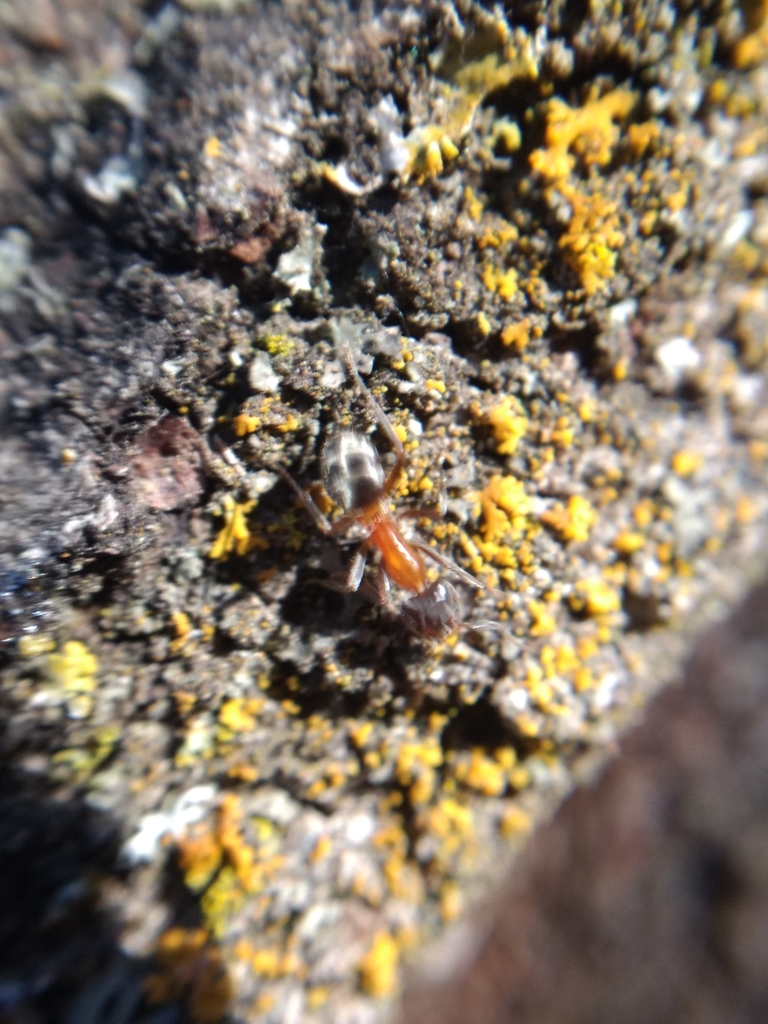
(c) Michele Jones, some rights reserved (CC BY) · licence
Family: Formicidae · Class: Insecta · Order: Hymenoptera
Liometopum occidentale (Western Velvety Tree Ant) is a California animal in the Formicidae family.
The Western Velvety Tree Ant (Liometopum occidentale) is a member of the subfamily Dolichoderinae within the family Formicidae. This species is characterized by its nocturnal, trail-forming behavior and distinctive foraging patterns. Workers are typically dark-colored with a velvety appearance, though detailed morphological measurements for this species remain poorly documented in available literature. Liometopum occidentale occurs in western North America, with documented populations in California's Coast Ranges and Central Valley regions. BugGuide observations record the species from San Benito County in the inner Coast Diablo Range, one of California's largest serpentine outcrop regions (BugGuide 2010). The species' range likely extends throughout suitable oak woodland habitats in California, though comprehensive distribution mapping has not been completed. This ant species inhabits oak woodland and chaparral environments, often associated with scattered Pinus sabiniana (gray pine). Documented habitat includes arid regions of the inner Coast Range where serpentine soils are prevalent (BugGuide 2010). The species appears adapted to dry, Mediterranean climate conditions typical of California's interior valleys and foothill regions. Specific elevation ranges and microhabitat preferences have not been thoroughly studied. Western Velvety Tree Ants exhibit highly specialized foraging behavior, establishing persistent trail systems that may be used for many weeks. According to AmphibiaWeb, these ants form nocturnal foraging columns that follow the same routes repeatedly, making them a predictable and important food source for various predators (AmphibiaWeb 2025). The species serves as a primary prey item for the federally threatened Arroyo Toad (Anaxyrus californicus), with adult toads consuming up to 25% of their body mass during 1-1.5 hour feeding sessions on Liometopum colonies. Toad feces typically contain 95% Liometopum exoskeletons by mass, demonstrating the significance of this ant species in local food webs (AmphibiaWeb 2025). Reproductive biology includes alate (winged) forms, with males documented during May in San Benito County (BugGuide 2010). Liometopum occidentale currently holds no federal or state conservation listing status. However, the species' ecological importance as a keystone prey species for threatened amphibians suggests that its population stability may influence broader ecosystem health. Threats to oak woodland habitats, including urban development, agricultural conversion, and climate change, could potentially impact Western Velvety Tree Ant populations. The species' association with serpentine soils may provide some protection, as these areas are often less suitable for development. Conservation of oak woodland ecosystems would benefit this species and the broader community of organisms that depend on these habitats. Additional research is needed to understand population trends, detailed distribution patterns, and specific habitat requirements for effective conservation planning.
Classification
Class: Insecta · Order: Hymenoptera · Family: Formicidae
Frequently asked questions
How is Liometopum occidentale classified?
Liometopum occidentale belongs to class Insecta, order Hymenoptera, family Formicidae.
What family does Liometopum occidentale belong to?
Liometopum occidentale is in the Formicidae family.
What is Liometopum occidentale?
The Western Velvety Tree Ant (Liometopum occidentale) is a member of the subfamily Dolichoderinae within the family Formicidae.
Is Liometopum occidentale found in California?
Yes. Liometopum occidentale is recorded in California in The California Species Project's catalogue.
Related species
Other California species in the same genus, family, or bioregion.
Data from The California Species Project — 14,000+ California species with verified data from CNPS, CDFW, USFWS, and more.