Liothrips ilex
Toyon gall thrips
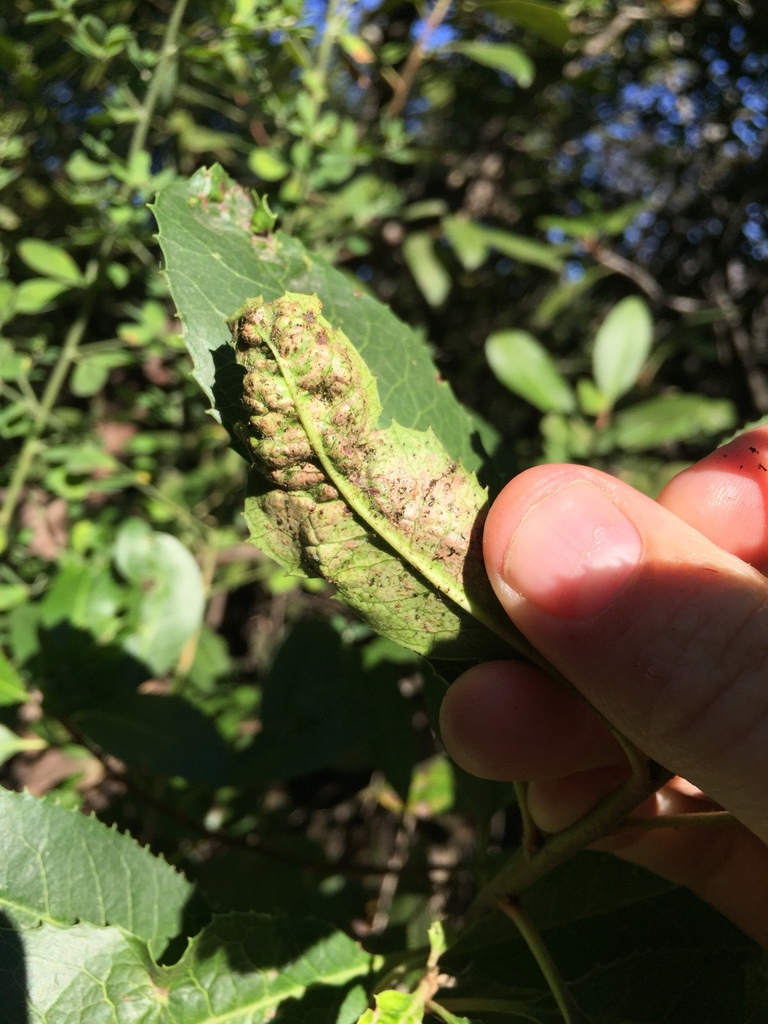
(c) crothfels, some rights reserved (CC BY) · licence
Family: Phlaeothripidae · Class: Insecta · Order: Thysanoptera
Liothrips ilex (Toyon gall thrips) is a California animal in the Phlaeothripidae family.
The toyon gall thrips (Liothrips ilex) is a small insect species in the family Phlaeothripidae, order Thysanoptera. Like other thrips, adults are typically 1-2 millimeters (0.04-0.08 inches) in length with fringed wings and elongated bodies. Thrips in the genus Liothrips are generally dark-colored, ranging from brown to black, with tube-shaped mouthparts adapted for feeding on plant tissues. The distribution and range of L. ilex have not been comprehensively documented in the scientific literature. The species name suggests an association with California, where toyon (Heteromeles arbutifolia) serves as a native host plant. Toyon naturally occurs throughout California's coastal ranges, foothills, and mountains, typically at elevations from sea level to 4,000 feet (1,220 meters). This thrips species appears to be specialized on toyon, a native California shrub also known as Christmas berry or California holly. Toyon thrives in chaparral, oak woodland, and mixed evergreen forest communities. The shrub produces clusters of small white flowers in summer followed by bright red berries in fall and winter. According to habitat planning resources, toyon is highly attractive to numerous beneficial insects and serves as an important native plant in California ecosystems (Xerces Society 2018). As a gall-forming thrips, L. ilex likely creates specialized structures on toyon tissues where it feeds and reproduces. Gall thrips typically insert their eggs into plant tissue, causing the plant to form protective structures around the developing larvae. The feeding and egg-laying activities of the adult females stimulate abnormal plant growth, creating the characteristic galls. These enclosed structures provide the developing thrips with both food and protection from predators and environmental conditions. Like other thrips species, L. ilex undergoes complete metamorphosis with egg, two larval instars, prepupa, pupa, and adult stages. Development typically takes 4-10 weeks depending on temperature and environmental conditions. Many thrips species overwinter in leaf litter or soil as larvae, pupae, or adults. The seasonal activity patterns and specific life cycle timing of the toyon gall thrips have not been well documented in the scientific literature. No formal conservation status has been assigned to Liothrips ilex at federal or state levels. The species does not appear on current lists of threatened or endangered species. However, like many specialized herbivorous insects, its conservation status would be closely tied to the availability and health of its host plant. Toyon populations face pressures from urban development, altered fire regimes, and invasive species in some areas of California. Detailed ecological studies of this species are lacking. The information presented here synthesizes available taxonomic records and general thrips biology. Scientific documentation for this species remains limited, particularly regarding its specific habitat requirements, population status, and ecological interactions beyond its relationship with toyon.
Classification
Class: Insecta · Order: Thysanoptera · Family: Phlaeothripidae
Frequently asked questions
How is Liothrips ilex classified?
Liothrips ilex belongs to class Insecta, order Thysanoptera, family Phlaeothripidae.
What family does Liothrips ilex belong to?
Liothrips ilex is in the Phlaeothripidae family.
What is Liothrips ilex?
The toyon gall thrips (Liothrips ilex) is a small insect species in the family Phlaeothripidae, order Thysanoptera.
Is Liothrips ilex found in California?
Yes. Liothrips ilex is recorded in California in The California Species Project's catalogue.
Related species
Other California species in the same genus, family, or bioregion.
Data from The California Species Project — 14,000+ California species with verified data from CNPS, CDFW, USFWS, and more.