Lipoptena depressa
Western American Deer Ked
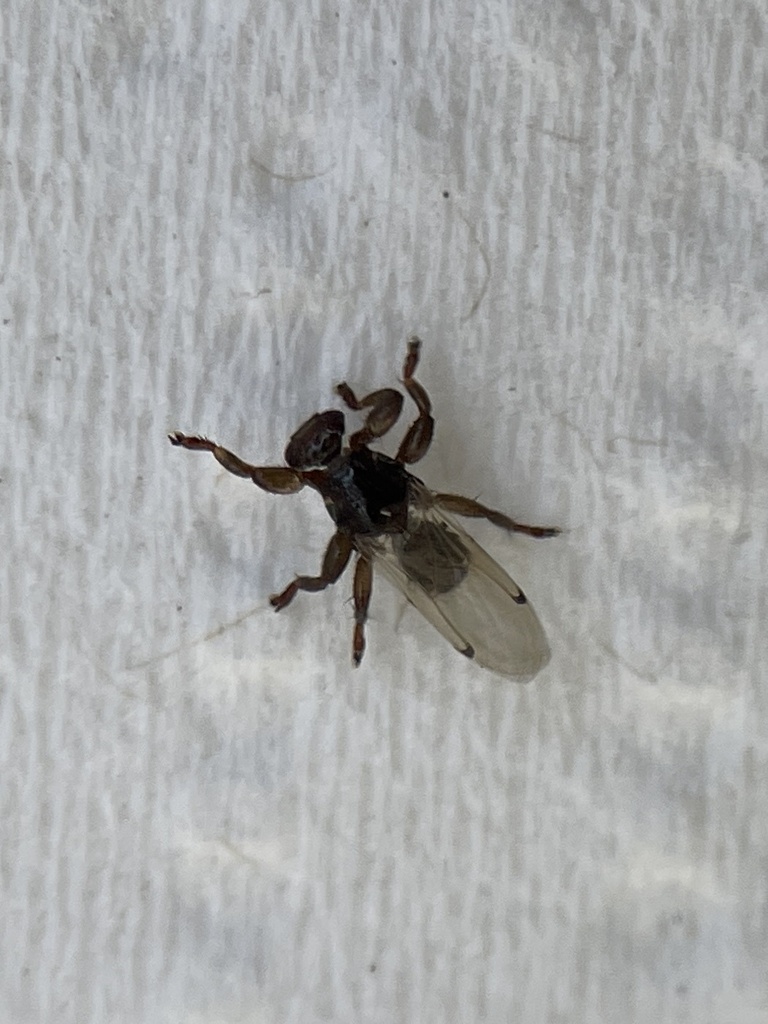
no rights reserved · CC0
Family: Hippoboscidae · Class: Insecta · Order: Diptera
Lipoptena depressa (Western American Deer Ked) is a California animal in the Hippoboscidae family.
The Western American Deer Ked (Lipoptena depressa) is a blood-feeding parasitic fly in the family Hippoboscidae. This species is one of three flies within the genus Lipoptena and represents a specialized ectoparasite adapted to life on mammalian hosts. Adult deer keds are flattened, wingless insects with strong claws designed for clinging to host animals. The body is brownish and leathery, measuring approximately 4-6 mm in length. Unlike many fly species, adult deer keds lose their wings shortly after finding a suitable host, becoming permanently flightless parasites. The Western American Deer Ked occurs throughout the western United States and western Canada, with its range extending from British Columbia south through California and east into the Rocky Mountain region (iNaturalist). The species is distributed across multiple western states including California, Nevada, Idaho, Oregon, Washington, and Utah. Within California, the species is likely present wherever suitable deer populations exist, particularly in mountainous and forested regions. This parasite inhabits diverse ecosystems where its primary host, the mule deer (Odocoileus hemionus), is found. These habitats include coniferous forests, mixed woodlands, chaparral, and mountain meadows from low elevations to subalpine zones. The species shows a strong association with areas containing Rocky Mountain ecosystems and similar western montane environments (iNaturalist). Deer keds are not free-living in the environment but rather spend their entire adult life cycle on their mammalian hosts. Lipoptena depressa exhibits highly specialized parasitic behavior, feeding exclusively on the blood of mule deer. Adults locate hosts during their brief winged phase, after which they shed their wings and remain permanently attached to the deer. The species has a unique reproductive strategy typical of hippoboscid flies, with females producing fully developed larvae that pupate immediately after birth. This adaptation, known as adenotrophic viviparity, allows the species to maximize reproductive success in the parasitic lifestyle. The larvae drop from the host to pupate in soil or leaf litter beneath deer bedding areas. Deer keds may serve as vectors for various pathogens, including bacteria and potentially other microorganisms that affect wildlife health (NatureServe). Recent research has documented pathogen records associated with North American deer ked species, highlighting their potential ecological and veterinary significance. The timing of adult emergence typically coincides with deer activity patterns, with peak abundance often occurring during fall months when deer are most active. Currently, Lipoptena depressa has no formal conservation status listings at federal or state levels. NatureServe ranks the species as NNR (Not Yet Ranked) both nationally and in individual states and provinces. The species' conservation status likely reflects the limited research attention given to parasitic arthropods rather than actual rarity. As an obligate parasite of mule deer, the species' long-term viability is directly linked to healthy deer populations and intact habitat connectivity across western North America.
Classification
Class: Insecta · Order: Diptera · Family: Hippoboscidae
Frequently asked questions
How is Lipoptena depressa classified?
Lipoptena depressa belongs to class Insecta, order Diptera, family Hippoboscidae.
What family does Lipoptena depressa belong to?
Lipoptena depressa is in the Hippoboscidae family.
What is Lipoptena depressa?
The Western American Deer Ked (Lipoptena depressa) is a blood-feeding parasitic fly in the family Hippoboscidae.
Is Lipoptena depressa found in California?
Yes. Lipoptena depressa is recorded in California in The California Species Project's catalogue.
More California species
This species has no close relatives in our California data — here are other species to explore.
Data from The California Species Project — 14,000+ California species with verified data from CNPS, CDFW, USFWS, and more.